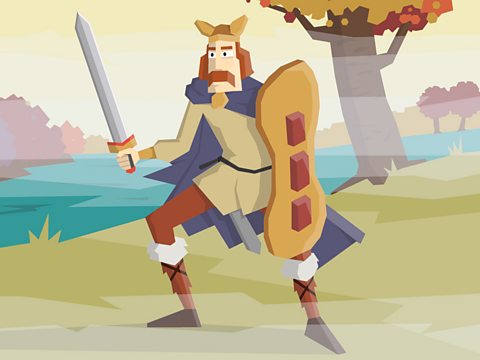
What was special about Maiden Castle?

Maiden Castle is one of the largest Iron Age hill forts. It was a settlement built on top of a hill and surrounded by walls made from wood.
It was built almost 3000 years ago on a large hill in Dorset.
The fort had complex entrances, and many roundhouses This showed how important it was to the people who lived there.
Artefacts found there, such as pottery, were made by people in the past. These discoveries help archaeologists understand what life was like for people in the Iron Age.
Created in partnership with English Heritage
Important words
Important words on Maiden Castle.
| Keyword | Definition |
|---|---|
| Archaeologists | People who study the past. |
| Artefacts | Objects that are made by people in the past. |
| Ditches | A long narrow channel dug into the ground. |
| Hearth | A fireplace in the centre of a house. |
| Hill fort | A settlement built on top of a hill and surrounded by walls made from wood. |
| Iron Age | A time when people began to use tools and weapons made of iron. |
| Neolithic | A time when people started farming. Also known as the New Stone Age. |
What is Maiden Castle?
Maiden Castle is one of the largest Iron Age hill forts in Britain.
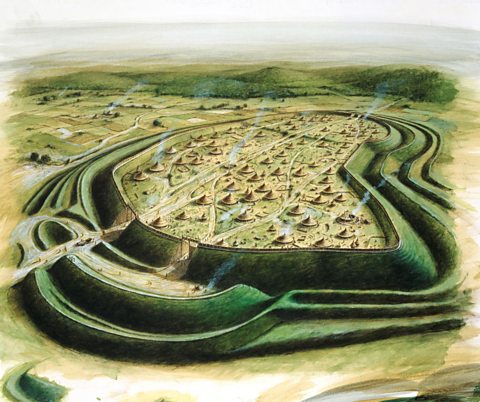 Image source, © Historic England (illustration by Paul Birbeck)
It is in Dorset in the south of England.
Historians believe it was built almost 3,000 years ago.
Over 4,000 possible hill forts have been found across Britain and Ireland.
Why did people build Maiden Castle?
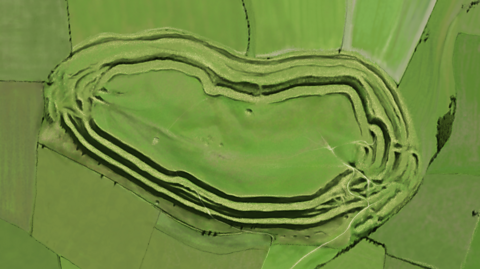 Image source, © Historic England
The fort is on top of a large hill which is 914 metres long.
That's about as long as 10 football pitches.
In the Iron Age, hundreds of people lived there.
In Roman times, these people were called the Durotriges tribe, meaning ‘hill fort-dwellers’.
They built the fort there protect themselves because they could see attackers better from high up.
Image source, © Historic EnglandHow was Maiden Castle built?
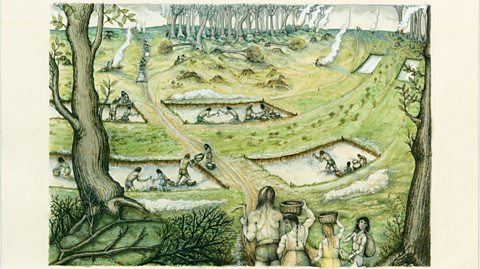 Image source, © Historic England (Illustration by Miranda Schofield)
Before Maiden Castle was built, people in the early Neolithic period (Stone Age) made circular ditches (a long narrow channel dug into the ground) in the land.
People used the space in the centre to hold feasts and make flint axes.
The Iron Age people built the hill fort on top of the earlier Neolithic structure.
They made it bigger and added ramparts.
They made the entrances more complicated so it was harder to get into the hill fort.
For example, the Western entrance had a 200 metre long winding corridor.
Image source, © Historic England (Illustration by Miranda Schofield)This also made the hill fort look impressive to show off the power of the people who built it.
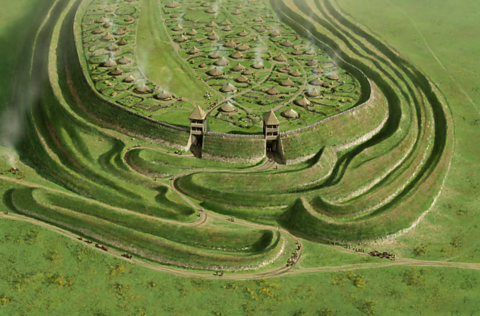 Image source, © Historic England (illustration by Peter Urmston)
What was life like at Maiden Castle?
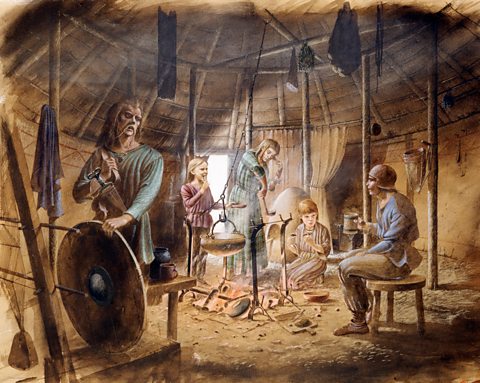 Image source, © Historic England (illustration by Paul Birkbeck)
People lived in roundhouses in Maiden Castle.
These had thatched roofs made of wood.
Roundhouses had central hearths (a fireplace in the centre of the house) where people could light fires.
They also had large pits for storing grain.
Later on roadways were built in between houses.
Not everyone in the Iron Age lived in hill forts.
People may have lived in hill forts for part of the year, or when they were expecting an attack.
Many other Iron Age settlements were undefended, with roundhouses set within fields and enclosures.
Image source, © Historic England (illustration by Paul Birkbeck)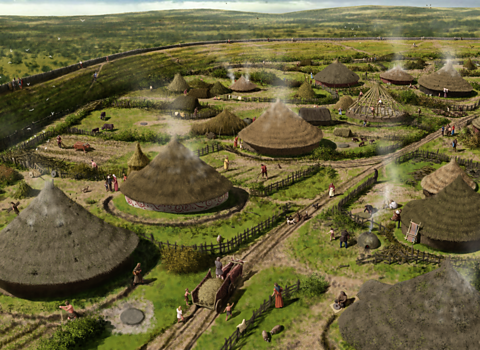 Image source, © Historic England (Illustration by Peter Urmston)
What has been found at Maiden Castle?
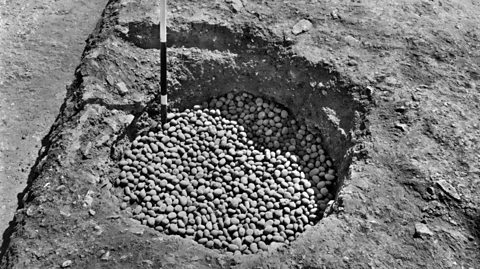 Image source, © The Society of Antiquaries
Most of the bank and ditches that you can see today were made in the 1st century BC, over 2000 years ago.
Over 20,000 sling stones (small rounded pebbles from Chesil Beach nearby) have been found near an entrance.
They were stored in large pits ready to be thrown or slung at attackers.
Most of the pottery used by people at Maiden Castle was made near Poole Harbour on the south coast, which is more than 35 miles away.
This could mean that people traded things outside of their local area.
Image source, © The Society of AntiquariesYou can find out more about Maiden Castle and life in the Iron Age in this BBC Bitesize Primary History page.
Think like a historian

Have a look at the thinking points below and think about your answer to each question. You could even write them down on a piece of paper or discuss them with somebody else if you want to.
The site of Maiden Castle was used very differently over time. Neolithic people used it for feasts and Iron Age people used it to build a hill fort for protection. What do you think is similar or different about how these people used the land?
Pottery that was made more than 56km away was found at Maiden Castle by archaeologists. What do you think archaeologists can learn about the people who lived there from these artefacts?
Iron Age people made the entrances to their hill forts very complicated and built huge banks around their settlement. Why do you think it was so important to the Iron Age people to make Maiden Castle look so impressive?
Did you think that the way people used the land over time changed a lot? It changed from a place to gather for celebrations and making tools to a place to live and defend. You may have thought that both groups saw the area as a special and important place for people to gather as a community.
Maybe you thought that it shows Iron Age people must have travelled and spoken to other settlements across the country. Perhaps you thought that it shows that people must have bought and sold different items that they made with other people and communities.
Did you think that they made it look impressive so that they could show their power and strength to other tribes? The scale and design of the structure could make them look important to other people. Maybe you thought that making the hill fort look strong and impressive would help make the people living there feel safer and more protected.
Activities
Activity 1: Old Oswestry hill fort
Old Oswestry is another Iron Age hill fort. It is in Shropshire, in the west of England. Its entrance passage was over 100 metres long. Two roundhouses have been found on the site.
Look at the drawing of Old Oswestry below. What similarities and differences can you spot between this hill fort and Maiden Castle?
You might want to look at:
- size of entrances
- location
- houses or settlements
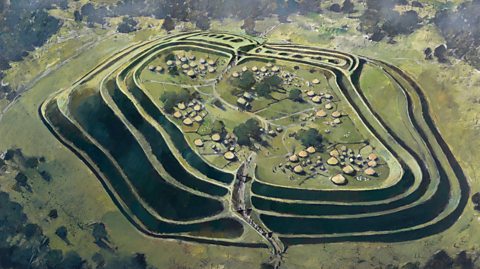 Image source, © Historic England
Activity 2: Quiz – Maiden Castle
Let's find out what you know about Maiden Castle.
Grown-ups corner
Are you a parent, carer or teacher?
Take a look at some of the links below on KS2 History which are packed full of knowledge, videos, quizzes and activities.
KS1 / KS2 History: Hill forts
BBC Bitesize for Teachers

KS2 History / PSHE and Social Studies: Iron Age forts and tribes
BBC Bitesize for Teachers

KS2 History: Iron Age Britain
BBC Bitesize for Teachers

Horrible Histories: Raid and Trade game! game
Play Horrible Histories: Raid and Trade KS2 History
More on Prehistoric
Find out more by working through a topic
- count9 of 21
- count10 of 21
- count11 of 21
- count12 of 21