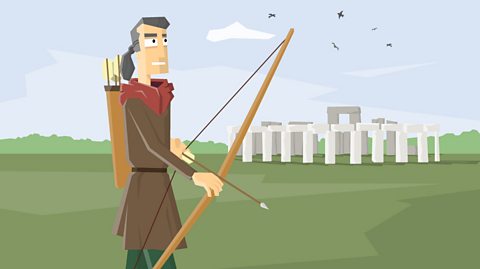
What was prehistoric Britain?
The Prehistoric period began when the first humans arrived in Britain.
It ended when the Romans invaded Britain in AD43.
This period is so large, that it is divided into three main ‘ages’:
- The Stone Age
- The Bronze Age
- The Iron Age
People could not read or write in this period so we have no written records from this time.
This means a lot of what we know comes from the discovery of artefacts, ancient tools and human remains.

Watch: What happened in prehistoric Britain?
Watch the video to learn more about what happened in Prehistoric Britain.
Take a trip through 900,000 years of prehistoric history.
Narrator: Excuse me. Yes, you. Ever wondered what prehistoric Britain was like? Great! Well let’s start at the beginning.The ancestors of humans first appeared in Britain around 900,000 years ago.
Here is one of them. I would like to introduce you to your great, great, great, great, great, great, great, great, great……great, great, great, great, great… grandfather.
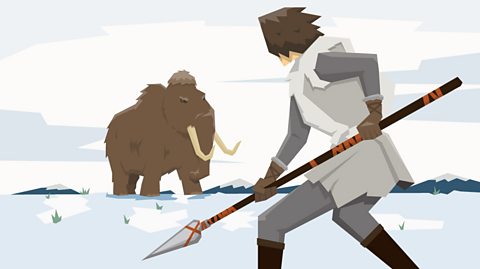
Don’t worry about that, he’s just saying pleased to meet you. These early Britons were hunter-gatherers. They used flint tools to hunt animals, like deer and mammoths.
And it got cold. Really cold, for a long time. Can you guess what it was called? No idea? It’s quite obvious… Ok, I’ll tell you… The Ice Age!
Then it was warm. Then hot. Then cold again. Once that was out of the way humans discovered farming and began to settle down in villages. This all happened during the… during the Stone Age… excuse me… stop!
Sorry, but we must get on to the Bronze Age.
It’s called the Bronze Age because people discovered how to use metals like bronze for the first time.
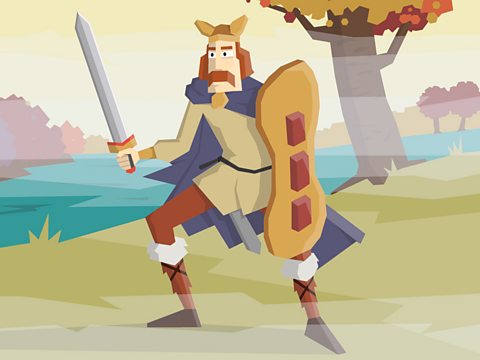
Welcome to the Iron Age! You’ve upgraded. People used iron in the Iron Age because it was easier to find and knock into shape. Ah, Celtic warriors. Don’t they look fierce!
The prehistoric period ended when the Romans arrived, who brought us roads and indoor plumbing.
Well, there we go, hundreds of thousands of years in a matter of minutes. Did you enjoy that? Fantastic! Me too.
Sorry, history can sometimes get a bit messy.
Important words
Important words on what we know about prehistoric Britain.
| Keyword | Definition |
|---|---|
| Archaeologist | Someone who studies objects and places from the past. |
| Conquered | To take control of another place or group of people, often by using force. |
| Empire | A large group of countries or lands that is controlled by one ruler, such as a king, queen or emperor. |
| Mesolithic period | This period, also known as the Middle Stone Age, was when early humans developed new skills like making finer tools. |
| Neolithic period | This period, also known as the New Stone Age, was when people created settlements and started to farm. |
| Palaeolithic period | The earliest part of the Stone Age, also known as the Old Stone Age, when people lived as hunter-gatherers. |
| Prehistory | The time in the past before written records. |
The first people in Britain

Prehistoric Britain began when the first humans arrived in the British Isles.
The Prehistoric period is divided into three ‘ages’, known as the Stone Age, the Bronze Age and the Iron Age.
The Stone Age lasted a very long time, so it is split up into three parts:
The first part was the Palaeolithic Period when humans were hunter-gatherers. They survived by hunting animals and finding food to eat.
Next came the Mesolithic period. This is when people began to develop new skills, like making smaller and finer tools.
The last part was the Neolithic period. This was when they learned to herd animals and grow crops.
How did life change?

This was a big change because they became farmers for the first time. They also began to build settlements and large monuments like Stonehenge.
After the Stone Age, people learned to use metal. First, they used bronze in the Bronze Age and then iron in the Iron Age.
Prehistoric people couldn't read or write, but they were incredible builders.
Their tombs, forts and monuments have survived for thousands of years.
The Prehistoric period ended when the Romans fought the Britons and conqueredBritain in AD43. Britain became part of the Roman Empire — a large group of countries or lands that was controlled by one ruler in Rome.
Watch: How do archaeologists study and interpret the past?
Watch the video to learn how archaeologists can find out about prehistoric Britain.
Discover how archaeologists study and interpret the past.
Greetings, archaeologists of the future!
Check out this future filter!
It shows things the way you will find them.
Let's try it on one of our axes!
Cool, but the handle’s gone.
Wood usually rots in the ground, unlike bronze.
But maybe you'll still figure it out from the wear marks on the axe head, or from a rare wooden handle that has lasted.
Clues to my life will be preserved in the ground, buried for you to find.
I'm making this bracelet as an offering to the gods.
Later, I'll throw it into the river, and one day you'll find it there.
You might wonder, was it a birthday gift?
But I reckon you'll figure it out.
You'll find it in the river and you'll know that rivers are special to us.
And you'll see it's lined with other shiny things that were never used.
That's why you'll think it was probably an offering to the gods.
There’s so much that you will learn about our lives.
Oh, dinner!
Strange to see it like that.
But when you dig it up, you'll find ash, burnt bones, even seeds left behind.
And from those tiny clues, you'll begin to understand what we're cooking for dinner.
Here's a whole home: walls, a roof, the smell of smoke from the fire inside.
But in the future, you'll only see the shapes of the walls.
That's your evidence.
The rest - like my favourite campfire story, or how to make Mom's amazing stew - will be lost.
I wonder… do you still wear bracelets in the future?
What do your homes look like?
And how much of my world will you uncover?
How do we know about prehistory?
Prehistoric people left no written records, so how do we know about their lives?
Archaeologists, who studies objects and places from the past, work like detectives looking for evidence. They find things that can tell us more about the past.
Click through the slideshow to learn more about how we can learn about Prehistoric people.

Image caption, The remains of homes and temples show how people lived and worshipped, like those on Skara Brae, the Orkney Islands, Scotland.


1 of 5
How did prehistoric Britain end?
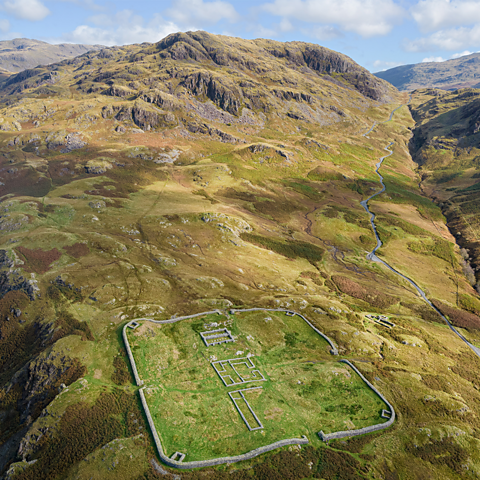
The Prehistoric period came to an end when the Romans invaded Britain.
In 55BC, Julius Caesar tried to invade Britain, but he was driven back by the Britons. The next year he tried again and failed.
Almost 100 years later, in AD43, the Roman Emperor Claudius launched a new invasion, this time the Romans conquered most of Britain. They fought the Britons to gain control of the land and eventually made it part of the Roman Empire.
Some ancient Britons retreated to Cornwall, Wales and Scotland, where they continued to follow their Celtic customs.
Many others decided not to move, they stayed on in Britain and learned to live like the Romans.
A few Roman writers described the ancient Britons, their writings provide a valuable source of evidence for life in Iron Age Britain.
Julius Caesar pictured the Britons as fierce warriors, who rode their chariots into battle.
He wrote that:
All the Britons paint themselves with woad, which produces a dark blue colour, and for this reason they are much more frightful in appearance in battle.
Think like a historian
Have a look at the thinking points below and think about your answer to each question. You could even write them down on a piece of paper or discuss them with somebody else if you want to.
Now you know that prehistoric people couldn’t read or write, why do you think the discovery of tools, weapons and homes are important to archaeologists?
Why do you think the discovery of farming is seen as the most important event in prehistoric Britain?
The Stone Age lasted such a long time that it was split into three parts. How do you think people’s lives changed between the Palaeolithic period and the Neolithic period?
Did you think that tools and weapons help give archaeologists clues about how prehistoric people worked and fought? Perhaps you thought that the discovery of homes helps archaeologists understand how prehistoric people may have lived.
Did you think that farming allowed prehistoric people to live in settlements instead of always moving from place to place to gather food. Maybe you thought that it meant they could grow their own food. This would help them to live and work together as a community.
Maybe you thought that in the Palaeolithic period, people were hunter gatherers, but by the Neolithic period, they became farmers. Perhaps you thought about how prehistoric people stopped moving to find food and started to build settlements and monuments to live in one place.
Activities
Activity 1: Prehistoric timeline
The prehistoric period is divided into three ‘ages’. They are known as the Stone Age, the Bronze Age and the Iron Age.
Click on the image to find out more.
Activity 2: Explore prehistoric sites
Take a look at three very different archaeological sites: a fort, a mine and a tomb.
Click on the images to uncover evidence about prehistoric Britain.
Activity 3: Prehistoric Britain quiz
Grown-ups corner
Are you a parent, carer or teacher?
Take a look at some of the links below on KS2 History which are packed full of knowledge, videos, quizzes and activities.
KS2 History: Ancient Voices
BBC Bitesize for Teachers

KS2 History : Middle Stone Age
BBC Bitesize for Teachers

KS2 History: The Romans. 4: The Romans in Britain
BBC Bitesize for Teachers
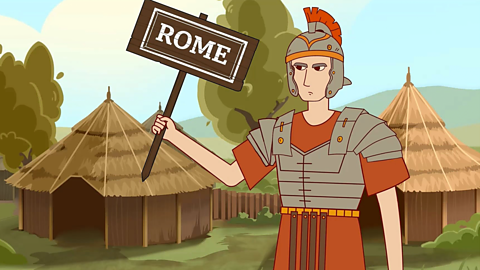
Horrible Histories: Raid and Trade game! game
Play Horrible Histories: Raid and Trade KS2 History
More on Prehistoric
Find out more by working through a topic
- count13 of 21
- count14 of 21
- count15 of 21
- count16 of 21