The Europa League winner turned director, actor, DJ and photographer
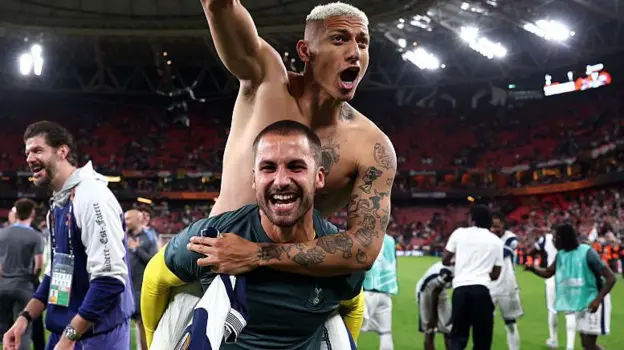
Alfie Whiteman was on the bench as Tottenham beat Manchester United to win the Europa League in Bilbao last May
- Published
Alfie Whiteman scans the self-portraits on display at a Grade II listed art gallery inside the Tottenham Hotspur Stadium, the ones he took of himself hanging out of a tumble dryer, celebrating a birthday alone in the woods and sitting naked on a jetty staring out over Sweden's Lake Mockeln.
"There was no intention of anyone ever seeing these pictures," he laughs. "But that also just reflects how I was living before - I kind of split my life in two."
Whiteman was on the bench when Spurs won the Europa League in Bilbao. Less than a year since that success he is showing BBC Sport his new exhibition having retired at just 26 a few months later.
An open-top bus parade through the north London streets where he grew up was the culmination of more than 15 years with the boyhood club he joined aged 10, having watched them lift the 2008 League Cup at Wembley with his dad.
"I was waving at my friend and sister like 'I'll be home in a sec just doing a loop round the block!'," he says about the Europa League celebrations. "There was a youth centre I used to help out in and one of the kids was like 'Hey! What are you doing there!'"
Whiteman had offers to stay in the game when his Tottenham contract expired last summer, trialling with Championship and League One clubs, but instead decided to focus on his work as a photographer and film director.
Stepping away was a huge decision, though, for a goalkeeper who could have played on for more than a decade. One coach told him retiring would be a "crime".
"I called my agent because I had to be like 'stop, I'm not going to go to this club…' and he was really understanding," says Whiteman. "But I didn't tell anyone, I didn't do an Instagram post like 'guys just so you know…' no one cares about that.
"It's such a commitment, essentially a life's work, sacrifice, all those other things that go with it, to end, in some people's eyes, prematurely. It's rejecting this kind of 'boyhood dream'.
"But I have had the best time of my life in the last eight months, learned so much and been so fortunate to be working with such talented people on exciting things. So I don't think that's necessarily true.
"It was scary, though, because at the time I didn't have anything set up. A few days after I was assisting this photographer and packing down C stands, and like 'this is great'. But I then had to scramble and do things, and still am."

Whiteman's debut exhibition Alfie Whiteman: 'A Loan' is on display at the OOF Gallery at Warmington House inside the Tottenham Hotspur Stadium from Friday
Whiteman had long been planning for a career away from professional football. On days off and during afternoons after training, he would meet directors or producers for coffee, or help assist on set as a runner.
He has his own radio show, first appearing under his mother's surname to keep a low profile before deciding "just to be myself".
"Everyone was like 'wow, you're a footballer and you listen to jazz, this is crazy!'," he smiles.
Fans discovered his Letterboxd profile, where he has reviewed more than 200 films, but Whiteman also spent free time working on photography projects and taking acting lessons.
One summer, while his team-mates set off for Dubai or the Maldives, Whiteman appeared in a play in Holborn - an experimental art piece where he played a "really cheesy, over-the-top boyfriend". "So it was quite easy," he jokes.
"All these little things were edging me closer to taking this step into this unknown," says the 27-year-old. "I knew I didn't want to be in football when I was done.
"I was trying to teach myself and learn, so that when that day came I wasn't at zero. I was quite unhappy for a while and thought I would rather try something else when I am young."
Whiteman has always been culturally engaged, his father was a jazz musician, but in his youth some team-mates would call him a "hippie". He says there used to be a feeling inside professional football that doing anything else on the side was a "distraction".
He was living a very different life to the stereotype of a footballer - Whiteman didn't play golf and would ride his bike or get the train to training. He lives close to the stadium, so would walk to home games.
"If you get kids from such a young age and put them in this bubble it is inevitable that everyone becomes a product of the environment and reflections of each other in the changing room," he explains. "And I lived that as an early teen. I was desperate for the monogram Gucci washbag."
But he came to separate his work from his personal interests: "I love the craft of playing football and being a keeper and rolling around on the grass, it's great, getting hit with the ball.
"But I also love these other things and [thought] one day I would like to try those. I didn't feel they really went together, hence why I had them running alongside.
"All my team-mates were great and we got on really well, but it was work. I was always a little bit... slightly different."
In the end, football was effectively stopping him being able to pursue opportunities presented in the creative industry, caught in a "never-ending cycle of season-holiday-season-holiday", to Whiteman that felt "kind of the same thing all the time".

Whiteman says he spent a lot of time alone during his loan spells in Sweden
Whiteman hasn't played football, though Baller League and mates' five-a-side teams have been in touch, or followed the game too closely since breaking out of that everyday elite structure.
No being bound to training schedules has allowed him to visit Pakistan - he is of Pakistani descent - and work on a film project in Ukraine, while he signed as a director and photographer with production company Somesuch and has his own studio in Shoreditch.
On Friday, Whiteman will launch his debut art exhibition close to his roots at the OOF Gallery in Warmington House, situated within the Tottenham Hotspur Stadium.
Whiteman only featured once for Spurs, brought on by Jose Mourinho to replace Joe Hart in a Europa League win over Ludogorets in 2020.
Such is the life of a fourth sometimes fifth-choice goalkeeper, he was training every day knowing he was unlikely to feature in matches. Indeed, Whiteman was hoping for more loan opportunities but was kept around as a homegrown player.
Most of his senior football, however, came over two loan spells earlier in his career with Degerfors, first heading to Sweden at a "day's notice" in 2021.
The focus of his exhibition - Alfie Whiteman: 'A Loan' - is from his time there, showcasing the photographs he took and diary entries he kept.
It was, as Whiteman says, "quite a contrast to growing up in London and being in a big city", and he found himself living in a rural cabin on the shore of Lake Mockeln.
"I tried to really live that experience, hence why I went and stayed in the woods, just to make the most of it because football can be such a great vehicle to experience different places," Whiteman explains.
"But the work in essence is also from a time when I was always questioning 'what am I doing? Is this my life path?' and decisions prior to that - like we all do.
"It's a highly personal thing, wondering what our future holds. [I was ] getting frustrated and being quite unsure about what I was doing and what I wanted.
"Being in football from nine years old, leaving school at 16, being in that bubble of what modern football is - trying to figure out the possibilities outside it is quite tricky."

Whiteman spent almost 17 years at Spurs but his only senior appearance came as a substitute against Ludogorets in the Europa League in 2020
Whiteman spent most of his time alone, a feeling escalated at first by a post-Covid world in which Sweden was not allowing non-work visitors. And anyway, he says "everyone has also got their own lives going on".
"There were a lot of periods of introspection," he says. "Just where I was at that point in life and these questions I was asking myself. I was really sitting with them, and that's what being alone does. Which is a good thing."
He would sit by the lake watching the sunset, and one stormy evening - while eating takeaway Pad Thai - decided it would make a "funny, sad" self-portrait.
"There was no one else to take a picture of that I had the confidence or ease to do," he explains. "There was an element of me just experimenting, trying to stimulate myself."
As Whiteman said, he never expected anyone else to see them - but looking at them on display now he understands the feelings that led him to retire last year were present for a while.
"If I had put this out three years ago, it wouldn't have made sense," he says. "It is nice now looking at them in a different state.
"We are always going to be asking ourselves these questions, but it's nice seeing that as a different chapter."


