A golden year for pop music, blockbuster movies and British Olympians - 8 memorable moments from 1984
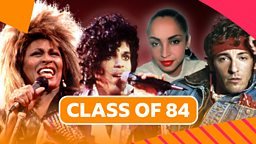
1984 was a landmark year for music, with Frankie Goes To Hollywood ripping up the rule book to top the chart on three occasions, Wham! continuing their ascendancy, Madonna enjoying her first UK chart hit, and Stevie Wonder landing Motown’s biggest ever UK hit. It all culminated with the biggest pop stars of the day coming together for Band Aid.
Beyond music, there were a wealth of blockbusters making their cinema debuts, there were some golden moments to cheer on in both the Winter and Summer Olympics, and in a nod to the future a certain computer was launched in spectacular style during the US Superbowl.
Below we take a look at some of the year's standout moments in music, sport, and popular culture.
![]()
Listen to Class of 84 now on BBC Sounds
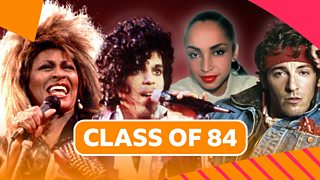
Discover the stories behind four classic albums from Prince, Sade, Tina Turner, and Bruce Springsteen. Plus hear more classic tracks from 1984 in Sounds of the 80s and One Hit Wonders’ specials.
1 | It was a golden era for pop
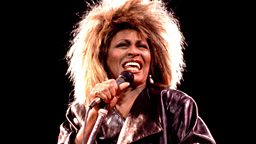
Within the space of a couple of months, between May and July 1984, the four seminal albums featured in Class of 84 were all released. First out was Tina Turner’s comeback album Private Dancer, eventually peaking at No.2 later in the year. Bruce Springsteen’s Born In The USA was released in June, but would have to wait until March 1985 to top the chart.
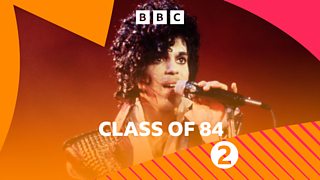
They were followed in July by Sade’s Diamond Life, debuting at No.2 and going on to be on the year’s biggest sellers, and Prince’s Purple Rain, which would only go as high as No.7, eight months after it was released, but still cemented its place as an all-time classic.
- You can hear tracks from Sade and Prince’s albums, alongside 1984 hits from New Edition, The Pointer Sisters and Jocelyn Brown, in Trevor Nelson’s Magnificent 7 Class of 84 special
- Hear a tribute to the legendary artist Prince, featuring Adam Lambert, Ellie Goulding, Noel Gallagher, Beverley Knight, Rita Ora and more in Prince – The Fans’ Story
Other albums of note in 1984 included the hits compilations, Now That’s What I Call Music volumes 2, 3, and 4, and The Hits Album, all of which were all among the year’s biggest sellers. It would be 1989 before compilations were given their own separate chart.
Elsewhere, 1984 was the year Michael Jackson’s 'Thriller' won eight Grammys and earned the Guinness World Record for the best-selling album of all time. Not long into the year he suffered severe burns from a freak lighting accident during the filming of a Pepsi Cola advert.
The biggest rising stars of the year were Frankie Goes To Hollywood who climbed to the top of the charts with their single 'Relax' despite (or perhaps because of) the song being banned by BBC Radio following Radio 1 DJ Mike Read's on-air expression of distaste for the record's artwork and risque lyrics.
UK commercial radio stations and TV stations continued to play the song, with the record-buying public being fed a steady stream of remixes to keep up interest. The BBC eventually lifted the ban, choosing to feature the track in the Christmas Day episode of Top of the Pops and Radio 1's best-selling singles of the year chart. Meanwhile ‘Frankie Says Relax’ t-shirts became a must-have fashion item, and the band enjoyed two further No.1s in 1984 with ‘Two Tribes’ and ‘The Power Of Love.'
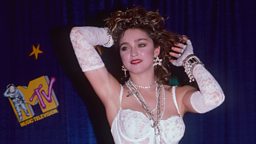
1984 was also the breakthrough year for the “Queen of Pop” Madonna who released her Like a Virgin album and accompanying single. She gave a memorable performance of the hit dressed as a bride atop a wedding cake at the very first MTV Video Music Awards.
MTV’s dominance of the small screen in America led to an explosion of British bands in the states. A so called British Invasion II saw the likes of Duran Duran, Eurythmics, Culture Club, Billy Idol and The Thompson Twins all make a big splash over the pond with iconic music videos, big fashion statements and even bigger hair.
Closer to home, George Michael dominated the UK singles chart with five top 10 singles: Careless Whisper (solo), Freedom, Wake Me Up Before You Go-Go, Last Christmas (all Wham!) and Do They Know It’s Christmas? (see below for more on that).
And for the likes of Nena, Snowy White, Fiction Factory, Neil from the Young Ones, and Joe Fagin with the Auf Wiedersehen, Pet theme, 1984 was the year they secured pop immortality with their only appearances on the UK singles chart. Hear their tracks, plus more 1984 One Hit Wonders right now on BBC Sounds.
2 | Band Aid made millions for charity
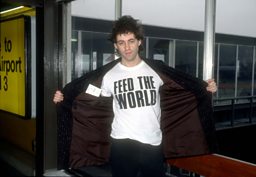
Although 1984 goes down in history as a year that gave us the modern era’s finest pop records, it was also a year which saw millions affected by a devastating famine in Ethiopia. Covered extensively by the BBC, many were moved by the harrowing scenes being broadcast into front rooms, including Bob Geldof, then lead singer of Irish punk band The Boomtown Rats. Together with his partner at the time Paula Yates, the pair decided to put their contacts in the music industry to good use and bring the world’s biggest pop stars together to raise money for the famine relief. Along with the help of Ultravox’s Midge Ure, they formed the supergroup Band Aid and quickly got to work producing the world’s biggest charity song of all time “Do They Know It’s Christmas?”
Recorded on 25 November 1984, the newly formed supergroup had just 24 hours free studio time to lay down the vocals and mix the track. Vocal contributions came from 80s stars Duran Duran, Spandau Ballet, U2, Bananarama, Kool & The Gang, Status Quo, Paul Weller, George Michael, Sting and Culture Club’s Boy George, with Phil Collins on drums. So keen to record his part, Boy George flew all the way from New York to London via Concorde at his own expense, arriving just on time to feature.
Upon release on 3rd December, the single went straight to No. 1, selling a million copies in its first week to become the fastest-selling single of all time in the UK. Retaining the top spot for five weeks, it was crowned 1984’s Christmas No. 1 and after selling over three million copies became the UK’s biggest-selling single at the time (until Elton's John's 'Candle in the Wind 1997'). Combined with global sales the single raised more than $24 million.
Beyond the initial project, the legacy of Band Aid has been huge and longlasting. Just a year later in 1985, Bob Geldof hosted the first ever Live Aid concert which was broadcast to over 160 countries, the largest televised pop performance of its time. Band Aid and Live Aid combined raised around $150 million in total for the Ethiopian famine relief. In 1989 Geldof called upon the highly successful Stock Aitken Waterman team to produce Band Aid II, this was followed by Band Aid 20 in 2004 and then Band Aid 30 in 2014. Might we see Band Aid 40 for Christmas 2024?
3 | Indiana Jones, Terminator, Ghostbusters and The Karate Kid were must-see movies
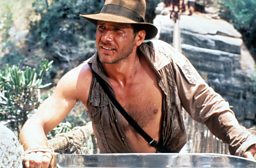
In 1984, film fans still had to flock to the cinema to see the latest flicks, sometimes years before they'd be shown on TV, although the home video market was about to explode.
Some huge titles graced our big screens this year, bringing in big bucks in the process. Indiana Jones and the Temple of Doom (a prequel to 1981's Raiders of the Lost Ark) was the year’s biggest success at the UK Box Office, grossing over £7.9 million.
It was a year for thrilling new franchises. The original Ghostbusters drew in big numbers (£5.1m), alongside still-beloved classics The Karate Kid (£3m), Gremlins (£2.9m) and Police Academy (£2.5m). The original Dune and Terminator films were also first released in 1984. Hollywood was experiencing something of a creative streak.
And if you were looking for a rom-com, Romancing the Stone, the Michael Douglas and Kathleen Turner-starring treasure adventure grossed £3.1m.
Alongside the timeless, synth-tastic Ghostbusters soundtrack, we had some excellent film scores from Eurythmics (for the film adaptation of George Orwell’s 1984), Mike Oldfield (for the truly chilling The Killing Fields) and of course Prince, whose iconic ‘Purple Rain’ album soundtracked a film of the same name. We were also introduced to Spinal Tap, whose fly-on-the-wall mockumentary ‘This Is Spinal Tap’ was one of the year’s breakout successes.
![]()
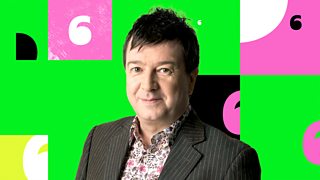
Radcliffe and Maconie - A 1984 special
Stuart Maconie marks the 75th anniversary of George Orwell’s influential novel 1984, exploring the music it has inspired - including David Bowie's - and talking to author Sandra Newman.
4 | Politicians as puppets, a new Doctor Who, and the first ever Crimewatch
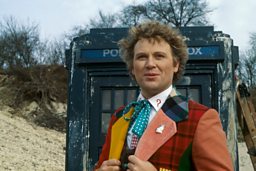
With cinemas enjoying a blockbuster year, British TV sets - although still low in fidelity and limited to four terrestrial channels - also aired some truly memorable moments.
Political satire Spitting Image, with its still-ubiquitous, garish puppets, debuted on ITV in February 2014. One month later, the UK version of game show The Price is Right - presented by Leslie Crowther - made its first appearance on the same channel. And in May, feel-good variety show Surprise Surprise saw singer turned TV presenter Cilla Black making dreams come true for unsuspecting members of the club.
Viewers were glued to the first ever edition of Crimewatch in June, which presented an unsolved case on the murder of Colette Adam. A man would be charged for the crime 25 years later, in 2009.
In March Colin Baker started a two year stint as Doctor Who’s sixth Doctor, replacing Peter Davison at the end of the story ‘The Caves of Androzani.' And in October 1984, ITV broadcast the first episode of The Bill (a pilot called ‘Woodentop’ aired in 1983). Sean Bean made his TV acting debut in the episode ‘Long Odds’, one of many future stars to notch an early credit on the long-running police drama.
And one remarkable sporting moment would get 24 million viewers to tune in on 14 February...
5 | Britain’s Torvill and Dean secure perfect score in ice dancing at Winter Olympics
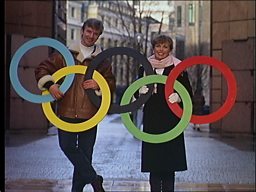
On the 8 February 1984 the Winter Olympic Games arrived in Sarajevo, then the capital of the Federal Republic of Yugoslavia, now Bosnia and Herzegovina. In the days leading up to the opening ceremony there was doubt from organisers as to how the games would proceed when the tournament sites were missing one key component - snow. Yet on the night of the 7 February, right on cue, a blizzard arrived to cover the mountains. This presented yet more headaches for organisers tasked with clearing the snow in time for the opening ceremony. Thankfully, with the help of the city's student population, the Winter Games got underway without delay.
Topping the medals tables by quite a stretch were East Germany and the USSR, taking home a total of 24 (nine gold, nine silver and six bronze) and 25 (six gold, ten silver and nine bronze) medals respectively. The host nation had their hero in skier Jure Franko who did his homeland proud by winning silver in the giant slalom event, securing Yugoslavia’s first ever Winter Olympic medal, their only medal of the tournament.
But it was Great Britain’s Jayne Torvill and Christopher Dean who really stole the show when they received twelve perfect scores (6.0) in the free dance section of the ice dance contest. Naturally their perfectly synchronised performance landed them gold in the competition and their score hasn’t been matched since. Their beautiful interpretation of Maurice Ravel’s Bolero will forever go down in Olympic history, a truly unforgettable moment for the huge audience watching back in the UK.
6 | British Olympians struck gold in LA
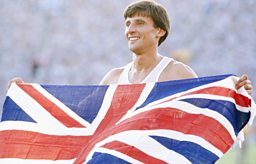
The summer of 1984 saw another major sporting event - the Summer Olympic Games hosted by the USA in Los Angeles. Held against the backdrop of the Cold War the Games didn’t get off to the smoothest start when the 14 countries that made up the Soviet-bloc chose to boycott the competition entirely (The US had led a boycott of the 1980 Olympics in Moscow, with 65 nations refusing to participate).
The USA team dominated on home soil, topping the medal count with a record 83 golds, beating the Soviet Union’s 80 golds four years earlier.
If we’re talking opening ceremony theatrics it doesn’t get more ostentatious than a man on a jetpack flying over spectators in the stadium. This is Hollywood after all! The show featured cowboys, native Americans, 9,000 dancers in sync and a performance of “Rhapsody in Blue” by George Gershwin – accompanied by just the 84 grand pianos...
It was a spectacular year for Great Britain who took home 37 medals including five golds. Years before his pivotal role in bringing the Olympics to London, it was Sebastian Coe who won gold in the 1500m race becoming the first man to win consecutive gold medals in the race, and beating fellow Brit and rival Steve Cram in the process.
Another name synonymous with the Olympics, Steve Redgrave picked up his first gold, alongside his teammates, in the men’s coxed four rowing competition.
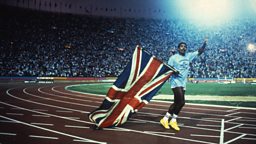
Meanwhile, Daley Thompson won gold and set a world record in the decathlon before courting controversy by wearing a t-shirt that read 'Thanks America for a good games and a great time' on the front and 'But what about the TV coverage?' on the back - a reference to American TV networks supposedly biased coverage of the event.
Elsewhere in sport, France triumphed in football’s 1984 European Championships, while Liverpool beat Roma to lift the European Cup for the fourth time, in a penalty shoot-out memorable for goalkeeper Bruce Grobbelaar’s wobbly legs antics. Liverpool also lifted the league title in England, but it was Merseyside rivals Everton who won the FA Cup, beating Elton John-owned Watford 2-0 at Wembley. Steve Davis beat Jimmy White in the World Snooker Championship, retaining his status as world no.1, John McEnroe and Martin Navratilova won the men’s and women’s titles at Wimbledon, and Niki Lauda was Formula 1 World Champion.
7 | The opening of the great Thames Barrier, a feat of modern engineering
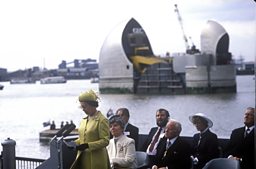
On 8 May 1984 Her Majesty Queen Elizabeth II officially opened the Thames Barrier, one of the largest movable flood barriers in the world. At first it was predicted to be used just once or twice a year but since becoming operational it's been used 221 times (between 5-6 times a year if you’re wondering).
The iconic barrier came about mainly as a response to the Great North Sea flood of 1953 which killed hundreds of people and affected England, Scotland, the Netherlands and parts of Belgium.
The barrier's opening day was met with fanfare, fireboats on the river, water cannons and balloons up in the sky.
Located between Greenwich and Woolwich and just south of London City Airport, the capital’s silver-domed guardian silently goes on protecting hundreds of listed buildings, thousands of acres and millions of people from flooding. And thanks to the barrier’s forward-thinking engineering it is expected to protect London from flooding until 2070.
8 | The groundbreaking advert for the first ever Apple Macintosh that almost never was
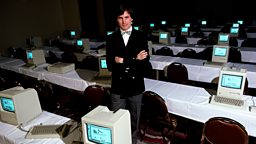
Years before iPhones, iPads and Airpods, in January 1984 Apple launched its first ever Macintosh PC. Led by a young Steve Jobs, Apple wasn’t quite the tech behemoth it is today, more the plucky underdog taking on rival IBM which dominated the IT market in the 1980s.
Although the first ever Apple Mac is an exciting piece of history in itself, it was the product’s TV advertisement that really cemented its iconic status over all these years. The Mac was first showcased to Americans in a groundbreaking commercial played out during Superbowl XVIII, the most watched TV broadcast in the USA.
Creatively referencing George Orwell’s novel ‘1984’, the Ridley Scott-directed ad framed IBM as the evil Big Brother and Apple as the heroic rebel force taking him down. Despite its lasting legacy, Apple’s board of directors were not impressed at the time and insisted the film be canned, and the advert slots be sold. Unable to shift the last of the coveted Superbowl advertising slots, Steve Jobs ultimately chose to defy the board and run the commercial anyway.
Unsure how it landed with viewers at first, the advert was subsequently picked up by the press and played out during national news programming, generating an estimated $5 million worth of free promotion. When the Macintosh finally went on sale it easily outsold IBM’s own offering, one of Steve Jobs’ many maverick decisions that would lead to Apple’s eventual triumph in the tech world.
Radio 2 Remembers...
Take a nostalgic deep dive into the big music and cultural moments of these memorable years.
![]()
1984
Band Aid, Torvill and Dean win gold, Madonna and the Apple Mac debut.
![]()
1985
Live Aid, EastEnders, Madonna, Whitney, Back to the Future and The Sinclair C5.
![]()
1986
Madonna, Maradona, Mexico, Memorable Movie Music and 'Maverick' Mitchell.
![]()
1992
The Bodyguard, Michael Ball at Eurovision and the Barcelona Olympics
![]()
1995
Britpop, Blackburn, Braveheart and Brosnan.
![]()
1996
Spice Girls, Knebworth, Trainspotting and the Fugees.
![]()
1998
Robbie, Geri, Fatboy Slim and Vindaloo.
![]()
1999
Britney, Baz Luhrmann, Fergie Time and a solar eclipse.
![]()
2000
Coldplay, Craig David, Destiny's Child and more.
![]()
2001
Beyoncé, Shaggy, Dido, Tiger Woods and more.
![]()
2002
Pop idols, memorable movies, and an Office romance.
![]()
2003
Love Actually, Finding Nemo, the Black Eyed Peas and the White Stripes.
![]()
2004
Mr Brightside, The Invincibles, Kelly Holmes and Strictly.