Tiger Island: An origin story
By Patrick Evans
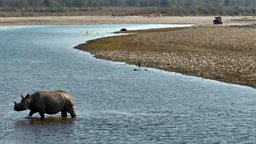
A greater one-horned rhinoceros. Western Nepal.
For safety, guides in Nepal carry a stout stick.
In 2023, I found myself working in Nepal, on a film about jungles, as part of the BBC landmark natural history series Asia. Rhinos were my focus, and our team was trying to record the heavyweight battles that take place between vast two-tonne male rhinoceroses, as they fight for mating rights in the sal forests north of Kathmandu.
Whilst on location, I received a message from Executive Producer Roger Webb, suggesting that we investigate tigers as a “jungles” subject. He sent a link to a BBC News story produced by BBC News Nepal, BBC World Service, who had been to Bardiya National Park in western Nepal, which had seen an apparent sixfold increase in tiger numbers in recent years.
It sounded promising, but I was reluctant, because I knew from personal experience how difficult it could be to film this animal. I had also recently heard of a crew spending over seven hundred days following tigers, without once filming them hunt.
But the prospect was too good to resist. And so, with a couple of days to spare before rhino filming was over, I flew across the country in the company of our fixer, Tashi Bista. To prove that capturing tiger behaviour in Bardiya would be viable, I would need to see one.
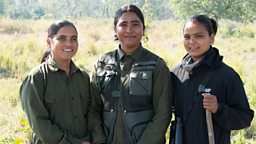
Arriving at the National Park, we were introduced to guide Sushila Mahatara and went looking. At one point, we had to cross the river, so we took off our shoes, waded to the other side, and followed an animal trail. For safety, guides in Nepal carry a stout stick. The sensation of walking barefoot in a forest where tigers were resident in large numbers, and could be anywhere, and should they approach, would need to be frightened off by a stick, was unforgettable.
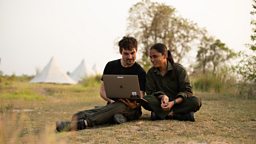
Dan O'Neill (big cat scientist), and Sushila Mahatara (wildlife guide) check remote camera footage in Western Nepal.
To have seen three tigers in two days was a clear sign - this place was special.
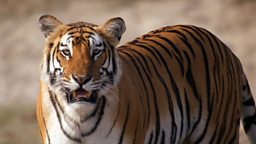
Later the same day, we were very excited, as we briefly saw a female tiger on the road. And the following morning, at a campsite where we had spent the night, we saw first one, and then a second tiger cross the dry riverbed, just a couple of hundred meters from our tents. I count this as my first real sighting of a tiger, because I was able to see its blazing eyes. I found myself truly shocked at its enormous size - it felt comparable to watching a horse crossing the landscape.
To have seen three tigers in two days was a clear sign - this place was special. And so, over the following two years, our jungles team returned several times to Bardiya to film tigers, working closely with Sushila and her sister Manju in building up a detailed picture of the lives of a mother tiger, Goma, who the sisters had named after their grandmother, who at the time had three cubs. The result was a story which opened the Asia jungles film, titled “Tangled Worlds”, and showed Goma’s relentless determination to hunt and provide food for her family.
During the process, it occurred to me that Goma, her cubs, and other tigers we had been filming, were by now so familiar to us, they could form the subject of an entire film, or perhaps even a series of films. Crucially, we had recorded Goma mating with a huge male, so we knew she would have a set of new cubs in due course, and they could be the stars of the show.
To convince our commissioners, I was sent on a recce with Roger, our Executive Producer. I was deeply worried; month after month of heavy monsoon rains means the vegetation grows so high, so lush and dense, the chances of seeing a tiger become incredibly slim. If we didn’t see one, it could spell the end of the dream.
In a gap in the rains, we went for a walk, led by Sushila, Manju, and their younger sister Ranju, all carrying sticks. Pausing at the main river, we sent up the drone to look for tigers, discovering a mother rhino and tiny calf instead. It was a magical moment, for the sisters had never seen a rhino calf suckling, but from the drone, we were able to witness the tender scene.
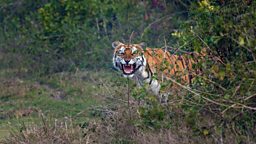
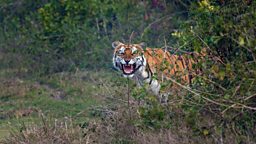
Tigress named locally as "Goma", Western Nepal.
If you march your winter journey, you will have your reward, so long as all you want is a penguin’s egg.Apsley Cherry-Garrard
On the way back, walking in single file, Roger suddenly exclaimed. “Is that a tiger?” It seemed unbelievable - but it was true. The sisters span around, checking through their binoculars, though there wasn’t a need, for it was only about thirty meters away. “Tiger, tiger, tiger!” Hurriedly, I raised my camera and filmed their excited reaction. Frustratingly, I wasn’t able to film the tiger before it disappeared, but it was likely Goma, for we were in the heart of her territory.
With proof that you could potentially see a tiger here even at the most difficult time of year, Tiger Island was given the go-ahead. And so, we were able to return and document the lives of Goma and her new cubs, as well as those of Goma’s daughter Mala.
As the early 20th century polar explorer Apsley Cherry-Garrard wrote in his account of his team’s efforts to recover Emperor penguin eggs to learn about their breeding cycle, “If you march your winter journey, you will have your reward, so long as all you want is a penguin’s egg.”
In my case, the equivalent to the penguin’s egg has been footage of tigers doing extraordinary things. The quest to capture new behaviour, to expand the boundaries of what we know about even some of the most iconic animals on Earth, is what gives all wildlife filmmakers hope that there is more out there. Perhaps all you need is patience, and the willingness to continue looking.