Summary

  1. Record-breaking heat exacerbates European wildfirespublished at 16:04 BST

    Elizabeth Rizzini
    Lead weather presenter
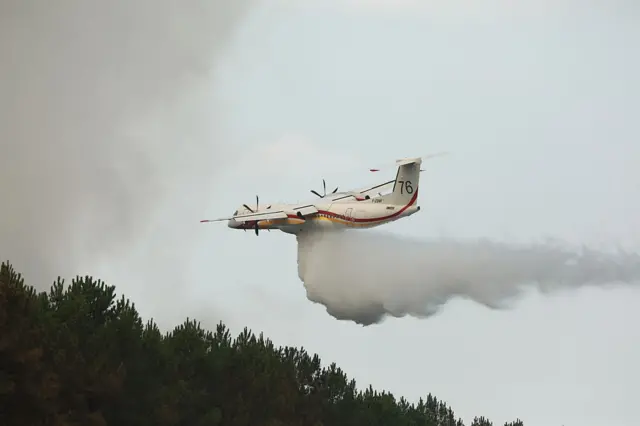
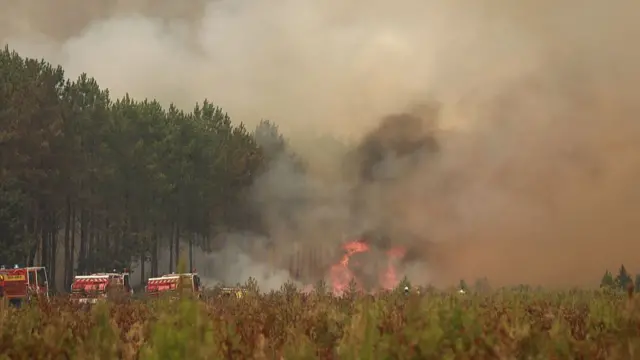
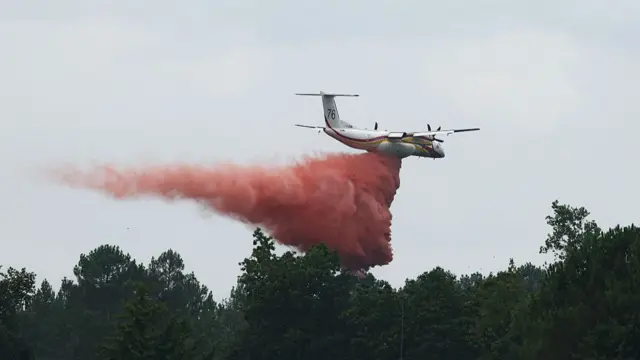
    Specialist aircraft drops water on a fire burning in a forest in south-western FranceImage source, Getty Images

    The hot and dry weather these last couple of months across western Europe has exacerbated the wildfires.

    It was the hottest June on record in France and the second hottest June on record (second to last year) in Spain.

    France recorded only half its monthly rainfall for June and Spain only 39%. In Spain it was the driest June on record.

    July looks like it could be the hottest month ever recorded in Spain but this will be confirmed at a later date.

    Europe is the fastest warming continent on earth according to the World Meteorological Organisation, warming at twice the global average.

  2. BBC Verify

    Satellite data shows smoke from wildfires spreading across Spain and Francepublished at 15:59 BST

    By Barbara Metzler

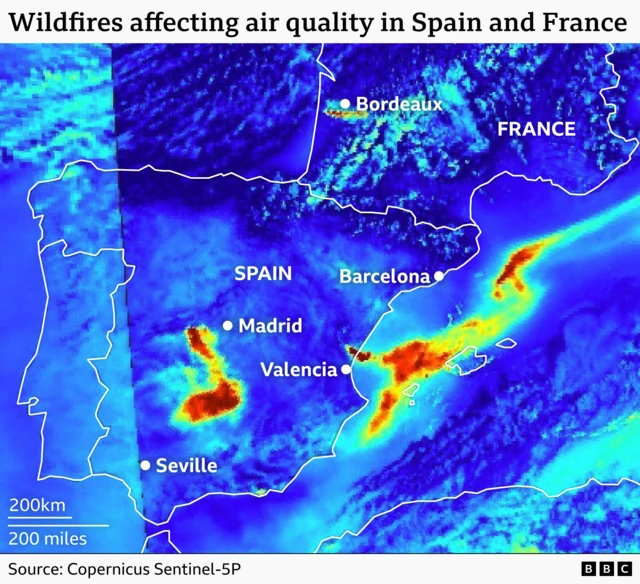
    BBC Verify has been analysing satellite data showing the spread of smoke from the wildfires in Spain and France.This image, captured by the Copernicus Sentinel-5P satellite on Sunday, uses the Aerosol Index to detect smoke and other tiny particles in the atmosphere.

    Map of Spain and southern France showing atmospheric aerosol concentrations detected by the Copernicus Sentinel-5P satellite. Colours range from blue (lower aerosol levels) to yellow, orange and red (higher concentrations of smoke and airborne particles). Large red-orange plumes are visible in east-central Spain, south of Madrid, and across the western Mediterranean near Valencia and the Balearic Islands, indicating wildfire smoke affecting air quality. Additional elevated aerosol levels appear near Bordeaux in southwestern France. Major cities including Madrid, Barcelona, Valencia, Seville and Bordeaux are labelled. Title: “Wildfires affecting air quality in Spain and France.” Source: Copernicus Sentinel-5P.

    Red areas indicate higher concentrations of absorbing aerosols which can include wildfire smoke. These tiny particles absorb sunlight, warming the atmosphere and reducing air quality.

    Three prominent plumes are visible over the Iberian peninsula and south-west France with the largest extending from the wildfire west of Madrid. Another is visible near Bordeaux, while a third lies along Spain's east coast near Valencia.

    The map shows how smoke is drifting and highlights areas downwind that may be at greater risk of poorer air quality.

  3. British tourist recalls 'ash falling from the sky' amid French firepublished at 15:50 BST

    Rozina Sini
    BBC Your Voice

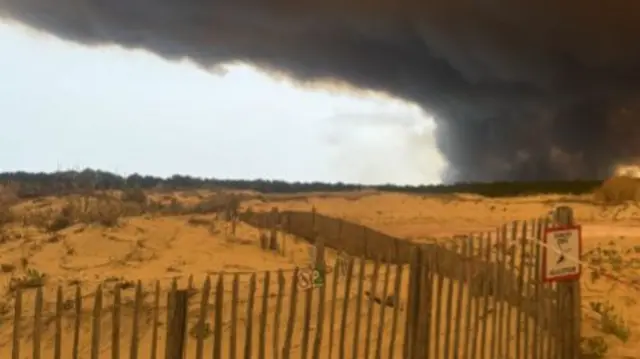
    A foggy beach with a smoke cloud in the distanceImage source, James Hillier
    Image caption,

    The beach at Lacanau was 'completely destroyed' by ash from the nearby wildfire

    James Hillier was visiting his son in the seaside commune of Lacanau, in the Gironde department, on Friday, when "the whole town got consumed by smoke".

    He and his wife headed to the beach, which is a popular surfing spot, and found that it had been "completely destroyed".

    "There was ash falling from the sky and I noticed a big lump of it landed on my hand," he tells the BBC.

    The smoke was so heavy that whenever they wiped their garden table clean, it quickly became covered with ash again.

    The couple, from London, left Lacanau on Saturday, only to find the main road to Bordeaux blocked by police, and "endless streams of fire engines" were driving past.

    Arriving in Bordeaux, they found a quiet city without many people arriving. "The air was acrid – it stung your eyes and people were wearing masks," Hillier says.

    They have now decided to leave Bordeaux and he says they want to "move up north".

    BBC Your Voice logo
  4. Temperatures to soar beyond 40C in Spainpublished at 15:36 BST

    Elizabeth Rizzini
    Lead weather presenter

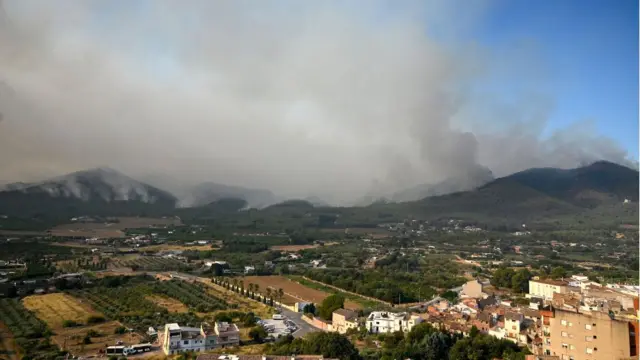
    A town in the foreground in sunshine, with a large cloud of smoke rising from the green hills beyondImage source, Getty Images
    Image caption,

    Fires have been raging near Valencia, on Spain's east coast

    The Spanish Met Office, AEMET, has issued amber alerts for a widespread heatwave until at least Sunday.

    The warning covers south-western and central regions, as well as the Canaries.

    A large area of high pressure will strengthen, with temperatures to rise day on day underneath cloudless skies.

    They will range from 39C to 41C by Wednesday and are expected rise later in the week.

    Temperatures will exceed 40C across the Guadalquivir, Guadiana and Ebro valleys for several consecutive days.

    Friday could be the hottest day of the week, with Cordoba expected to reach 44C, while Toledo, Zaragoza and Ciudad Real could all see temperatures of about 42C.

  5. In pictures: France and Spain continue to tackle raging wildfirespublished at 15:24 BST

    Wildfires continue to cause uncertainty for Spanish and French residents as more than 300,000 people have had to leave their homes.

    Let's take a look at this morning's developments, in pictures:

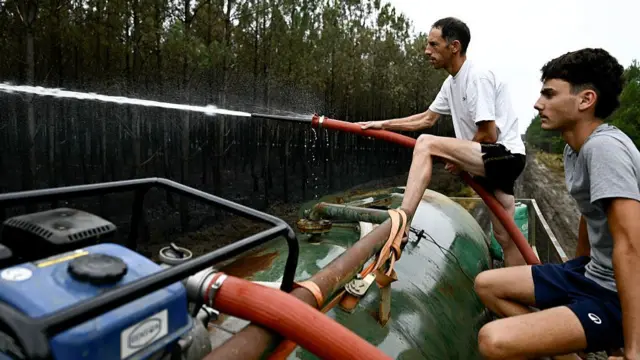
    Farmers spray water on hotspots to help firefighters battle the wildfire in Saint-Jean-d'Illac, west of Bordeaux, on July 27, 2026, during wildfires in the Gironde region, southwestern France.Image source, Getty Images
    Image caption,

    West of Bordeaux, in Saint-Jean-d'Illac, farmers have been helping firefighters tackle blazes in the Gironde region

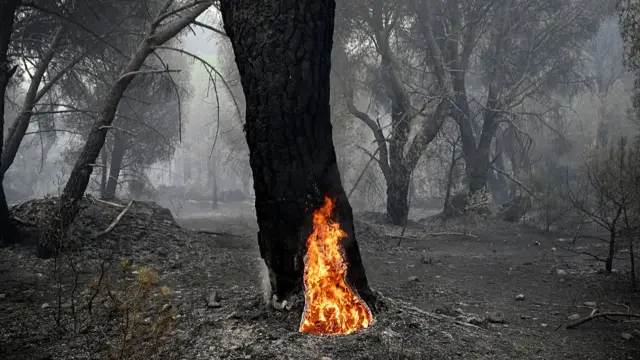
    A large pine tree with its hollowed trunk still burning from the inside, is seen in a scorched forest following a wildfire near La Adrada, 95 kilometres west of Madrid, on July 27, 2026.Image source, Getty Images
    Image caption,

    Further south in Spain, fires scorched and continue to burn through forests in La Adrada, west of Madrid

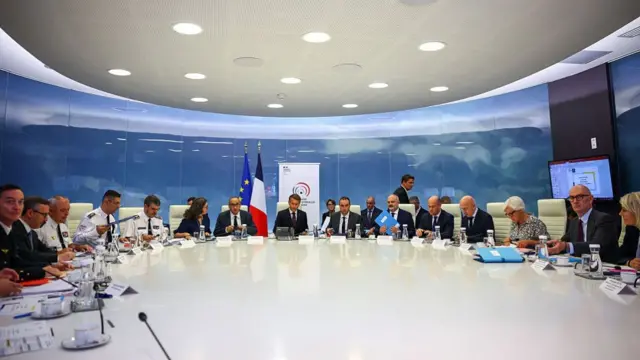
    France's President Emmanuel Macron (C), France's Prime Minister Sebastien Lecornu (C-R), France's Interior Minister Laurent Nunez (C-L) attend a meeting with other members of the cabinet and Civil Security to discuss wildfires in the country, at the Hotel de Beauvau, the French Interior Ministry, in Paris on July 27, 2026.Image source, Getty Images
    Image caption,

    French President Emmanuel Macron has been holding a crisis meeting in Paris to discuss the government's response as wildfires continue to scorch parts of the country

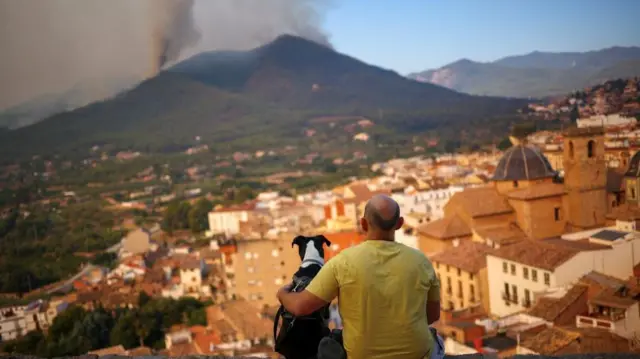
    A man and his dog look at a wildfire in a mountain in Onda, Spain, July 27, 2026.Image source, Reuters
    Image caption,

    Thousands of people have been displaced and while some fires have been contained, hot and dry weather is likely to persist - increasing the risk of other wildfires

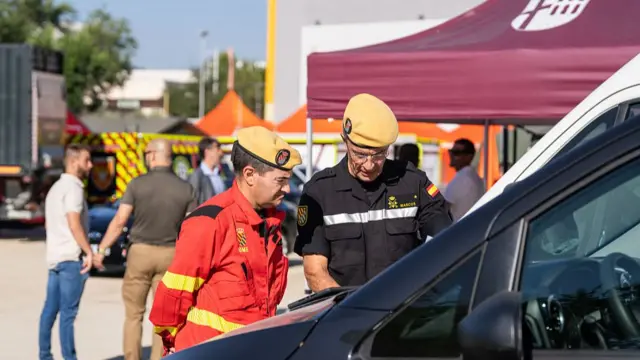
    Two officers from the Military Emergency Unit (UME) are working at the Forward Command Post (PMA) in Navalcarnero, on 27 July, 2026 in Navalcarnero, Madrid, Spain.Image source, Getty Images
    Image caption,

    Spanish PM Pedro Sánchez says more than 150,000 hectares have burned across Spain since January - an area six times larger than during the same period last year

  6. Is climate change to blame?published at 15:13 BST

    Mark Poynting
    Climate reporter

    A massive wildfire struck the Gironde department of southwestern France on July 27, 2026.Image source, Getty Images

    There is no single reason why these fires are so intense, but scientists are very confident that climate change is playing a role.

    Most wildfires are started by humans, whether deliberately or accidentally. But climate change means we're seeing more of the weather conditions conducive to the spread of fires.

    Intense heatwaves – like we have seen repeatedly this summer - draw extra moisture out of soils and vegetation.

    These tinder-dry conditions help fires to spread at speed, especially if winds are strong. This can lead to larger, more intense fires than might have happened otherwise.

    The UN’s climate panel expects these “fire weather” conditions to become even more common in the Mediterranean as the planet continues to warm.

    But there are lots of other factors in addition to climate change. In recent months rainfall has been lower than average across much of south-western Europe - which is thought to be down to natural variability.

    And some researchers have long warned that the Mediterranean’s forests and scrublands are not being properly managed – leaving plenty of vegetation as fuel for fires.

  7. Are you affected by the fires? Have your holiday plans changed?published at 14:55 BST

    Are you a resident or tourist who has been affected by the European wildfires, or did you have plans to visit the area? If it is safe to do so, get in touch.

    You can get in touch in the following ways:

    Please read ourterms & conditions andprivacy policy

    In some cases, a selection of your comments and questions may be published, along with your name and location as provided, unless you request otherwise. Your contact details will never be published.

    A purple horizontal banner shows the words 'Your Voice'
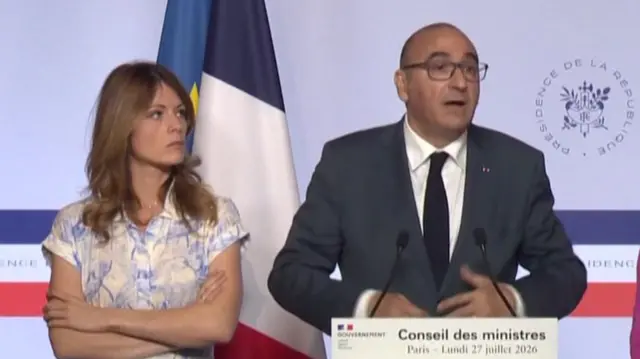
  8. Fire has 'a life of its own', says French interior ministerpublished at 14:51 BST

    Laurent Nuñez, Interior Minister gives a news conferenceImage source, EVN
    Image caption,

    Interior Minister Laurent Nuñez gives an update on the wildfires

    France's Interior Minister Laurent Nuñez says firefighters are facing an "unprecedented" situation in Gironde, battling a fire that "has a life of its own".

    Speaking after a government crisis meeting, he says weather conditions and the composition of the forests are causing the wildfire to behave "in a completely erratic manner".

    "It is autonomous, self-sustaining, and spreads in all directions. So it is a fire that's difficult to control," says Nuñez.

    He says it has burned through 40,000 hectares of land already - nearly double the total area that was burned by Gironde wildfires in 2022.

  9. Plans to travel to France or Spain? Here's what you need to knowpublished at 14:37 BST

    Mitchell Labiak
    BBC Business reporter

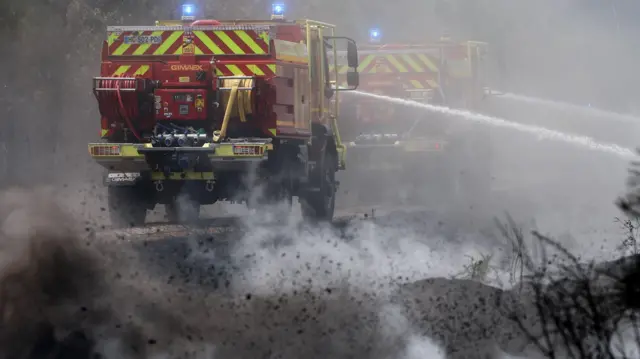
    Two fire engines travel down dirt road and spray water into scrublandImage source, Reuters

    Should I travel to France or Spain right now?

    The UK government has not specifically warned against travel to anywhere in France or Spain, but it does advise caution.

    For those in an affected area of France or Spain or planning to travel there, the UK government recommends following instructions and updates from local authorities and emergency services at all times.

    Does travel insurance cover wildfires?

    The answer depends on your policy.

    "If your travel plans are disrupted by a wildfire and your policy includes trip disruption cover then travel insurance may cover some of the resulting costs," says Chris Bose, director of general insurance policy at the Association of British Insurers (ABI).

    However, only half of travel insurance policies have "catastrophe" cover, according to analysis from Defaqto.

    What should I do if my airline or accommodation cancels my booking?

    In the case of cancelled flights or accommodation, Bose recommends seeking refunds from your airline, tour operator or accommodation provider in the first instance.

    Duthie says if your airline cancels your flight due to wildfires then "they should offer you the chance to rebook, or provide a full refund".

  10. Not enough firefighters in all of France to deal with this, says Gironde officialpublished at 14:18 BST

    There may not be enough firefighters and trucks to station all around the Gironde wildfires, the president of the departmental council tells the BBC.

    Speaking on the World at One, Jean Luc Gleyze welcomes the influx of equipment and personnel into his region, but says more would be needed.

    "It's not possible now to put firefighter trucks every 100 metres or 300 metres all around the fire. It's not possible. We don't have enough people and enough trucks and even I think France don't have enough."

    Gleyze, who oversees fire and rescue services in the area, also calls for authorities and land owners to review the management of forests, with alternatives to pine trees included in woodland.

    "I think the people owning forests need to have a kind of diversity in the trees they will plant, because the trees with leaves burnt less than pine woods," he adds.

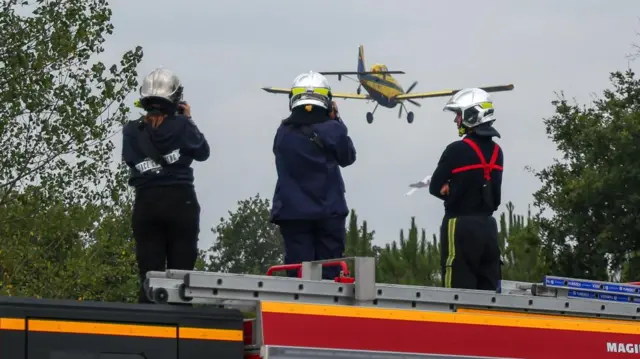
    People wearing helmets standing on top of a fire engine as a small plane flies overheadImage source, Reuters
  11. How wildfires spewing flames can create their own stormspublished at 14:00 BST

    Wildfires near Bordeaux have created their own thunderstorm.

    The BBC's France correspondent Hugh Schofield explains the science behind the phenomenon.

    Media caption,

    How wildfires spew flames and create their own storms

  12. British tourists could lose thousands from aborted Gironde holidaypublished at 13:47 BST

    Alex Emery
    BBC Your Voice

    Sarah, from Hertfordshire, and her sister-in-law Georgia, from Kent have been speaking to BBC News about their planned family holidays in and near Bordeaux.

    Sarah and her family arrived in Bordeaux on Friday but soon realised they would be unable to remain there for the week because the smoke was so thick.

    "We had gone down to the river in Bordeaux, and by the time we got back the smoke was so thick.

    "We sealed all the apartment up, but it still had a really strong smell of smoke everywhere. It was quite worrying," she says.

    Georgia had been due to travel to the region when her sister-in-law got in touch to say how bad the smoke had got in Bordeaux.

    "We realised late on Friday night that we wouldn't be able to go there, so quickly changed our plans and booked somewhere to stay in the Loire region to save our holiday," Georgia says.

    But she says that despite advice from local officials not to travel to the area, their accommodation operator won't give a full refund because the fire hadn't yet reached Lacanau where they were due to stay.

    "If we don't find a solution with them we currently stand to lose over £3,500," she adds.

    A group of eight people pose for a photo with the grounds of Chateau Villandry behind them
    Image caption,

    Sarah and Georgia's families made it to the Loire Valley over the weekend and have visited Chateau Villandry

    BBC Your Voice graphic on a purple background
  13. Macron will visit Gironde region this afternoonpublished at 13:31 BST

    Fire engines carry out edge protection and mop-up operations on a wildfire in Marcheprime, in the Gironde region, amid worsening drought conditions following a heatwave and water shortages across much of France, July 27, 2026.Image source, Reuters
    Image caption,

    France's Gironde region has been badly hit by this summer's wave of wildfires

    French President Emmanuel Macron is heading to wildfire-hit Gironde region this afternoon, the presidential palace has said.

    Macron will meet local officials, firemen and emergency services during his visit, where he plans to thank them.

  14. BBC Verify

    Satellites show wildfire damage near Bordeauxpublished at 13:22 BST

    By Thomas Spencer

    BBC Verify has been looking at satellite imagery that shows the spread of wildfires west of the city of Bordeaux in France’s Gironde region.

    Satellite imagery taken on 26 July reveals a large area of countryside has been burnt. Data from the EU’s Copernicus Sentinel-2 satellite’s burned area detector tool also shows swathes of scorched land close to the coast.

    This Flourish post cannot be displayed in your browser. Please enable Javascript or try a different browser.

    Data compiled by Google Maps, external also reflects the large area that is estimated to have been affected by the Gironde wildfire with major roads closed in its wake.

    Another online tool, the French reporting app Feux de Foret, external, is also tracking the fires that have led to more than 200,000 people having to leave their homes.

  15. Dry and hot weather in Spain means wildfires will continue to burnpublished at 13:12 BST

    Elizabeth Rizzini
    Lead weather presenter

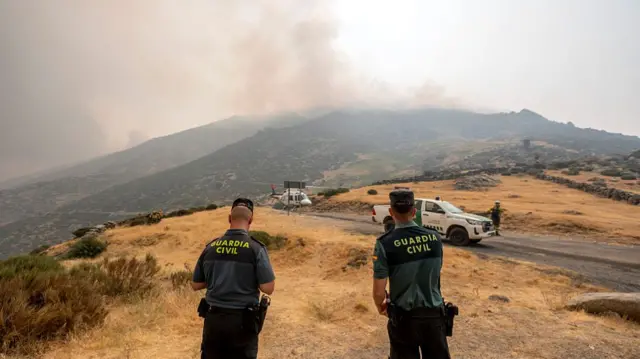
    Two guards watch a wildfire on a hillside in SpainImage source, Getty Images

    As in France, high pressure will dominate in Spain meaning dry, settled and increasingly hot conditions, favourable for more wildfires to develop and for the current fires to stay burning.

    There could be some isolated showers and thunderstorms on Thursday across eastern Spain and the far north but other than that it will stay dry throughout the week.

    By Saturday there is a greater chance of a few showers for central and eastern areas but again they will be localised.

    Temperatures will rise further over the next few days across the interior of the peninsula into the high 30s or low 40s.

    As in France, the winds will remain light for most under the area of high pressure, although a keen easterly breeze could affect the Costa del Sol.

    There are still likely to be localised effects within the regions affected by the wildfires, which can also generate their own winds.

  16. PM Sánchez warns of 'difficult hours' ahead in Spainpublished at 13:00 BST

    Sergi Forcada Freixas
    Reporting from Spain

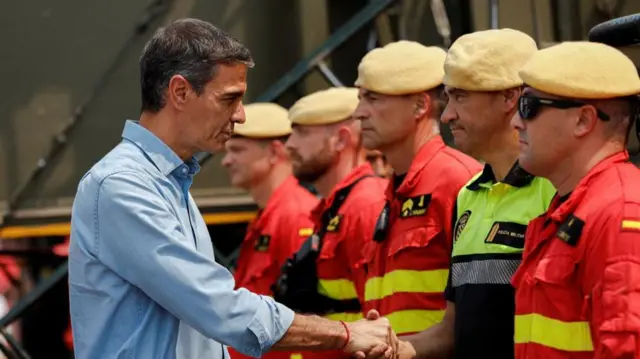
    Spanish Prime Minister Pedro Sanchez meets members of emergency services as he visits an area affected by a wildfire in La Vall d'Uixo, Castellon province, Spain, July 27, 2026.Image source, Reuters

    Spanish Prime Minister Pedro Sánchez has visited the emergency command centre in Vall d’Uixó, near Valencia, where a wildfire remains out of control.

    Sánchez warns “difficult and complex hours” still lie ahead and that temperatures are expected to rise in the coming days.

    “I ask for understanding and for everyone across the country to exercise the utmost caution and prevention,” he says

    Sánchez adds that around 150,000 hectares have been burned across Spain so far this year, six times the area destroyed by wildfires at the same point in 2025.

    Earlier, Sánchez said "urgent solutions" were needed to build a safer Spain that is prepared for future challenges. He also unveiled €10m (£8.6m) in funding for new climate shelters, including for educational centres.

  17. Analysis

    Climate change allows wildfires to spread faster and burn more fiercelypublished at 12:46 BST

    Justin Rowlatt
    Climate editor

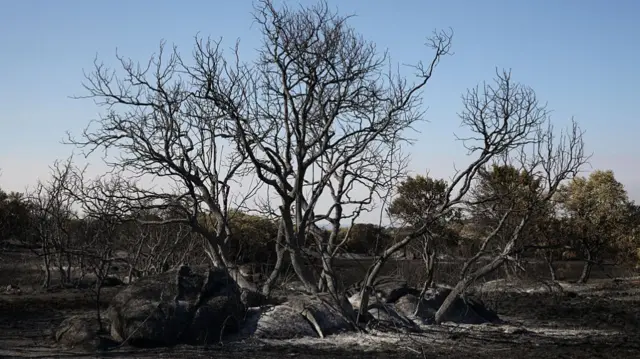
    Burnt and blackened trees are shown against a blue sky in Spain.Image source, Getty Images

    The question is no longer why has so much land already burned this fire season, but why these fires have become so fierce and difficult to control.

    Part of the answer lies in the sequence of weather this year.

    An unusually wet winter encouraged abundant vegetation growth. A dry spring and early summer, followed by repeated heatwaves, then dried much of that vegetation into tinder.

    Grasses, leaves and small branches can ignite quickly, while the prolonged heat has also drawn moisture from larger shrubs, trees and deeper forest litter, allowing fires to burn hotter and for longer.

    Strong and shifting winds can help flames spread unpredictably. But large fires can also generate their own winds. The intense heat creates an updraft that draws in more air at ground level and can fan the fire further.

    Europe is the fastest-warming continent and while climate change did not provide the sparks that started these fires, it is making the hotter, drier conditions that allow fires to spread faster and burn more fiercely more likely.

  18. 'A wall of orange flames came roaring up over the hill'published at 12:30 BST

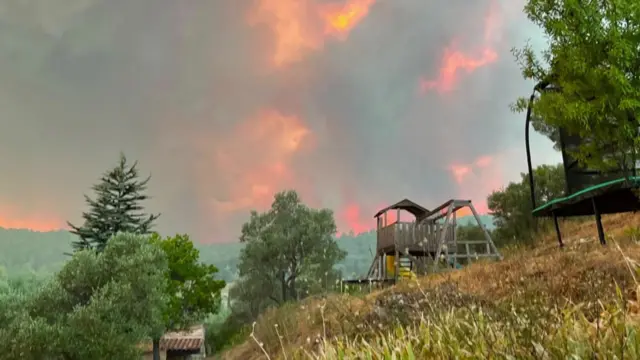
    Play equipment on a wooded hillside with a smoke and flame filled skyImage source, Jo Barnes

    Jo Barnes and her family had a near miss when a wildfire near the town of Cotignac in southern France came within metres of her house.

    They first saw smoke on Tuesday and were initially told by emergency services that the fire was under control, but by the evening it had changed direction and rapidly moved towards her property.

    "A wall of orange flames came roaring up over the hill," Barnes tells BBC News, forcing them to leave their house quickly and stay away for four days.

    "On Friday afternoon the fire came back to our area... within 10 metres of the back of our house, we have a gas tank here, it was all very dramatic."

    She describes how the family returned on Saturday afternoon "fearful about what we would find", but luckily their house was intact despite the surrounding hillside being burnt and completely black.

    The town of Cotignac was also undamaged by the fire, with people now just trying to get back to normal, Barnes adds.

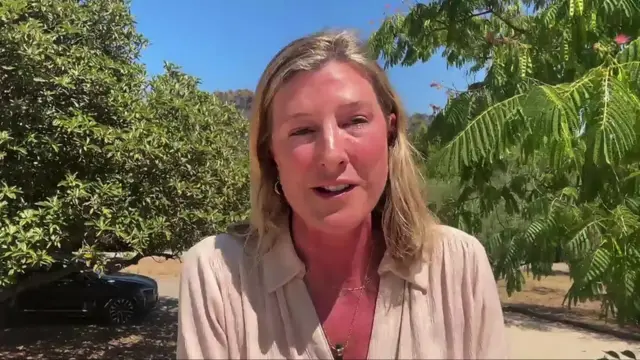
    A woman with long blonde hair sits in the sunshine with trees and a car behind her
  19. In France, the weather is only set to worsen wildfire conditionspublished at 12:21 BST

    Elizabeth Rizzini
    Lead weather presenter

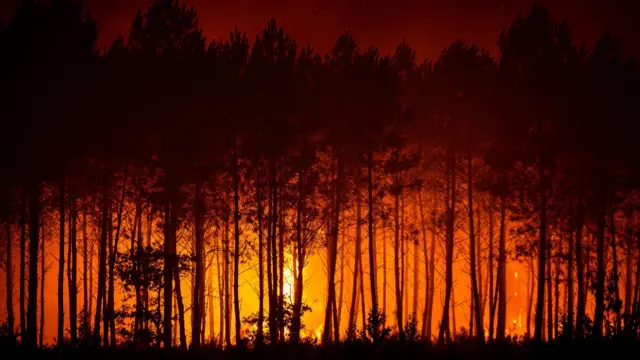
    A view of fire through silhouettes of treesImage source, EPA/Shutterstock

    In France, weather conditions will not help contain the wildfires and may worsen the situation.

    High pressure remains dominant for much of the week which means dry, settled conditions and little rain, but possibly some very isolated showers and thunderstorms.

    There have been a few showers overnight which have made little difference to the wildfires on a weakening weather front. It'll be dry across the whole of France by this afternoon with temperatures in the Bordeaux region in the high twenties in Celsius.

    But it will get hotter. Temperatures by Tuesday in the west will be in the low to mid 30s, the low 40s being possible by Wednesday. Brisk winds fan the flames and make wildfires worse.

    On Wednesday into Thursday there could be a few scattered showers across central France but the dry and hot theme continues until Friday.

    There may well be more showers on Saturday across central and southern France but many places will remain completely dry.

    While the winds remain light through the week they will shift in direction as the area of high pressure moves around and this could help to spread the fires in slightly different directions.

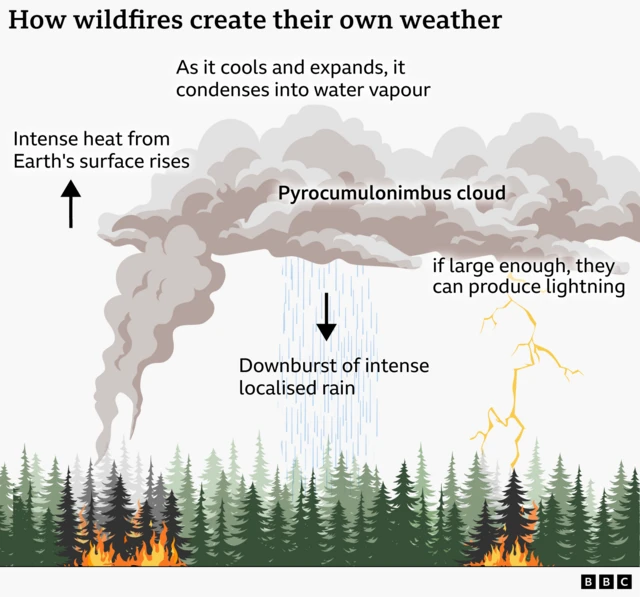
    There will be localised effects too, including the fact that wildfires can generate their own winds when huge fire thunderstorm clouds form, which are known as pyrocumulonimbus clouds.

    Infographic titled “How wildfires create their own weather.” Flames burn in a forest at the bottom of the image. A large column of hot smoke rises from the fire into a broad pyrocumulonimbus cloud. Labels explain that intense heat from Earth’s surface rises, then cools, expands, and condenses into water vapour. Rain falls from the cloud in a concentrated downburst of localised rain, and a lightning bolt on the right illustrates that large pyrocumulonimbus clouds can also produce lightning, potentially igniting new fires. BBC logo in the lower-right corner.
  20. Specialist aircraft used to slow spread of wildfirespublished at 12:09 BST

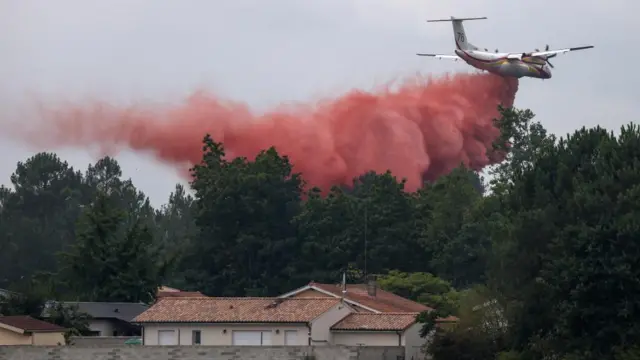
    A plane flying over a house and trees dropping fire retardant in south west FranceImage source, Reuters
    Image caption,

    A Bombardier Dash 8 Q400 MR aircraft drops fire retardant over a forest near Bordeaux on Monday

    Specialist aircraft are being used to battle wildfires in France, dropping fire retardant on vegetation and land where the wildfires are burning.

    The retardant works by depleting the fire of oxygen and slowing the rate of fuel combustion.

    It is usually sprayed around a wildfire on vegetation and land that is fire-prone to stop the flames from spreading to that area.

    The repeated use of the bright substance also acts as a visual aid for pilots and firefighters, as after a few days it can fade due to sun exposure.

    A plane flying over trees dropping fire retardant in south west FranceImage source, Getty Images