Summary

  • Temperatures in parts of England could hit 38C (100F) today as the UK's fifth widespread heatwave this year peaks

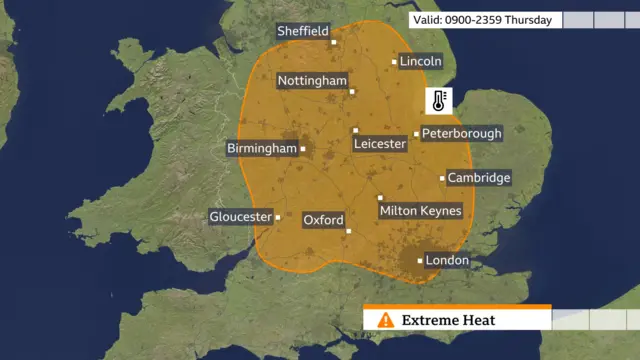
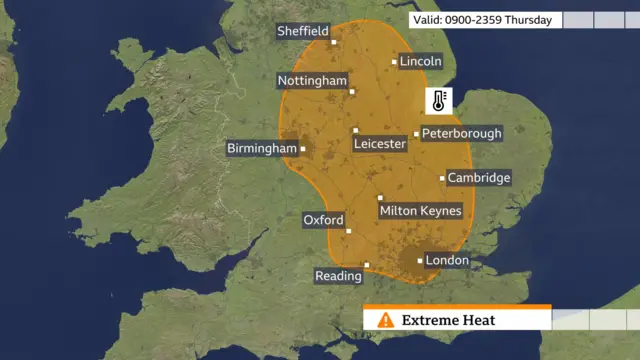
  • An amber extreme heat warning has been expanded to areas in England further west and is in place until 23:59 tonight

  • Scotland and Northern Ireland will have more cloud with the chance of showers in some areas - here's the latest UK forecast

  • Meanwhile A&Es in England are experiencing their busiest summer ever with health workers describing "dripping with sweat from head to toe" during the record-breaking heat

  • The last time temperatures rose above 36C in August was 2020, when 36.4C was recorded at Heathrow and Kew Gardens

  • This latest spell of extreme heat comes after the Met Office warned this summer is on course to be the UK's hottest since records began

How are you coping with the heat?

  1. More than 45 million people living in a drought area in Englandpublished at 11:00 BST

    Some 71.3% of England is now in drought, the Environment Agency announced on Monday.

    The East Midlands, Lincolnshire and Northamptonshire, Kent and East Sussex, and Solent and the South Downs were moved into drought status, joining seven previously-announced areas in England and the whole of Wales.

    A total of 45 million people are now living in a drought area in England, with more than 27 million facing water use restrictions, the Environment Agency said.

    Yorkshire and the North East were moved to a "prolonged dry weather" status, the stage before drought, meaning nowhere in England is currently under a "normal" status.
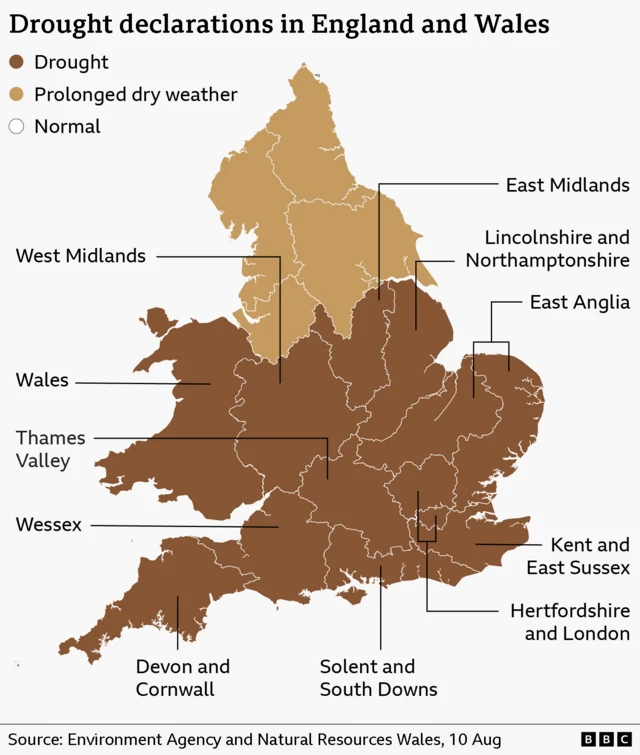

    A map of England and Wales which shows all of Wales, southern England and the Midlands are now in drought, with Yorkshire and north-east England in "prolonged dry weather" status
  2. Temperatures hit 30C - for 38th day in UK this yearpublished at 10:49 BST

    Darren Bett
    Lead weather presenter

    Temperatures have now reached 30C at Charlwood and Kenley in Surrey, and Herstmonceux in East Sussex.

    That makes 38 days now that the temperature has hit 30C in the UK this year.

    For context the previous record was 34 days in 1995. Last year there were 16 days and in the summer of 1976 there were 24 days.

    Another example that climate change is making extreme weather more likely, more extreme, and lasting longer.

  3. Thousands of Thames Water customers without running water as temperatures risepublished at 10:39 BST

    Harry Low
    BBC London News

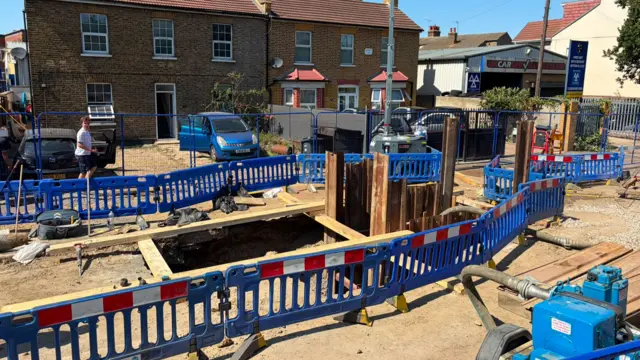
    Roadworks shows hole in ground and red/white/blue fences around it

    Thousands of households in east London and Essex affected by a major water outage are expected to have supplies restored by Friday after Thames Water completed repairs to three burst mains.

    It's nearly a week since about 10,000 homes were left with low water pressure or no water after a series of bursts in South Woodford last weekend.

    The water company had previously told residents it would be fixed by Wednesday and Thursday having said the broken pipes "are proving to be more difficult to repair than first thought".

    Many have expressed anger as they join long queues at bottled water stations, demanding refunds.

    Thames Water said it was "working towards all customers being back in supply by Friday", although it warned recovery times would vary depending on how quickly the network stabilised. The company said some households could regain water sooner.

    It has repeatedly apologised for the outage, and said it would "continue to deliver to customers who are registered as water dependent on our priority services register" - but some customers on the register told the BBC on Tuesday that this had not happened.

  4. Firefighters tackle New Forest wildfire for fifth straight daypublished at 10:27 BST

    Toby Wadey
    BBC South

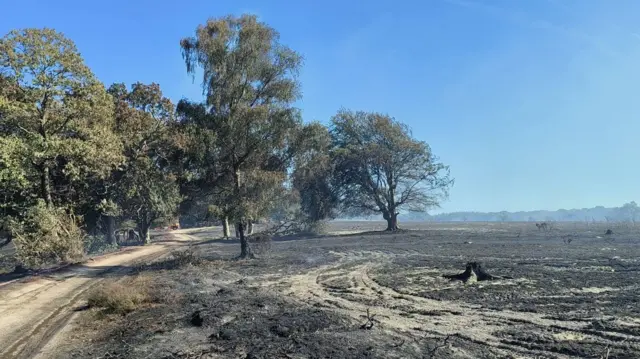
    Trees next to a barren landscape in the New Forest that has been hit by wildfiresImage source, Forestry England

    Firefighters are battling a wildfire in Hampshire's New Forest National Park for a fifth day.

    The blaze has burned through 1.6 sq km (400 acres) of heathland, an area roughly the size of 230 football pitches.

    Crews say the fire's perimeter is now under control, but motorists have been warned about smoke affecting nearby roads this morning.

    Temperatures in the area are expected to reach 31C later, raising concerns that conditions could hamper efforts to fully extinguish the fire.

  5. Met Office expands amber warning area as high temperatures expected further westpublished at 10:18 BST
    Breaking

    Darren Bett
    Lead weather presenter

    The Met Office has expanded the area covered by its amber extreme heat warning further west.

    The length of the warning has not changed and still remains in place until 23:59 today.

    In its update, the Met Office says: "The highest temperatures will be in parts of the the Midlands and western England, where 37C or even 38C could be reached."

    A map showing an amber warning - updated to cover more parts of western England
  6. Highest ever A&E numbers in England, as figures suggest heat-related deaths almost doubled in May and Junepublished at 10:08 BST
    Breaking

    Nick Triggle
    Health correspondent

    A&Es in England are experiencing their busiest summer ever – with the record-breaking heat cited as a key factor.

    Last month 2.49 million people attended emergency departments – the highest ever.

    That came after May and June each saw more than 2.4 million attendances, meaning the three highest totals have come in the past three months.

    Alongside the risk of dehydration and heatstroke, a bout of extreme heat raises the chances of complications from chronic conditions like advanced heart, kidney and respiratory failure.

    Preliminary figures suggest there were more than 2,800 heat-related deaths in May and June – almost double the total for last year.

    NHS medical director Prof Frankie Swords praised the "outstanding professionalism" of staff in what she admitted were challenging conditions.

    Unions have described what they say are inhumane conditions for staff with some having to work in buildings with poor ventilation and no air conditioning.

    The Royal College of Nursing said it had had reports of nurses collapsing and others with pre-existing health conditions having seizures.

    The pressures have been further complicated by equipment breaking down, including scanners and IT systems.

  7. Your pictures as England wakes up to another scorching daypublished at 09:53 BST

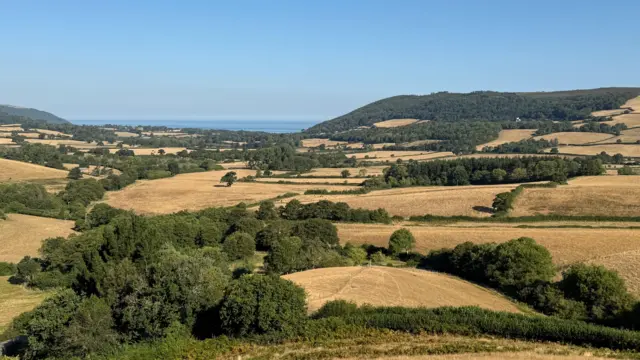
    A wide view of rolling fields - all yellow - with trees dotted in betweenImage source, BBC WEATHER WATCHERS/SPARKY
    Image caption,

    It's a sea of yellow in Somerset as fields feel the heat

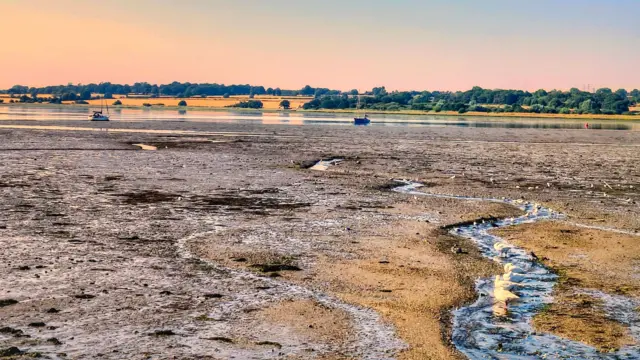
    A dry estuary with the tide out in EssexImage source, BBC WEATHER WATCHERS/MR BLUE SKY
    Image caption,

    The scene in Mistley, Essex, as the sun rose this morning

    A dog paddles in the sea in West SussexImage source, BBC WEATHER WATCHERS/CLAIRE AND BELLA
    Image caption,

    This pooch in West Sussex followed the advice and got their morning dip in early - the RSCPA recommends not walking dogs during the hottest parts of the day

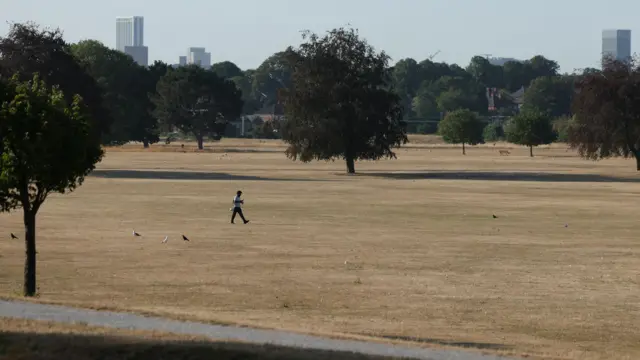
    A person walks across yellow grass with trees visible an Birmingham's skyline in the backgroundImage source, EPA/Shutterstock
    Image caption,

    Parkland in Birmingham is looking parched as an amber warning covers parts of the Midlands today

  8. Temperatures already in the high 20s in Englandpublished at 09:28 BST

    Darren Bett
    Lead weather presenter

    Temperatures are rising rapidly this morning because of the dry ground, light winds and strong sunshine.

    Here are the highest recorded temperatures as of 09:00 this morning:

    • Coleshill 27.4C
    • Benson 27.0C
    • Nottingham 26.8C
    • Manchester Airport 26.0C
  9. Analysis

    Scientists look at the climate signal in all this heatpublished at 09:26 BST

    Matt McGrath
    Environment correspondent

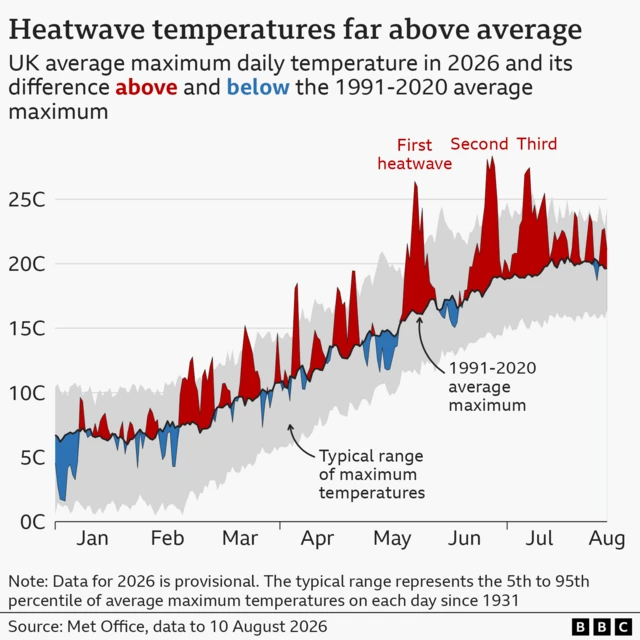
    The UK has recorded a day at or above 35C in four consecutive months: May, June, July and August.

    That's something we've not seen before.

    Until this year the UK had never reached 35C in the month of May at all, but that threshold was breached at Kew Gardens on 26 May.

    June then brought 38C, while July topped 35C twice, and the benchmark was broken again yesterday.

    What matters to climate scientists in all these individual hot days is the pattern that emerges, and this summer it's been striking.

    Today's forecast could well run around 7C above the long-term benchmark, the 1961-1990 average.

    That is an astonishing figure.

    While no single event can be pinned on climate change on its own, what we've seen this year is broadly what scientists have long warned of: major heat events, that were once rare, now arriving one after another.

    A graph showing UK average maximum daily temperatures in 2026 so far, and how it compares with the long-term average. A black line shows increasing average maximum temperatures between January and June as winter progresses to summer. A wider grey area above and below this line shows the typical range of these maximum temperatures for each date since 1931. Maximum daily temperatures for 2026 are also shown as a thin grey line which goes above and below the average. Where temperatures in 2026 have been above average the area is shaded red; where temperatures have been below average the area is shaded blue. Most of the year has had above-average temperatures, with below-average temperatures less common. Two red spikes in late May and late June are significantly higher than even the highest values in the typical range, roughly 10C above average for the time of year. There have been further spikes in July and August.
  10. A closer look at what an amber extreme heat warning meanspublished at 09:11 BST

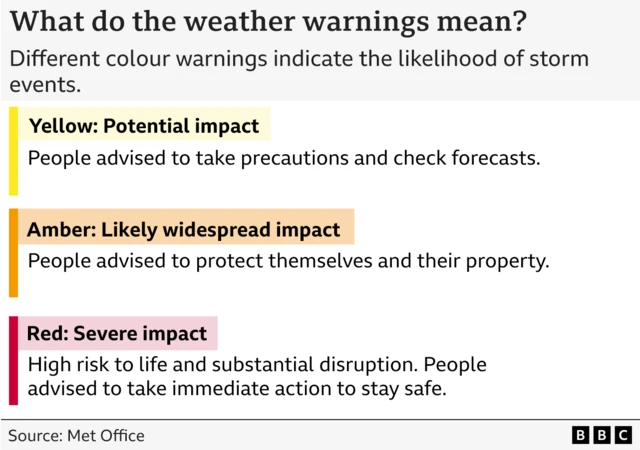
    Weather warnings are issued by the Met Office for severe weather - this can be due to rain, snow, wind, thunderstorms, lightning, fog, ice or, in today's case, extreme heat.

    An amber extreme heat warning - the second most severe warning issued by the Met Office - is in place for large parts of England today.

    Until 23:59 today, that means:

    • People - particularly those vulnerable to heat - could become ill, and there's also a wider risk of sunburn or heat exhaustion
    • More people are likely to visit coastal areas, leading to an increased risk of water safety incidents
    • There could be delays to trains and on the roads
    • Some heat sensitive equipment could fail - possibly leading to power cuts and the loss of other services
    A graphic showing the different types of weather warnings and what they mean
    Image caption,

    A quick overview of the Met Office's weather warning system

  11. Two amber heat warnings now in effect across Englandpublished at 09:03 BST

    Darren Bett
    Lead weather presenter

    The amber extreme heat warning issued by the Met Office runs from 09:00 to 23:59 and warns of impacts on transport, infrastructure and health.

    The area covered includes parts of Yorkshire, Lincolnshire, the Midlands, East Anglia and southeast England. Maximum temperatures in this area could be 37C or 38C.

    A map showing the areas where an extreme heat warning has been issued
    Image caption,

    The Met Office has issued an "extreme heat" warning for parts of England

    There is also amber heat health alert for the whole of England until 09:00 on Friday.

    This is issued to Public Health England to help health authorities prepare for an increase in admissions relating to high temperatures.

    You won’t find an alert for Wales, Northern Ireland or Scotland as this service only applies to England.

  12. Amber extreme heat warning comes into effectpublished at 09:00 BST
    Breaking

    An amber "extreme heat" warning, issued by the Met Office, has just taken effect.

    This means from now until 23:59 tonight, extreme heat is expected across large parts of England, which could impact health, infrastructure and travel.

    We'll bring you more on which areas are covered by the warning in our next post.

  13. 'Dripping with sweat': Health workers criticise working conditions in heatwavepublished at 08:51 BST

    Nick Triggle
    Health correspondent

    Conditions for staff and patients in the NHS and care sector have been undoubtedly difficult.

    This morning the Royal College of Nursing has released testimonies from its members who said they had been suffering during the heatwaves.

    They reported having to deliver care without access to air conditioning, fans or even windows that open.

    Members reported "dripping with sweat from head to toe", with one claiming to have collapsed from dehydration after working a long shift on a ward with no ventilation.

    Two members with pre-existing conditions reported having seizures brought on by the heat.

    It came after Unison, which represents ambulance workers, criticised conditions last week.

    The union said its members had reported being sent out in ambulances in stifling heat - often with limited access to drinking water or toilet facilities.

    One ambulance technician from Birmingham told the union working in the heat was "vile".

    "We have one uniform whether it's -10C or 30C. You're sweating even when you're just driving."

  14. A very difficult summer for the NHSpublished at 08:45 BST

    Nick Triggle
    Health correspondent

    This has been, arguably, the most difficult summer for the NHS in its history.

    In fact, the pressures, particularly in A&E, have been described as bad as they are in winter.

    England’s NHS medical director Prof Frankie Swords said the health service has had to deal with a summer "onslaught" – with the heatwaves and World Cup combining to create huge stresses.

    June saw the most visits ever to A&E per day – over 80,000 on average. And this could well be beaten later on Thursday when the figures for July get released.

    Alongside the risk of dehydration and heatstroke, a bout of extreme heat raises the chances of complications from chronic conditions like advanced heart, kidney and respiratory failure.

    The pressures have been further complicated by equipment breaking down, including scanners and IT systems, while working conditions for staff have been described as inhumane as the NHS has struggled to keep buildings cool.

  15. All the records that have been broken so far this summerpublished at 08:35 BST

    Darren Bett
    Lead weather presenter

    Here are the records that have been broken (so far) this summer:

    • 37 days of 30C heat
    • Eight days of 35C heat
    • Four calendar months in a row to record 35C
    • Highest June temperature of 38C
    • Driest July in England and Wales

    All of these are in line with evidence that summers are getting hotter and are likely to become drier because of climate change.

    Even if temperatures during the rest of August remain "average", the Met Office still expects this summer to be the hottest ever, beating the previous record set just last year.

  16. Send us your updates, pictures and tipspublished at 08:31 BST

    How are you being affected by the heatwave? Tell us how you are coping with the heat, and send us your pictures.

    You can share your experiences with us in the following ways:

    Please read ourterms & conditions andprivacy policy. In some cases a selection of your comments and questions will be published, displaying your name and location as you provide it unless you state otherwise. Your contact details will never be published.

    Your Voice banner
  17. What's the latest UK forecast?published at 08:26 BST

    Darren Bett
    Lead weather presenter

    Scotland and Northern Ireland will have more cloud with the chance of showers and even some longer spells of rain in north-west Scotland.

    With some sunshine in eastern areas it will be very warm though with temperatures of 26C to 28C and it may feel more humid.

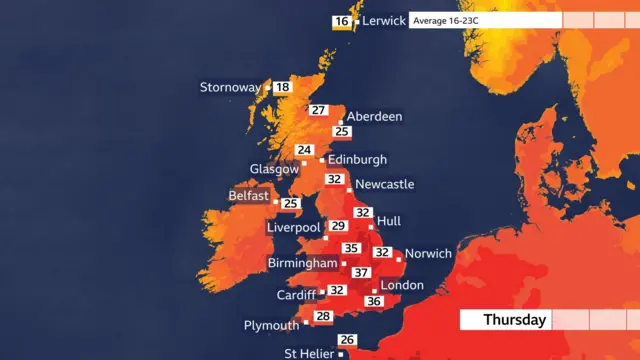
    England and Wales will be hotter with light winds and strong sunshine with little or no cloud. Temperatures will widely reach 30C to 34C.

    Parts of the Midlands, East Anglia and south-east England will be hotter with 35C to 37C likely.

    It is possible the temperature could reach 38C – equalling the highest temperature of this year that was recorded in late June.

    UK map widely coloured in deep oranges and red to denote the hottest day of the week with temperatures of 27 in northern Scotland, 25C in Northern Ireland, 32 C in Wales and 37 in England noting the August averages of 16 to 23 C
    Image caption,

    Forecast temperatures for the peak of the heat on Thursday

  18. Temperatures could reach 38C in England as latest heatwave peakspublished at 08:20 BST

    Rachel Flynn
    Live reporter

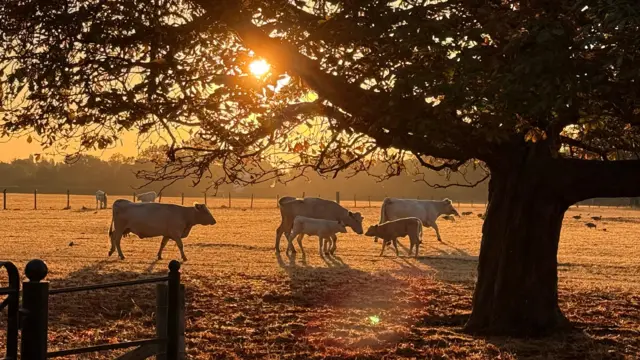
    Cows seek shade as sun rises in a field in OsterleyImage source, BBC WEATHER WATCHERS/ARCCLOUD9
    Image caption,

    Cows in Osterley, London

    It could be another record-breaking day, with temperatures in some parts of England likely to hit 37C - and possibly even 38C.

    The last time we saw temperatures above 36C in August was 2020.

    It's expected to be warmest in the east, south-east and the Midlands in England, according to the Met Office, with an amber extreme heat warning in place from 09:00 BST.

    We'll have updates throughout the day, along with the tips and tricks to stay cool.