Summary

  • Donald Trump says as part of the US's deal to end the war, Iran will "never have a nuclear weapon"

  • Speaking at the G7 summit in France, the US president also renews criticism of Israel's strikes on Lebanon, saying: "You don't have to knock down an apartment house every time you're looking for somebody"

  • Pakistan, a key mediator, announced on Sunday that the US and Iran had reached an agreement but its full details are yet to be shared - here's what we do know

  • On Monday, Trump administration officials said the deal had already been signed electronically by both sides - a formal signing ceremony is due to take place in Geneva, Switzerland on Friday

  • Also at the G7 summit, PM Keir Starmer says the UK will play its "full part" in getting the Strait of Hormuz open - here's a quick guide to the oil shipping route

  1. Conflicting messages on details of deal from US and Iranpublished at 12:39 BST

    Nabiha Ahmed
    Live reporter
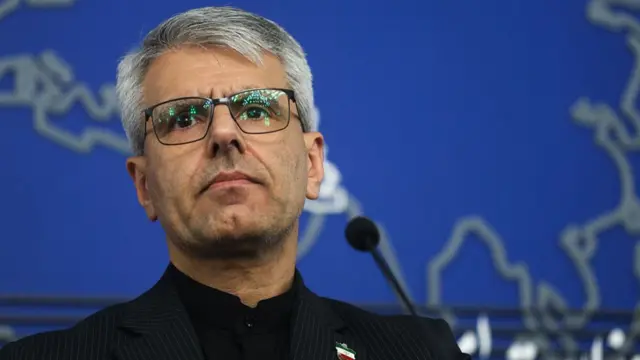
    Esmail Baghaei Hamaneh, spokesperson of Foreign Ministry seen during his weekly press conference.Image source, Getty Images
    Image caption,

    Baghaei discussed economic sanctions, the Strait of Hormuz, and Israeli military presence in Lebanon during a press conference yesterday

    The contents of a deal between the US and Iran to bring about an end to the war are yet to be released, but we've been hearing some details from officials on both sides.

    Since the deal was announced on Sunday, there have been conflicting messages from officials in Washington and Tehran on what it will look like:

    What has Iran said?

    Economic pledges: Iran'sforeign affairs spokesperson Esmail Baghaei said yesterday the US has committed to taking action to rebuild Iran and to lifting economic sanctions.

    The Strait of Hormuz: Baghaei also said that Oman and Iran would be taking "necessary measures" to ensure the "safe" passage of ships through the vital waterway.

    Lebanon: "Lebanon and the end of the war in Lebanon are an inseparable part of the agreement to end the war," Baghaei said yesterday, adding that the the US "must ensure" that Israel follows suit.

    What has the US said?

    Economic pledges:Trump has described the prospect of investing money in Iran as "ridiculous". It comes after reports that the US was prepared to allow an investment fund for Iran in exchange for Tehran’s agreement to a final settlement.

    The Strait of Hormuz: Trump said on Sunday the Strait of Hormuz would be opened when the initial agreement was signed, but has not provided details on who will control the strait.

    Lebanon: A senior US official said yesterday that Israel's withdrawal from Lebanon is not part of the deal.

  2. What we know about the US-Iran deal to end the warpublished at 12:21 BST

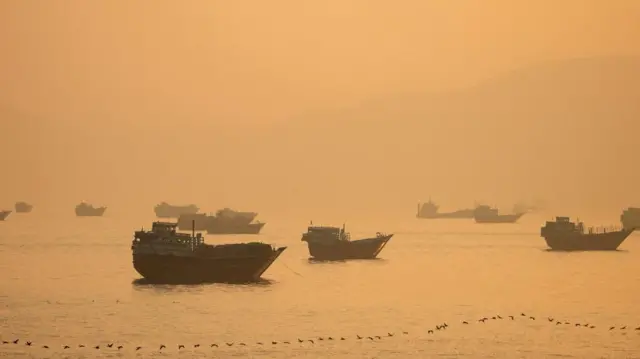
    Vessels at the Strait of Hormuz.Image source, Reuters
    Image caption,

    US officials say the Strait of Hormuz will re-open on Friday

    Donald Trump says the peace deal between the US and Iran is now progressing to the "second stage" - but did not provide more details.

    Here's the latest on the deal

    The deal was agreed on Sunday but details of its content have yet to be released.

    On Monday, the US president said "the deal is all signed" and the full text will be published "pretty soon".

    He also suggested it could be released once the two parties have formally signed the deal in Switzerland on Friday.

    Senior US officials have said that, as part of the deal, the Strait of Hormuz would re-open on Friday.

    US Vice-President JD Vance then said Trump may decide to release the contents of the deal earlier.

    The deal will extend a ceasefire for another 60 days, during which the sides will negotiate details of a final agreement.

    Iran's Foreign Minister Seyed Abbas Araghchi confirmed a new round of negotiations on reaching a final peace deal with the US would begin in Switzerland the same day.

    US officials also said technical talks on Iran's nuclear programme are expected to begin this week during negotiations.

  3. Analysis

    A political nightmare for Netanyahupublished at 12:05 BST

    Lucy Williamson
    Middle East correspondent

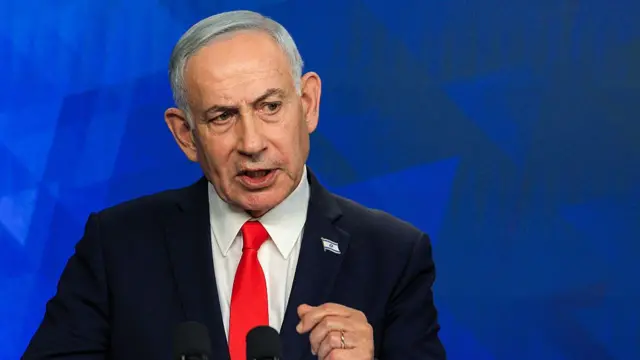
    Benjamin Netanyahu in a black suit with red tie.Image source, Getty Images

    The deal to end the US-Iran war has presented Israel's prime minister with a political nightmare, smashing the three cornerstones of Benjamin Netanyahu's political career.

    How can the man who styled himself as the political whisperer of Washington, with real influence over American politicians, be sidelined quite so comprehensively and insulted so publicly by his key US ally?

    How can the man who made taking on Iran the centre-piece of Israel's security policy end the war with Iran's regime arguably in a stronger position?

    And how can his old, tarnished political image as Israel's "Mr Security" survive the demand from Washington and Tehran that Israel cease attacking Hezbollah in Lebanon, months before an Israeli general election?

    Amid the cacophony of criticism and outrage from across the political spectrum, Israel's prime minister bristled at suggestions from journalists on Monday night that he had failed. But he also admitted there were cases in which he and Trump saw things differently.

    Often quick to claim victory, Israel's prime minister now faces a difficult task in deciding his next steps.

    Security has been the cornerstone of Netanyahu's offering to voters for decades. That is an increasingly difficult message to deliver.

    • You can read more analysis from Lucy Williamson on how the Iran deal weakens Netanyahu's positionhere
  4. Implications for Lebanon remain unclearpublished at 12:00 BST

    The US and Iran have agreed a deal to end their conflict, but the implications for Lebanon remain unclear.

    Pakistan's Prime Minister Shehbaz Sharif, in his role as mediator, said on Sunday that Lebanon was included in the termination of military operations - however strikes have continued in recent days.

    US officials said that while Lebanon was covered by the ceasefire framework, the withdrawal of Israeli forces from Lebanese territory was not a condition of the deal. Israel would retain the right to self defence, they added.

    On Monday, Israeli Defence Minister Israel Katz opposed a withdrawal from Lebanese territory currently occupied by Israel. He pledged that if Iran attacked Israel due to events in Lebanon, it would strike "with full force".

    Israel’s Prime Minister Benjamin Netanyahu told reporters his forces would not withdraw from southern Lebanon and would maintain operational freedom to target any threats to Israel’s security.

    Lebanese President Joseph Aoun has welcomed the peace announcement, saying he looks forward to it translating into "practical steps that will put a definitive end to the cycle of violence".

    But overnight, Israel’s military confirmed it had carried out strikes on what it called terrorists who approached its soldiers in southern Lebanon.

    Israel says four people were killed in the strikes. Hezbollah said it had fired missiles and drones at Israeli forces in return.

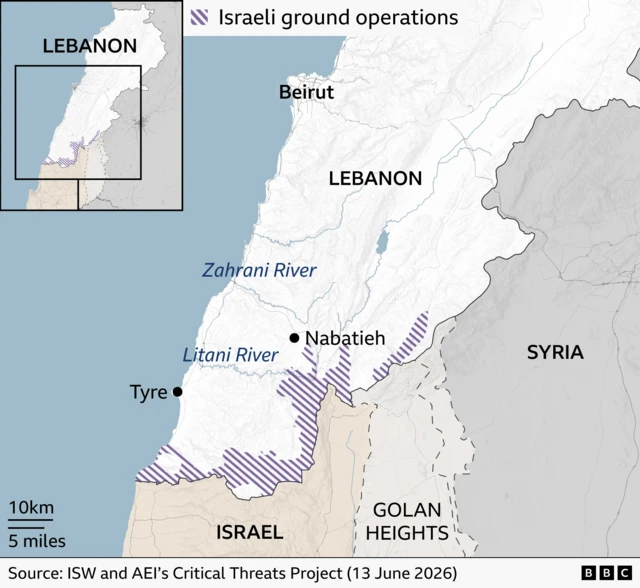
    A map of southern Lebanon showing towns, rivers and borders near Israel and the Golan Heights. A shaded areas shows where ISW analysis puts Israeli ground operations along the south of Lebanon. Major towns are marked with black dots, including Beirut on the coast in the north and Tyre on the coast in the south and Nabatieh inland. The Zahrani and Litani Rivers are labelled in blue, flowing west to the Mediterranean Sea. The southern border with Israel is shown, and the Golan Heights lies to the southeast, and Syria to the east.
  5. Analysis

    Trump's harsh comments reflect his irritation with Israel's actionspublished at 11:47 BST

    Paul Adams
    Diplomatic correspondent

    President Trump has renewed his criticism of Israel’s actions in Lebanon during remarks to the press at the G7 summit at Evian-les-Bains.

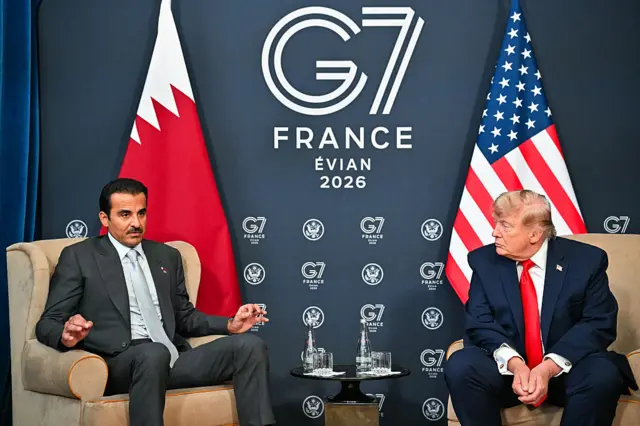
    "You don’t have to knock down an apartment house every time you’re looking for somebody," the president told journalists during his meeting with the Emir of Qatar.

    "Because there are a lot of people in those apartment houses and they’re not all Hezbollah, I can tell you."

    It’s the latest in a string of harsh comments from the president, reflecting his irritation at the actions of Israel’s Prime Minister Benjamin Netanyahu - a man he earlier this week described as having "no judgement" - and his realisation that the continuing conflict in Lebanon still has the potential to derail the fragile peace process with Iran.

    But Donald Trump also called the fighting in Lebanon as "the minor war" and described the Iranian-backed group Hezbollah as "the little pinprick out there that constantly rears its head", suggesting that he thought the deal with Iran would survive even if Israel continues to attack Lebanon.

    The president knows that Lebanon matters a great deal more to Iran than it does to him.

    He may regard fighting there as minor, but his remarks this morning show he recognises that his Iranian interlocutors don't see it that way.

  6. Reopening Strait of Hormuz 'very, very important' for UK, Starmer sayspublished at 11:36 BST

    We can bring you more now from Keir Starmer, who says reopening the strait is "very, very important" for the UK because its impact on energy prices have affected "every house across the country".

    Energy costs have rocketed since Iran responded to US and Israeli attacks by effectively blocking the crucial Strait of Hormuz shipping route.

    Starmer also says he welcomes the deal between the US and Iran and congratulates Trump and the mediators.

    This Flourish post cannot be displayed in your browser. Please enable Javascript or try a different browser.

    Speaking to Times Radio about G7 countries, he adds: "It's going to make a material difference to our economies, to stability in the world and of course we're all united in saying that Iran must not get... a nuclear weapon."

  7. UK will play its 'full part' in getting Strait of Hormuz open - Starmerpublished at 11:30 BST

    UK Prime Minister Keir Starmer has also just spoken at the G7 Summit in France.

    Starmer says the UK will play its "full part" in getting the Strait of Hormuz open "as quickly as possible".

  8. What is the G7 and who's attending?published at 11:28 BST

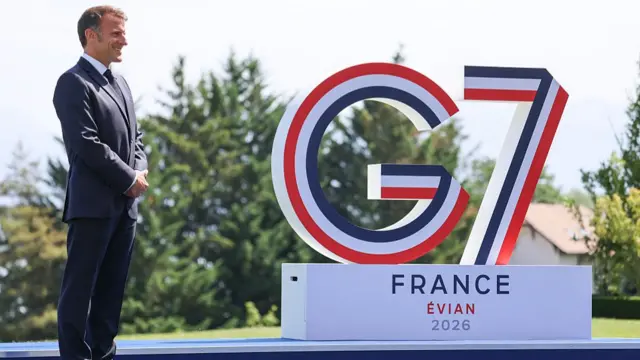
    France's President Emmanuel Macron waits for the official greeting ahead of a work lunch as part of the G7 summit.Image source, Getty Images

    The G7 (Group of Seven) is an organisation of the world's seven largest so-called "advanced" economies, which dominate global trade and the international financial system.

    They are: Canada, France, Germany, Italy, Japan, the UK and the United States.

    This year's summit is being held in the French town of Évian-les-Bains this week.

    Other leaders have also attended, with Ukrainian President Zelensky joining Tuesday's session.

    And there's also a strong presence from the Middle East - leaders from the UAE, Qatar and Egypt are also attending talks.

  9. Iran's nuclear programme - explainedpublished at 11:23 BST

    Ghoncheh Habibiazad
    Senior reporter, BBC Persian

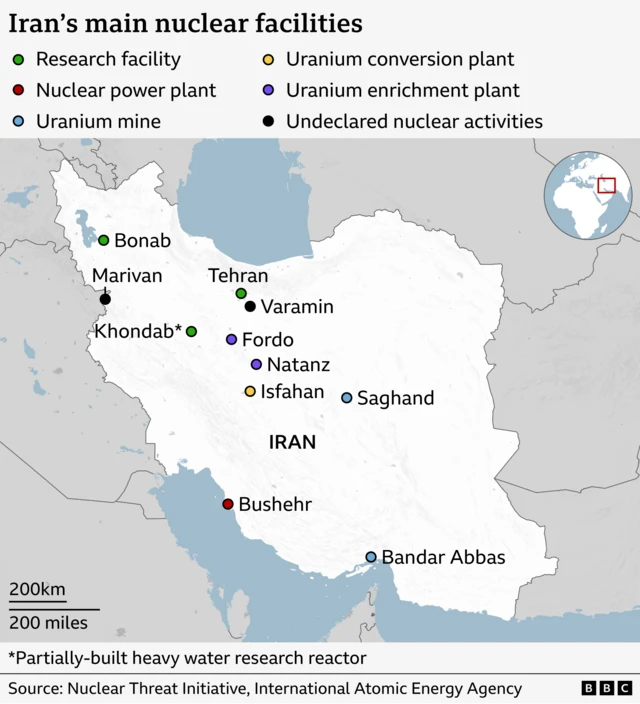
    Iran's nuclear programme has been the focus of diplomatic talks, sanctions on Iran, and inspections for decades.

    It was often referred to by Donald Trump as the reason the US joined with Israel in launching strikes on the country in late February this year.

    Iran maintains its programme is peaceful.

    The US and Israel have consistently rejected this and say there have been efforts to develop nuclear weapons.

    Under a nuclear deal agreed in 2015, Iran had limited its enrichment to 3.67%, which can be used to produce fuel for commercial nuclear power plants. Weapons-grade uranium is 90% enriched or more.

    Iran began openly escalating its enrichment levels after Donald Trump abandoned the previous agreement in 2018.

    By June last year, Iran was enriching at 60% and had amassed a stockpile of 400kg, according to the International Atomic Energy Organization (IAEA).

    The IAEA said last week it had been able to conduct a "routine inspection" at the Bushehr Nuclear Power Plant recently, but it had been almost a year since inspectors had been able to access other nuclear facilities.

    A map of Iran showing the location of its main nuclear facilities
  10. Israel 'has to be more responsible with respect to Lebanon', Trump sayspublished at 11:15 BST

    Donald Trump (R) attends a bilateral meeting with Qatar's Emir Sheikh Tamim bin Hamad al-Thani during the G7 summit.Image source, Getty Images
    Image caption,

    Trump made the comments while speaking to Qatar's Emir Sheikh Tamim bin Hamad al-Thani during the G7 summit

    On Lebanon, Donald Trump says Israel has been fighting Hezbollah for "too long and too many people are being killed".

    Asked whether he is frustrated with Israeli PM Benjamin Netanyahu, Trump says they have a "great relationship" but adds that he "has to be more responsible with respect to Lebanon".

    "I didn't like that he did an attack... that was too much," Trump says.

    • For context:An Israeli air strike on Beirut put pressure on attempts to reach a deal to end the war over the weekend, with Trump saying at the time: "Let's not blow it"

    "Without the US, there would be no Israel... because no other president was willing to do what I did," he adds.

  11. US won't invest money in Iran - Trumppublished at 11:08 BST

    More now from Trump, who goes on to say the US is "not investing any money in Iran".

    It comes after reports that the US was prepared to allow an investment fund for Iran in exchange for Tehran’s agreement to a final settlement.

    He describes the "rumour that got out there yesterday" as "ridiculous", adding: "We have no obligation to invest any money in Iran."

  12. Iran will never have a nuclear weapon, Trump says at G7 summitpublished at 11:05 BST

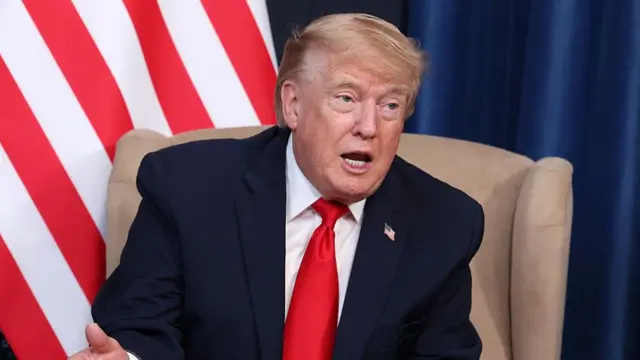
    Donald Trump in a blue suit and red tie speaking while sat in a chair.Image source, Getty Images

    US President Donald Trump says "Iran will never have a nuclear weapon" under a new deal.

    Speaking at the G7 summit in France, Trump says the Iran deal is going to a "second stage" but does not provide any more detail.

    "We have a deal that’s a fair deal, it’s a good deal," he adds.

    On Monday, the US president said a deal to bring about an end to the war was "all signed". Iran's foreign minister said negotiations on reaching a final peace deal with the US would begin in Switzerland on Friday.

    US Vice-President JD Vance describedthe memorandum of understanding (MOU) between the US and Iran as "about a page and a half" and a "very general" document.

    Technical talks on Iran's nuclear programme are expected to begin this week, US officials said, while any sanctions relief or release of assets will depend on Iran meeting commitments under the deal.

    A key sticking point in negotiations between Iran and the US has been Iran's nuclear enrichment and Western insistence that the country not possess a nuclear weapon.