Summary

  1. Our health team answer key questions - recappedpublished at 14:21 BST

    Madeleine Lake
    Live reporter

    Who can get the vaccine? It's recommended for children aged 12 to 13, those under 24 who missed it during school, and those with higher risks to HPV.

    Do I need a cervical screening if I've had a HPV jab? Screenings are still important even if you've been vaccinated. It doesn't protect against all types of HPV that cause cervical cancer.

    If my HPV test is positive, does it mean I have cancer? It's rare for an abnormal result to show that cancer has already developed. A positive test means a high-risk strain of HPV has been found – which will then be checked under a microscope to look for cell changes.

    Can men get HPV? Yes and many do. Most men will not know they have HPV and won't get symptoms. Some types can cause genital warts and other high-risk types can cause cancers.

    Do I need to be tested for HPV if I've never had sex? It's passed from one person to another through close skin-skin contact. You're at risk if you're having any sexual contact. If you have not had any kind of sexual contact your risk of getting HPV is low.

    You can still send us your questions - email: yourvoice@bbc.co.uk, external

    Your voice banner
  2. 'I would hate to see another young person's life destroyed by cervical cancer'published at 13:53 BST

    Elliot Burrin
    Live reporter

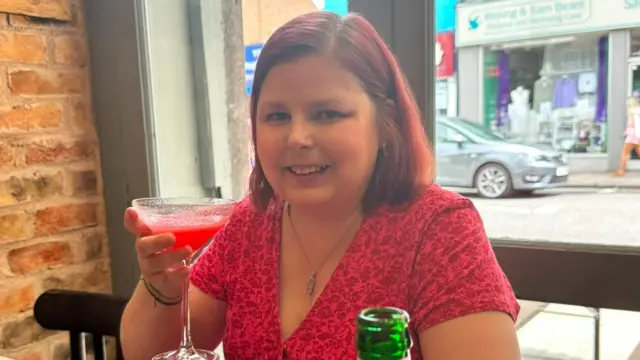
    A young woman with pink, shoulder length hair is sat at a restaurant. She's holding up a drink and smiling to the camera

    Ellie was only 29 when she was diagnosed with cervical cancer, shortly after giving birth to her first child. She had no symptoms, was healthy and hadn't been losing weight – but a scan revealed a tumour on her cervix.

    She tells me it was a "real shock", especially as her first cervical screening test suggested everything was normal.

    A hysterectomy removed the cancer, but the following year, Ellie was re-diagnosed after an MRI showed a cancerous tumour in her pelvis. Today, she's talking to me after being in remission for five years.

    Ellie has two young daughters and says they will definitely be vaccinated when they're old enough. She says it's "amazing" that cervical cancer is becoming "something we can eradicate".

    She now lives with "a myriad of health conditions" and mobility issues as a result of the cancer and treatment.

    "I would hate to see any other young person see their life destroyed by it," Ellie tells me.

  3. Many still missing out on HPV protectionpublished at 13:39 BST

    Michelle Roberts
    Health editor

    Cancer Research UK is warning that too few teenagers and young people are coming forward for an HPV jab.

    Figures for England show close to 1 in 4 young people , externalcurrently leave school unprotected against HPV.

    In some regions, including much of London, uptake has fallen below 70% among those who have just become eligible for the jab.

    In the UK, all secondary school aged children aged 11-13 are offered it. Any who missed their vaccine can get it for free via their GP up to the age of 25.

  4. Can men get HPV and what are the risks?published at 13:23 BST

    Smitha Mundasad
    Health reporter

    Steve, from Cheltenham, says he has a rare condition called Recurrent Respiratory Papillomatosis, caused by specific strains of HPV, which causes recurring growths on and around his voice box.

    Men can get HPV and many do – it can be passed on to male and female partners through vaginal, anal or oral sex or genital skin-to-skin contact. Most men will not know they have HPV and won’t get symptoms.

    But some types of HPV can cause genital warts and other more high-risk types can cause penile and anal cancers and cancers at the back of the throat, base of the tongue and tonsils.

    Another rare disease caused by HPV is Recurrent Respiratory Papillomatosis (RRP) where mostly non-cancerous tumours grow in the airways and around the voice box.

    A purple banner with white writing that reads 'your voice'
  5. What you need to know about HPVpublished at 13:11 BST

    This Flourish post cannot be displayed in your browser. Please enable Javascript or try a different browser.

  6. Why cervical screening is still important if you've had HPV vaccinepublished at 13:02 BST

    Michelle Roberts
    Health editor

    We're answering your questions around cervical cancer, screening and HPV.

    Laura in London, who had the vaccine as a child, says she later tested positive for HPV after going for a smear test and had abnormal cells removed.

    While the HPV vaccine is extremely effective, it is still possible that some people will develop cervical cancer.

    HPV infections are very common and the jab is designed to protect against infections - but does not treat them.

    Women are still advised to go for cervical screening to check for HPV.

    If it is found, more checks can be done to know if any monitoring or treatment is needed. Screening and HPV vaccines prevent cancers and save lives.

    BBC your voice banner
  7. What is a smear test and is it different to a HPV test?published at 12:38 BST

    Michelle Roberts
    Health editor

    Gynecologist collects a Pap smear sample for cervical screening.Image source, Getty Images

    Cervical screening used to be called a smear test.

    This was the test used before HPV testing, which is what we use today. Nearly all cases of cervical cancer are linked to high-risk HPV.

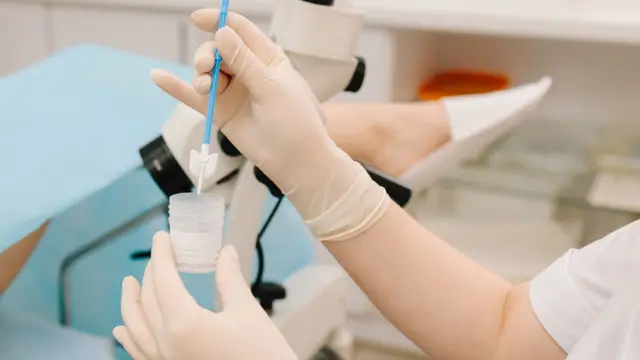
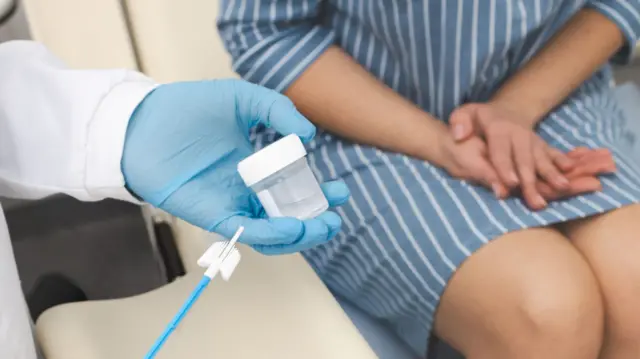
    During the HPV test, a nurse or doctor uses a soft brush to take a sample of cells from the cervix.

    This is then sent off for testing at a laboratory to see whether high-risk HPV is present.

    If it is, then the sample will be checked for signs of cell changes which could develop into cancer over time if left untreated.

  8. 'When vaccination is easy to access and explained clearly, uptake is strong'published at 12:20 BST

    Elliot Burrin
    Live reporter

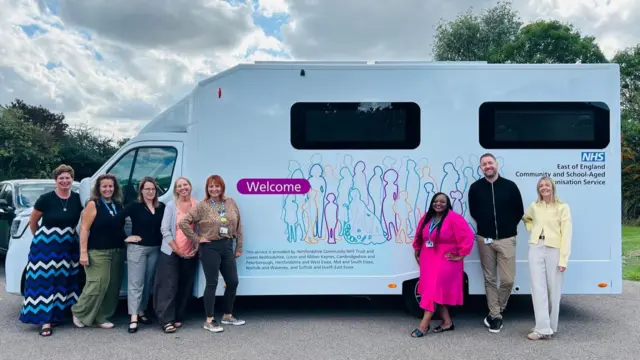
    Eight people stand smiling, posing for a photo in front of a van that is used to deliver vaccinations for children. The people are wearing staff lanyards and the van is marked 'NHS East of England Community and School-Aged Immunisation Service'.Image source, Hertfordshire Community NHS Trust

    Caroline Shepherd works as an assistant director for Child Health and Immunisations in the East of England - a region which has the highest HPV vaccine uptake rates in the country.

    When young people come to get their jab from the NHS service, Caroline says some of them are nervous, so it's important to explain what the vaccine does and the types of cancers it can prevent.

    "It's often a much more positive experience than they expected," she says, adding that many of them "leave feeling proud" after getting vaccinated.

    The service, which goes into schools, is also tackling declining national vaccination rates by reaching out to households where children haven't got the HPV vaccine.

    "When vaccination is easy to access and explained clearly, uptake is strong," Caroline says.

    "The vast majority of parents continue to support vaccination, but vaccine hesitancy, anxiety, lack of information or reasonable adjustment leads to a vaccination being missed," she tells me.

  9. If my HPV test comes back positive, does it mean I have cancer?published at 11:43 BST

    Michelle Roberts
    Health editor

    A positive HPV test does not mean you have cancer. It means a high-risk strain of HPV has been detected.

    The sample is then checked under a microscope for cell changes.

    If there are none, you will be invited for a further HPV test sooner than usual to check that the HPV has gone (the body often clears the infection itself).

    If cell changes are found, this does not mean you have cancer. You will be invited to have more checks and may need some treatment.

    It is very rare for an abnormal result to show that a cancer has already developed.

  10. Doctor on why some parents hesitant to get children vaccinatedpublished at 11:28 BST

    Tara Mewawalla
    Live reporter

    Alexandra Lawrence smiling while sitting at her surgery deskImage source, Alexandra Lawrence
    Image caption,

    Alexandra Lawrence is chair of the Gynaecological Expert Reference Group North East London Cancer Alliance (NELCA)

    As a consultant gynaecological oncologist at the Royal London Hospital, Alexandra Lawrence speaks to parents who are sometimes hesitant to get their children vaccinated.

    She says this is because they believe the HPV vaccine will promote sexual activity in young women, but not getting children vaccinated “makes them less protected” and “might undermine their future health".

    Lawrence says the HPV vaccine also protects men and boys from certain cancers, protects any future partners, and is particularly useful for men who have sex with men.

    “The younger you have the vaccination the more likely you are to have enduring immunity," Lawrence explains. "Ideally you’d have it before you have sex.”

    Lawrence adds that for some people, having HPV has a “big taboo”.

    “It’s a sexually acquired infection but pretty much everybody who ever has sex gets exposed to HPV. It’s just luck of the draw if you get high-risk HPV or low-risk”. However, she says, “people are becoming much more accepting of it”.

  11. I've had my HPV jab. Why do I even need to go for cervical screening?published at 11:12 BST

    Michelle Roberts
    Health editor

    Cervical screening is still important even if you've been vaccinated against human papillomavirus (HPV).

    The HPV vaccine doesn’t protect against all types of HPV that cause cervical cancer. Cervical screening is another effective way to prevent cervical cancer.

    It aims to detect certain types of HPV infection that can cause changes to the cells of your cervix.

    If any abnormal cells are found, these can be monitored or treated before they have a chance to become cervical cancer.

  12. Mum told she had cervical cancer at 30 is 'real advocate for vaccine'published at 11:03 BST

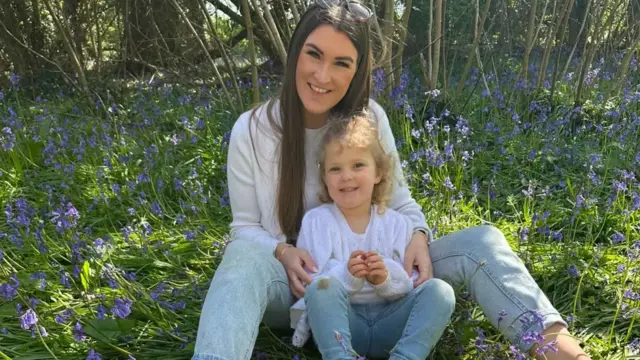
    A woman with brown hair sitting in a field of flowers in a wood with her young daughter sitting and smiling in between her legsImage source, Other
    Image caption,

    Alexandra and her three-year-old daughter Ivy, who was born after she had cervical cancer

    Alexandra Legg left school just before the HPV vaccine was introduced in England.

    In 2021, just as she was planning her wedding, she was diagnosed with cervical cancer aged 30.

    "I remember hearing the words and I just couldn't really breathe very well," she says. "I was so upset - everything went through my head, it was so hard."

    Her treatment involved the removal of lymph nodes in her abdomen, although surgeons were able to preserve a small part of her cervix, giving her a chance of becoming pregnant.

    Just a year later, her daughter Ivy was born. "Those nine months were so scary because I was at such risk of losing her at any point," she says.

    Alexandra says her life could have been far less traumatic if she had been offered the HPV vaccine and urged those eligible to get it.

    "I'm a real advocate for this vaccine and when Ivy is old enough, she'll be first in the queue," she adds.

  13. How HPV and cervical cancer are relatedpublished at 10:56 BST

    The human papillomavirus (HPV) causes almost all of the main types of cervical cancer, according to Cancer Research UK.

    There are many different types of HPV - 14 of which are considered high risk for cervical cancer. Two types of the virus (HPV 16 and HPV 18) cause about 70 out of 100 (70%) of all cervical cancer cases.

    For most people, HPV causes no harm and goes away on its own. However, if you have a persistent infection and a high risk type of HPV, you are more at risk of developing cervical cancer.

    People living with HIV or AIDS, and tobacco smokers have a higher risk of getting cervical cancer, while women who have a sexually transmitted infection alongside HPV may also be at greater risk.

  14. Do I need to be tested for HPV if I've never had sex?published at 10:45 BST

    Michelle Roberts
    Health editor

    Gynecologist doctor taking smear for cytology from female patient in gynecological office.Image source, Getty Images

    HPV is passed from one person to another through close skin-to-skin contact.

    You are at risk of getting HPV with any kind of sexual contact, including oral sex, touching of the genital area, vaginal sex, anal sex, and sharing sex toys.

    It is possible to get HPV from just one occasion of sexual contact. If you have not had any kind of sexual contact, your risk of getting HPV is low.

    You may decide not to have screening if you have not been sexually active, but you can still go if you want to. It might help to talk it through with your GP.

  15. Key findings of first report of its kindpublished at 10:41 BST

    The landmark new research looks at mortality rates of cervical cancer and vaccination data for women aged 20 to 34 to calculate the impact of vaccination on cervical cancer survival.

    Here's a breakdown of the key findings:

    • Children vaccinated at age 12–13 against HPV have close to zero risk of dying from cervical cancer before the age of 30
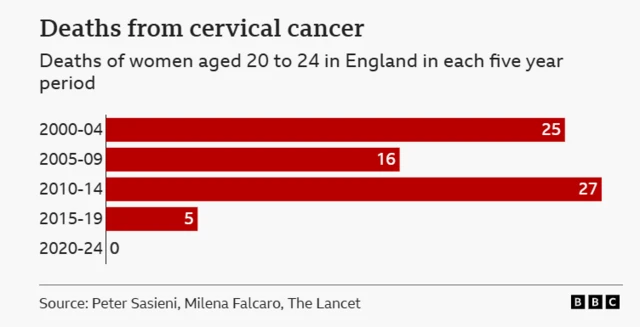
    • Between 2020 and 2024, no cervical cancer deaths were recorded in women aged 20 to 24 - the first time that had happened over a five-year period
    • Around 200 cervical cancer deaths were prevented by HPV vaccination up to the end of 2024
    • Cervical cancer deaths have fallen sharply since school-age girls began being offered it in 2008
    • Without vaccination, 23 deaths from cervical cancer would have been expected between 2020-2024
    A chart showing the death rates of women aged 20 - 24 from cervical cancer in England
  16. Who can get the HPV vaccine?published at 10:15 BST

    Doctor applies bandage to preteen girl's arm following an immunization.Image source, Getty Images

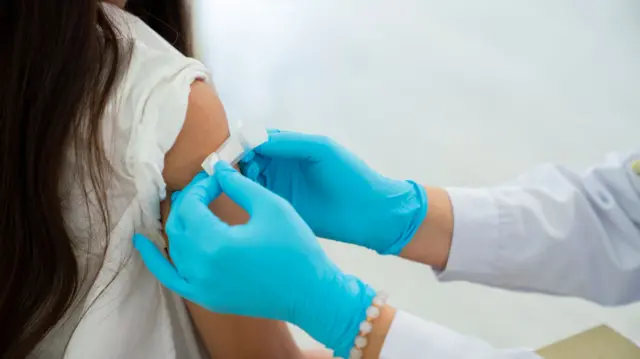
    The HPV vaccine - which helps protect people from human papillomavirus - is given as an injection into the arm.

    It's recommended for children aged 12 to 13, who are usually offered the vaccine in year 8 of secondary school.

    For those aged 24 and under who missed taking the vaccine as a child, you can get it by contacting your GP or school nurse.

    The NHS also recommends it to those at higher risk to HPV, including: sex workers, people with HIV, and men who have engaged in sexual intercourse with men.

    The number of doses taken depends on two factors: your age, and how well your immune system works. People under 25 usually take a single dose, with those who have a weakened immune system taking up to three doses across a year.

    You cannot have the vaccine if you've had a serious allergic reaction to a previous dose of the vaccine, or an ingredient in the vaccine.

  17. Risk of dying from cervical cancer before 30 'close to zero' after HPV vaccinepublished at 10:11 BST

    Schoolgirl getting a vaccineImage source, Getty Images

    Welcome to our live page covering HPV (human papillomavirus) and cervical cancer in England.

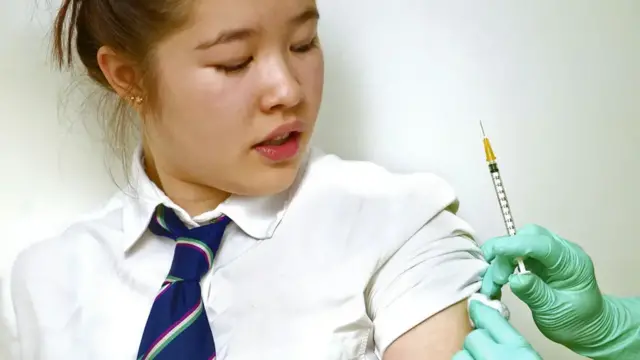
    Landmark new research has revealed that children who are vaccinated against HPV at age 12-13 have close to zero risk of dying from cervical cancer before the age of 30.

    The first study of its kind, external showed deaths from cervical cancer have fallen sharply since school-age girls began being offered the HPV vaccine in 2008.

    And crucially, between 2020 and 2024, no cervical cancer deaths were recorded in women aged 20 to 24 in England - the first time that had happened over a five-year period.

    Around 200 lives have been saved in England so far thanks to the jab, according to the study spearheaded by Queen Mary University of London and funded by Cancer Research UK.

    Without vaccination, around 23 deaths would have been expected in the five-year window from 2020 to 2024.

    Our experts will be answering the key questions on cervical cancer and HPV, as well as what these findings mean throughout the day. Stay with us.