What do we know about Anglo-Saxon art and culture?

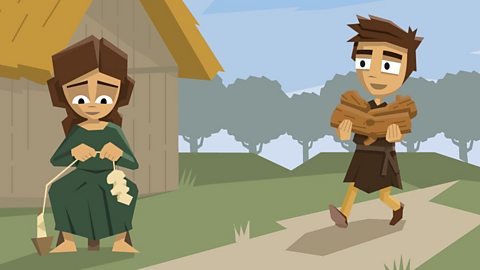
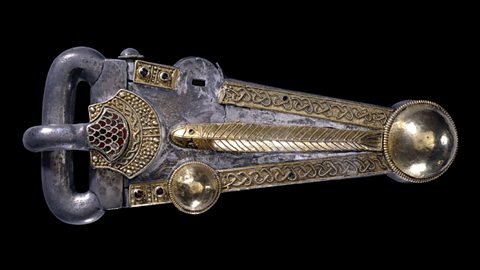
The Anglo-Saxons were skilled craftspeople. They made metalwork and jewellery using materials such as gold and gemstones.
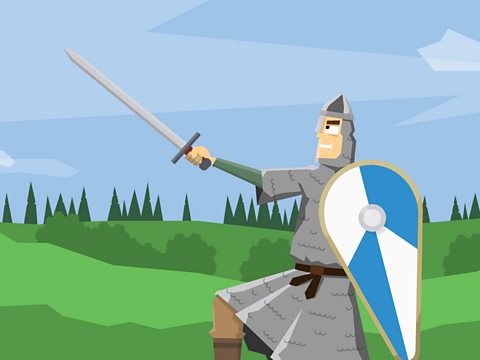
They enjoyed playing games and story-telling. The most famous story they told is about a brave warrior called Beowulf.
Important words for the Anglo-Saxons
| Keyword | Definition |
|---|---|
| Garnet | A gemstone, usually red in colour. |
| Pagan | A person who worships many gods. They are often from outside the culture's main, organised religions. |
| Beowulf | The earliest Anglo-Saxon poem. It was written in Old English. |
| Riddle | A puzzling question. |
| Lyre | A stringed musical instrument. |
What was Anglo-Saxon culture like?
The Anglo-Saxons were great craft workers. They made intricate jewellery, musical instruments and homemade toys and games.
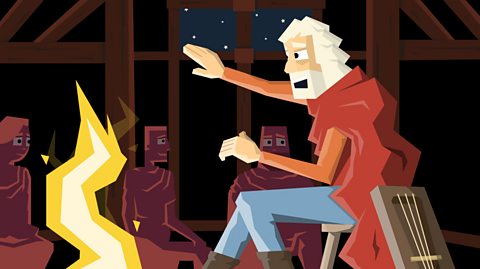
They were also keen storytellers. They would gather together in feasting halls and tell thrilling stories.
Often their stories would be accompanied by music played on a string instrument called a lyre.
The Saxons liked to play with words too. They amused themselves by telling clever riddles.
What did their art and treasure look like?
Anglo-Saxon jewellers made brooches, beads and gold ornaments. At first, their artwork was pagan, but after the conversion to Christianity in the AD600s astonishing artwork was made for churches.
Take a look below at these Anglo-Saxon treasures.
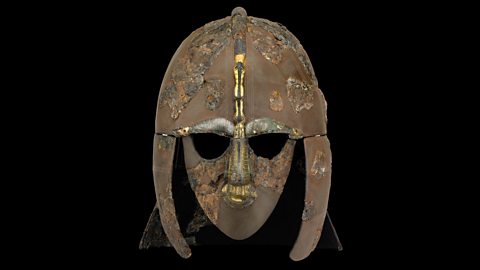
Image caption, Pieces of this helmet were found at Sutton Hoo. They have been placed together and reconstructed in this photo. There are boars' heads on the end of each eyebrow and a dragon head above the nose. Together they make the shape of a bird with outspread wings.


1 of 4
Trading for gold and garnets

Archaeology has revealed some of the treasures of the Anglo-Saxons. The most famous burial site was found at Sutton Hoo, Suffolk, in 1939.
The Staffordshire Hoard, the largest hoard of gold and silver jewellery, was discovered in 2009 and dates to AD650-675.
Gold was important as it showed high status and wealth.
Garnets were believed to protect warriors. Garnets were also used to represent the blood of Christ.
Objects found at Sutton Hoo and the Staffordshire Hoard came from as far afield as Sri Lanka, Afghanistan, Greece, Turkey and Syria. This shows there was a trade network between Asia and Europe.
What kind of stories did they tell?
Written work was in Latin, the language of the Church, or in Old English. Very few Anglo-Saxons could read or write.
All their stories were told to them by their friends and family. Anglo-Saxons loved tales about brave warriors and their adventures.
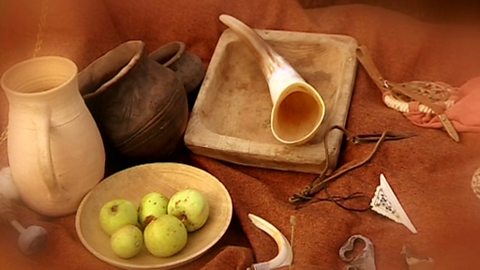
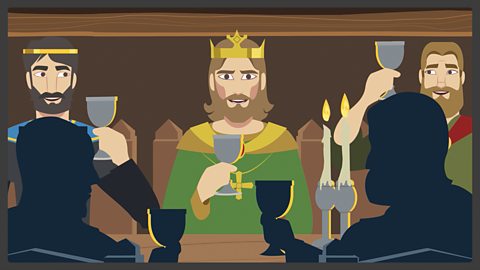
On dark winter days, people gathered in the great hall around a log fire. They listened to stories and poems, feasted and sang songs. They ate roast meats with bread and fruit, and they drank ale or a strong drink made from honey called mead.
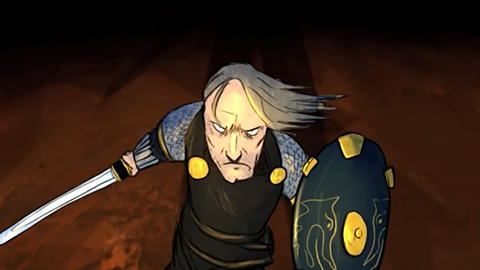
A favourite story told how Beowulf, a heroic prince, battled the fierce man-eating monster Grendel. The story of Beowulf was first written down around the 8th or 9th century, but long before that the story was told around the fire.
Watch: The story of Beowulf
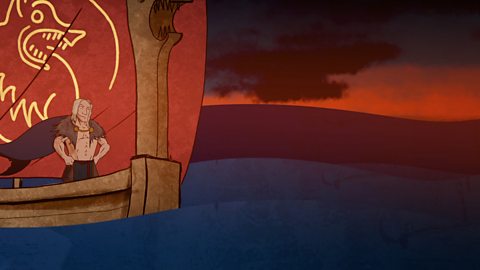
Narrator: Britain, 600 AD. The Roman army left 200 years ago and the empire has ended.
New people have come to settle here, these are the Anglo-Saxons.
They told some of the very first English stories.
Storyteller: There once was a king called Hrothgar, who ruled a land far away over the sea.
Hrothgar built a great hall, much bigger than this one, where his warriors could drink and listen to stories.
But an ogre, Grendel, lived in a deep dark swamp nearby.
[PEOPLE SCREAMING]
Grendel returned whenever he felt like it, day or night. A young warrior named Beowulf hears of Hrothgar’s troubles and sails to Hrothgar’s kingdom to help.
Beowulf: More I hear that the monster dire in his wanton mood / reeks not weapons hence shall I scorn.
Grendel doesn’t frighten me. I will fight him with my bare hands.
[DRAMATIC MUSIC]
Narrator: People loved to listen to tales of warriors, because it’s an important part of Anglo-Saxon life.
Osric: What happened in the end?
Storyteller: See, I said that story of Beowulf would make Osric feel better.
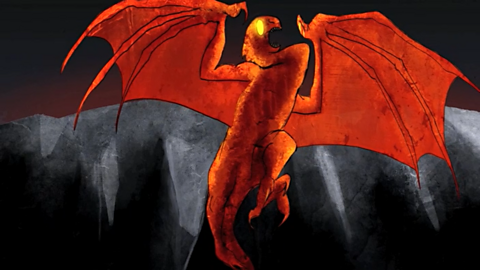
Well, years later when Beowulf himself was king, a huge dragon was guarding treasure. A thief trying to steal a jewelled cup disturbed the dragon, who immediately flew into a furious rage.
Once riled, the dragon was unstoppable.
Narrator: Beowulf and the dragon fight to the death. Both are slain.
What games and sports were there?

Children played with homemade toys. They had rag dolls and carved wooden toys, as well as games that used counters and dice.
From finds in graves, we know children also had spinning tops and played tunes on pipes made from reeds or animal bones.
Anglo-Saxon men enjoyed sporting pastimes, like wrestling, weight-lifting (using heavy rocks) and horse-racing. These sports kept them fit for work and strong for war.
Think like a historian

Have a look at the thinking points below and think about your answer to each question. You could even write them down on a piece of paper or discuss them with somebody else if you want to.
What can we learn about the Anglo-Saxons from the stories they told?
Why are archaeological finds important?
Did you think about the themes in stories such as Beowulf? Many Anglo-Saxon stories are about bravery, loyalty and honour. This suggests they thought these were important qualities for people to have. Stories can be a good way to learn about the values people had in the past.
Perhaps you thought about some of these ideas: archaeological finds can tell us where the Anglo-Saxons lived and settled; they can tell us that the Anglo-Saxons were skilled craftspeople; or they can tell us about the Anglo-Saxons' trade networks.
Activities
Activity 1: Anglo-Saxon riddle
The Anglo-Saxons liked to tell each other riddles. Can you work out the answer to this one?
I appear on the ground like a blanket and melt in the midday sun. What am I?
Did you get it right? The answer is snow!
Why not have a go at making your own riddle? You can test it out with a friend or grown-up and see if they guess correct.
Activity 2: Quiz – Anglo-Saxon art and culture
Grown-ups corner
Are you a parent, carer or teacher?
Take a look at some of the links below on KS2 History which are packed full of knowledge, videos, quizzes and activities.
Anglo-Saxon village life and work
Bitesize for Teachers
Anglo-Saxon Britain (animation)
Bitesize for Teachers
Athelstan - first king of England?
Bitesize for Teachers
Horrible Histories: Raid and Trade game! game
Play Horrible Histories: Raid and Trade KS2 History
More on Anglo-Saxons
Find out more by working through a topic
- count6 of 8
- count8 of 8
- count1 of 8