How did Britain's wealth grow?

Throughout the Victorian period, the British Empire became larger and wealthier.
Britain used its empire to gather many raw materials, such as cotton and tea, from across the globe and its colonies, such as India and South Africa. A colony was a country in the British Empire outside of the UK.
Using new steam-powered technology, Britain turned these materials into goods and became the ‘workshop of the world’.
Trading with other countries across the world made Britain incredibly wealthy, but it also created a large gap between the rich and poor.
Watch: Where did Britain's wealth come from in the Victorian period?
Find out where Britain's wealth came from in the Victorian period with Bakshi, an Indian sailor.
We've just returned from India.
Tea, cotton. And smell the spices!
Reminds me of Ma cooking food over the fire and my silly brother chasing chickens in the courtyard.
It's all worth a lot of money and the ships bring in so much of it.
This trade makes Britain rich.
Easy! Bring it down. Watch yourself!
And it is not just India. Africa, the Caribbean, Australia, Canada. All part of the British Empire.
Ships bring sugar, tobacco, gold from all over the world.
So much wealth made possible by so many people.
My Ma is still in India, in a place called Assam.
She rises before dawn, works until dark, doing back‑breaking work among the tea bushes.
The baskets are heavy but her pay is small.
Factory workers here in Britain build the wealth of the country too.
They make iron, pottery, cloth and machinery.
Goods which are then sent and sold across the globe.
They call this place the “workshop of the world”.
The traders and business owners grow richer and richer, while workers in the fields and workers in the factories struggle to survive.
Across the world many suffer while a few live in luxury.
I wish things were different.
For my mother, for me, for everyone.
Important words for the Victorians
| Keyword | Definition |
|---|---|
| Empire | A large group of countries that are ruled by one ruler or government. |
| Raw material | A natural material that hasn’t been changed. |
| Port | A place where ships pick up and drop off different goods. |
| Profit | The extra money someone gets when they sell something for more than it cost. |
| Factory | A large building where items are made using machines. |
| Steam engine | A machine which uses steam from boiling water to create movement. |
| Merchant | A person who buys and sells goods. |
| Slums | A poor part of a city where many people live in crowded homes. |
What was the British Empire?

The British Empire was a large group of countries that were ruled over by Britain. These included Canada, Jamaica, Kenya, India, and Australia.
It first began in the late 1500s under Queen Elizabeth I, but it reached its greatest power and size during the Victorian period when Queen Victoria ruled.
At this time, the British Empire covered around one-quarter of the world's land. It was often called ‘the empire on which the sun never sets’. This was because it was always daylight in at least one of the countries it ruled.
Queen Victoria was the head of the British Empire and was given the title 'Empress of India' in 1876. This showed how important India was in Britain's power.
How did the British Empire create wealth?

Trade involves the buying and selling of different goods between people and countries.
Britain ruled over many countries which gave it access to different and valuable raw materials, such as:
- Tea, cotton, spices and timber from India
- Palm oil from West Africa
- Diamonds and gold from South Africa
Merchants used large ships to gather these materials cheaply and bring them back to British ports. These materials were then used to create more expensive goods that could be sold for a profit. For example, raw cotton was brought to Britain and turned into clothes and textiles in large factories.
Britain's powerful navy, and control of the merchant ships, helped the country grow its trade across the world. This was one of the reasons why Britain became one of the wealthiest and most powerful nations in the world.
How were goods in Britain made and traded?

Britain brought in raw materials cheaply from its empire. The invention of the steam engine in 1712, and improvement of it meant steamships and locomotives (trains) could be used to transport raw materials and finished products more quickly.
It also allowed factories to operate all day and night. This meant items like cloth, iron tools and pottery, could be quickly and cheaply produced in large amounts.
This activity led to Britain being known as the ‘workshop of the world.’ The goods made in British factories were sold and made the business owners money. This led to Britain becoming one of the wealthiest and most powerful nations in the world.
Did you know about The Great Exhibition in 1851?
The Great Exhibition took place in Crystal Palace in London in 1851. It showed off the work of the best inventors and scientists from Britain and across the world. It featured art, musical instruments, machinery and inventions from over 25 different countries. It showed Britain was one of the world leaders in trade and technology.

How did wealth affect British people and the colonies?
British merchants and business owners (who were part of the upper class) became wealthier. However, many people in Britain's colonies, such as India and South Africa, were treated poorly and worked in difficult conditions.
During the Industrial Revolution, a new middle-class grew very quickly. These Victorians owned and ran some of the businesses and factories which needed lots of different types of workers.
Working class people were often unskilled workers who worked hard and had dangerous jobs in factories and coal mines. They lived in overcrowded areas called slums that were often dirty and had no running water. This group included children.

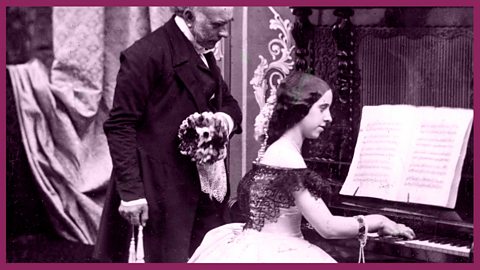
Image caption, A photograph showing a wealthy middle-class Victorian wedding party. Wealthy and middle-class Victorians lived comfortable lives. They could afford expensive clothes and fine jewellery. They did not work in factories and had time for parties.


1 of 5
What other jobs were there in the Victorian period?
As Britain made money through trade, different jobs were needed to manage the country’s money and keep goods moving to be sold. More people started work as:
Merchants and shopkeepers who sold goods on busy streets.
Bankers and clerks (assistants) who looked after the growing wealth of the cities and country.
Railway workers who kept the new trains working properly.
Think like a historian

Have a look at the thinking points below and think about your answer to each question. You could even write them down on a piece of paper or discuss them with somebody else if you want to.
- The British Empire grew significantly throughout the Victorian Period. Why do you think this played an important role in making Britain so wealthy?
- How do you think steam power changed the way Britain made and sold goods?
- By the end of the Victorian Period, Britain was very wealthy. How do you think this new wealth affected the gap between different groups of people?
Did you think that Britain’s Empire allowed Britain to gather many different raw materials, such as cotton and timber, cheaply and easily? Britain used these materials to create expensive goods and sold them for a large profit. Maybe you thought that having such a large empire gave Britain more places to sell the items it made in its factories. This increased the amount of trade Britain could do helping Britain to become very wealthy.
Did you think about how steam engines allowed machinery to work all day and night, making items much faster and more cheaply than people could by hand? Perhaps you thought about how steam engines made the movement of goods and people much quicker. New steamships and locomotives could move heavy goods and machinery easily and quickly across the country and world.
Did you think about the growth of the middle class? Business owners and merchants became very rich and could afford to live in large houses with servants. Maybe you thought about the working-class and how they struggled. Many people, including children, lived in dirty slums and worked long hours in dangerous factories to help their families survive.
Quiz
Grown-ups corner
Are you a parent, carer or teacher?
Take a look at some of the links below on KS2 History which are packed full of knowledge, videos, quizzes and activities.
Famous Victorians: Isambard Kingdom Brunel
BBC Bitesize for Teachers
KS2 History: Dodgers guide to key inventions
BBC Bitesize for Teachers
Life in a wealthy Victorian family
BBC Bitesize for Teachers
Horrible Histories: Raid and Trade game! game
Play Horrible Histories: Raid and Trade KS2 History
More on Victorians
Find out more by working through a topic
- count1 of 3

- count2 of 3

