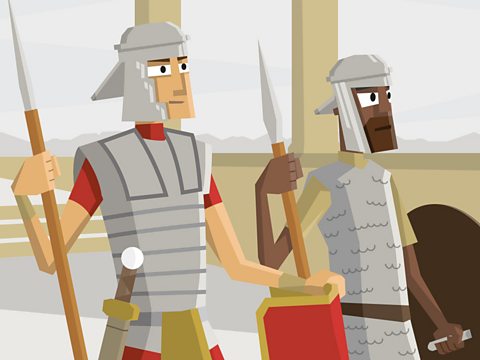
Were the Romans different to the Britons and Celts in Britain?
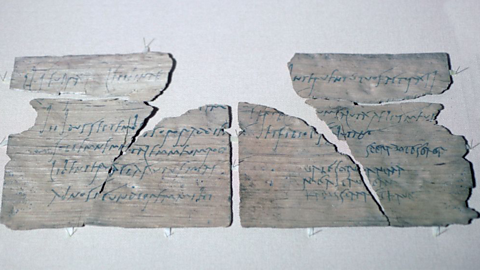
When the Romans came to Britain, they brought many new ideas and ways of life with them.
Over time, the people of Britain and the Romans mixed, sharing lots of ideas together.
The Britons and Celts took on many new Roman ways of life and the Romans took on local customs (the usual way of doing something in a certain place).
Important words
Important words on what life was like in Roman Britain.
| Keyword | Definition |
|---|---|
| Aqueduct | A man-made structure that carried fresh water to towns and cities. These could be overground or underground. |
| Citizen | Someone belonging to Rome, who was protected by Rome’s laws. |
| Customs | The usual way of doing something in a certain place. |
| Forum | A meeting place with markets. |
| Insulae | Either a criss-crossed street or Roman flats or apartments. |
| Latrines | Public or private toilets. |
How did towns and houses change?

The Romans built new towns.
These were often protected by walls and there was everything a citizen (someone belonging to Rome, who was protected by Rome’s laws) of Roman Britain would need inside:
- houses
- shops
- temples
- meeting spaces
- workshops
- bathhouses
| Important Buildings | Used for |
|---|---|
| the forum | meeting place and markets |
| the baths | public place to wash |
| the latrines | public toilets |
Watch: Who lived in Roman Britain?
Watch as Kashta, a Roman soldier, tells you about how soldiers from the Empire and Britions lived in Roman Britain.
Salve! Hi!
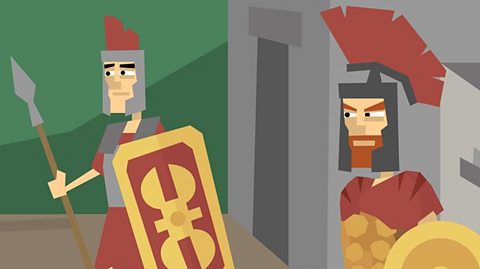
I’m Kashta, a soldier from Africa serving in the Roman army.
This is dinner. Or… maybe a pet.
I haven't decided yet.
They're sending us to Hadrian's Wall in Britannia.
That's Livius from France. Lucio’s from Spain. And our archer here? He’s from Syria. Best shot on the boat.
Some of our roles will be written down on tombstones and in the Notitia Dignitatum, a military document. So you’ll know in the future we were here.
Britain's full of soldiers from every corner of the Empire.
Ah, we’ve arrived. Now for a long walk! See you at the fort!
Here we are at Aballava. Traders, families, and children from overseas have come along with us for the ride.
They'll all make their lives here with us.
This isn't just a fort, it’s a community.
See this graffiti? Names from far-off places. Archaeologists will read these one day and know we came from lots of different places.
And it's not just here. Writings all along the Wall record people from France, Spain, Greece, Romania.
It's written down. Proof that soldiers who lived here came from all over the Empire.
And get this: even your scientists in the future will check our teeth and bones to learn about what food we ate as children.
They'll use this and more to show we weren't born here. Creepy, right?
So who lives in Roman Britain? Mostly Britons of course!
But the Empire brings in people from Africa, France, Spain, Syria. Soldiers, traders, families… and the odd goose!
And if you don't believe me, well, the military documents, the graffiti, the bones, they'll tell you the same story.
Dinner! Dinner! Oh Gods!
Dinner, come back! Dinner, come back!
What were houses like?
Most people in Britain would have still lived in small villages of wooden houses with thatched roofs.
The Roman's also lived in towns like Aquae Sulis (Bath), which was famous for its baths.
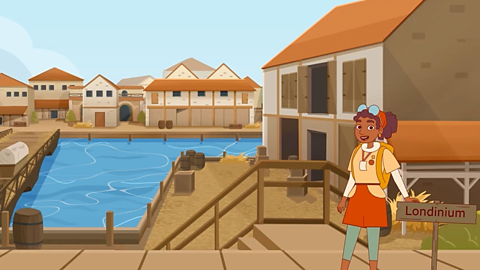
The biggest city in Roman Britain was Londinium (London).

Poorer Romans in towns or cities might have lived in insulae, which were like modern flats or apartments, made from wood and had shops on the ground level.
Roman villas were usually built in square or rectangular shapes and had separate rooms.

Wealthy Romans also built grand country houses called villas.
Villas were large farms with a big house for the owners.
They had many rooms, some with beautifully painted walls, and mosaic floors.
They also had lots of servants and farm workers to help run the villa.
There is only evidence of around 100 villas in Britain from a population of around 3-5 million people.
Most of the Roman villas found by archaeologists are in the south of England. The governor of Britain had one in London. Another villa was beside the sea, at Fishbourne (near Chichester in West Sussex).
What was a Roman family like?

Men were in charge of the family in Roman Britain.
Mothers were thought to be less important than fathers.
Men also worked the land or in trade.
The Roman army had soldiers from all over the Empire stationed in Britain and from Spain to North Africa.
Boys from rich families learnt Latin and wrote on wax tablets. They were also trained to fight with swords.
Children could be married at the age of 14 and marriages were often arranged between families.
Life for women in Roman times was often hard because they weren’t classed as citizens (someone belonging to Rome, who was protected by Rome’s laws) and weren’t protected under the same laws as men.
Women ran the home, cooking and raising the children, although in wealthy families, enslaved people often did this work.
Many women died young (in their 30s), because childbirth could be dangerous and diseases were common.
Watch: Children in Roman Britain
Watch the video below to learn more about what life was like for children in Roman Britain.
Find out what life was like for children in Roman Britain
What was life like for children in Roman Britain?
Discipline for children was very firm in Roman times as it was thought to make them strong, to improve their character and, for boys, to prepare them for life in the army.
Before the Roman invasion, most British children learnt about their histories and their tribal customs through stories and songs shared with their families around a fire at night. But once the Romans were here then, for the posh kids at any rate, you had to learn to read and write. And what they were learning to read and write was, of course, Latin.
This is a wax tablet and it's what school children in Roman Britain would have used when they were learning to read and write.
It's really cleverly designed, because it's basically just two bits of wax put on top of some wood, and they're joined together with a bit of string or leather here. And this doesn't look like it, but this is a Roman-style pen - it's just a bit of pointy metal. And the very clever thing is that you could write down your word, and I'm going to write a word, "Londinium", which is what the Romans called London. But, if you made a mistake, then you could rub it out with this flat end of the pen.
So, I'm writing Londinium and it will look like I've made a mistake at the end, because when they were writing capitals, the Romans didn't use a U, like we use, they used a V instead. So, it looks like I've written Londinivm, but I haven't. I've actually written the Roman name for London - Londinium.
Some girls were educated, but it was mainly the boys. And if you were poor or a slave, then it was very, very unlikely that you'd get the chance to be taught at all.
Those children privileged enough to receive an education learned reading, writing and maths, as well as other subjects, such as how to speak in front of an audience, which would prepare them for important jobs, like being in the Roman army.
What technology did they bring?
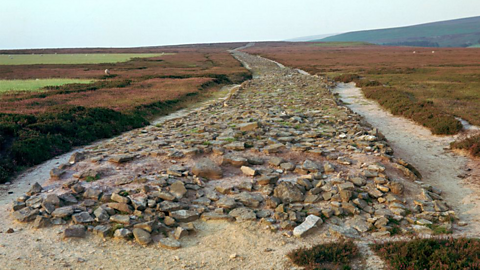
The Romans were very good at building roads and bridges.
To make sure soldiers and supplies could move from town to town quickly, the Romans made their roads as straight (in a line) as possible.
While most Roman roads were excellent, some people complained about the need to repair them after lots of heavy use and worried they would injure animals which the Roman's used for transport.
Many roads in Britain today follow the same or similar routes to those that the Romans built 2,000 years ago.
Although they didn’t invent the arch, the Romans were masters at using arches to build big buildings and aqueducts (a man-made structure that carried fresh water to towns and cities, these could be overground or underground).

Aqueducts were built to supply towns with water from springs, rivers or lakes.
The Romans liked to keep clean, using water from the aqueducts. Towns and forts had underground drains to take away dirty water and sewage.
The drain pipes were flushed with water from the baths, so they didn't get too smelly, though it didn't always work.
Fresh water and sewers were important, without them people risked catching disease.
Think like a historian

Have a look at the thinking points below and think about your answer to each question. You could even write them down on a piece of paper or discuss them with somebody else if you want to.
Why might the people living in Britain not want to live like the Romans?
Did the introduction of roads, aqueducts and public baths benefit everyone?
Were Roman ideas and ways of life similar to today?
People were used to their own ways of life and some Roman ideas were very different. The Romans were also seen as ‘invaders’ and so many people, particularly in the north, didn’t like the Romans or their ways of life.
The Romans wanted as many people as possible to become Roman, but lots of people continued living away from Roman towns and cities. Roads would help anyone move faster between towns but aqueducts and public baths would only be useful to people living in towns and cities.
Some Roman ideas and inventions are similar to what we use today and others weren’t. We still use roads, have clean water and look after our bodies, but women have many more rights now and we don’t speak Latin.
Activities
Activity 1: Roman homes
Click on the labels below to find out about the different rooms of a Roman villa.
Activity 2: Important Roman buildings
Click on the town below to find out about some of the important buildings.
Activity 3: Quiz – Life in Roman Britain
Grown-ups corner
Are you a parent, carer or teacher?
Take a look at some of the links below on KS2 History which are packed full of knowledge, videos, quizzes and activities.
KS2 History: The Romans
BBC Bitesize for Teachers
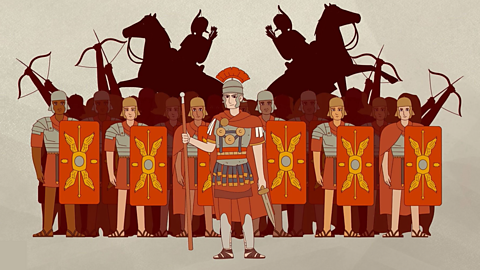
KS2 History: The Romans. 4: The Romans in Britain
BBC Bitesize for Teachers
KS2 History: The Romans. 5: The legacy of Ancient Rome
BBC Bitesize for Teachers
Horrible Histories: Raid and Trade game! game
Play Horrible Histories: Raid and Trade KS2 History
More on Roman Empire
Find out more by working through a topic
- count6 of 6
- count1 of 6
- count2 of 6
- count3 of 6