How do historians use newspapers to interpret the past?

Historians use newspapers as a primary source of evidence to learn more about the past. A primary source is a something created at the time or near the time of an event that we can use to learn about the event.
Newspapers have provided us with information about significant historical events and people. It was often the first way that people found out important news.
In the modern day newspapers are still printed, and they are also available online. Many years ago, they would be printed and sold on street corners. It is possible to search for old newspapers online and view them in archives in libraries.
If you do explore your local history, make sure you go with a trusted adult.
Important words
| Keyword | Definition |
|---|---|
| Archive | A collection of records and information that is stored somewhere such as a library or museum. |
| Bias | A one-sided viewpoint about someone or something. |
| National newspaper | A newspaper that covers news from across the whole country and often around the world. |
| Local newspaper | A newspaper that covers news from a local area. |
| Propaganda | Sending a message about an idea to make people believe it. It could be biased, misleading or done to boost morale. |
| News outlet | An organisation such as newspapers or broadcasters that gather and report news. |
Watch: How can newspapers help us learn about the past
Discover why newspapers are useful historical sources and why they are only one part of the story.
Holly: Read all about it. Read all about it. Incredibly well dressed, historian, hands out newspapers on the street. Read all about it.
Today, most of us hear about the news with much more immediacy. But not so long ago, national newspapers were the main way that people heard about events from across the country and around the world.
Back in the Victorian era, you might have seen newspaper sellers on street corners.
There's also these, local newspapers, which would keep us up to date with events much closer to home.
Newspapers are an amazing way to look at a moment in time, but do they tell the whole story?
Now, you'd think if you wanted to research a topic from the past, you could just pull up a newspaper article from the archive and you'd have the whole story.
But that's not quite right, the news is more of a clue than the full picture.
We really need to put on our detective hat and find out who wrote the article, where they got the information from, and how reliable is that information.
We can do this by checking other sources for the same story, eyewitness accounts, photographs, even other articles, and using these to build together a full picture of events, not just what the journalist or the newspaper owner wanted you to think.
We also need to think about how the newspapers of the past reflect the values, interests, and opinions of the time, which may be completely different to how we see things today.
Let's look at some real headlines and see what's behind them.
First up, this article from National Newspaper, The Daily Mirror in 1939.
Now, during the Second World War, parents were advised to send their children to live in the countryside, often with absolute strangers in order to keep them safe from bombing raids in the big cities.
‘And they did smile! A teacher cheerly told a father, “We'll be back in a week. The weather's glorious for a nice holiday.” Organisation was so good that a quarter of an hour after the assembly, the children were ready to move. Not one of the 250 children was late at Mandeville Street School, Lower Clapton. Once inside their buses, they talked happily with their parents through the windows. “Got your comics, Bert?” shouted a fond father. Bert had them all right, with his gas mask. The evacuation went off with remarkable smoothness.’
Wow, the evacuations sound like they were great fun and that everyone was excited to have a holiday in the countryside. It turns out there are quite a lot of other sources that show that we are not getting the full picture of this event.
Later on, evacuees reported, and letters from children showed, that a lot of them were very distressed by the separation from their parents. They may have been safe from the bombings, but the evacuations were definitely not a holiday. Lots of doctors’ inspections also showed that many evacuees were not getting enough to eat, which embarrassed the government at the time and showed that these cheerful articles may not have been the whole truth.
This headline falls under ‘wartime propaganda’, and what that means is that the newspapers had to follow government guidelines on what they could print. This meant they had to print happy stories and leave out the bad news.
And what this means for us as historians is we have to dig a little deeper to uncover the truth. Newspapers are hugely valuable sources of information that can help us see into the past.
I'd love to know what newspaper articles you can find about your town from a hundred years ago. What are the pictures or documents or eyewitness accounts you can find to back up that story?
It's up to you to uncover History Clue Crew!
How has reporting news changed?

How quickly we learn about the news has significantly changed due to technology.
For example, in 1952, it would have taken longer to learn about historical events such as the death of King George VI. Not everyone had a television, and many people learned about the news from newspapers.
Because of the internet and social media, the news of Queen Elizabeth II’s death in 2022 spread across the world within minutes of the news breaking. Due to this technology, we find out news much quicker now than we did in the past.
How do historians use newspapers?

Historians use newspapers as part of a wider picture into history. It is important for historians to use information such as who wrote the piece and their viewpoint to understand the bias and what a journalist may have wanted us to think.
Newspapers have been an important way of finding out about what life was like during the World Wars. Historians are aware that during World War Two, there was a lot of propaganda.
Newspapers had to use government guidelines when printing information. For example, they could only share mostly positive stories and they sometimes did not publish negative stories that could affect morale. Historians think about this when using newspapers made at that time to learn about the war.
Historians use might use many newspapers written by different people, alongside other accounts, pictures and first-hand reports to show the full picture of historical events and people.
How do newspapers help us to learn about continuity and change?

Newspapers help us to learn about how our local area has changed through time. They offer insight into how historical events have unfolded and the direct impact that it had nationally and locally.
Local newspapers reflect local traditions and events that are important to communities. Looking at what newspapers write about a place over time helps us to see what has stayed the same and what has adapted.
For example, since 1985, a small town in mid Wales called Llanwrytd Wells, has hosted a Bog Snorkelling Championship. This unique event has been reported on in the Western Mail newspaper and other news outlets ever since.
Examples of newspapers

Image caption, Newspapers were often sold on street corners. It was often the first way in which people learned about the news.


1 of 4
Think like a historian

Have a look at the thinking points below and think about your answer to each question. You could even write them down on a piece of paper or discuss them with somebody else if you want to.
How could you find out about important news that happened near you 10 years ago? How about 50 years ago?
Historians are careful to use more than just one newspaper when learning about a period of history. What other pieces of evidence might they look at?
Did you think about using newspaper archives to find about local news? With a trusted adult, could you could look at the websites of local newspapers, or visit your local museum or library to see if they have a newspaper archive. Bigger museums such as the British Museum have online archives that you could search.
Newspapers provide only one viewpoint of history, so historians use information from other places made around the same time to get the full picture of an event. Historians use newspapers alongside other accounts, pictures, first-hand reports and other newspapers written by different people to understand a person or event better.
Quiz
Grown-ups corner
Are you a parent, carer or teacher?
Take a look at some of the links below on KS2 History which are packed full of knowledge, videos, quizzes and activities.
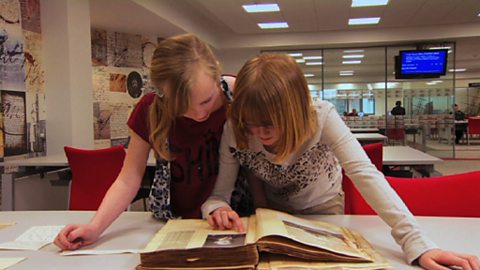
How to research newspapers
BBC Bitesize for Teachers
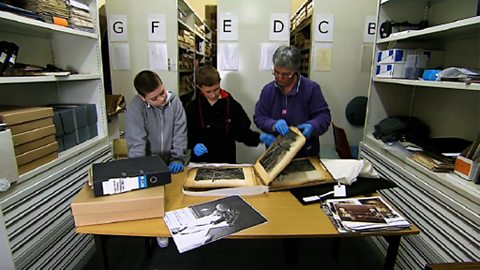
How to use archives
BBC Bitesize for Teachers
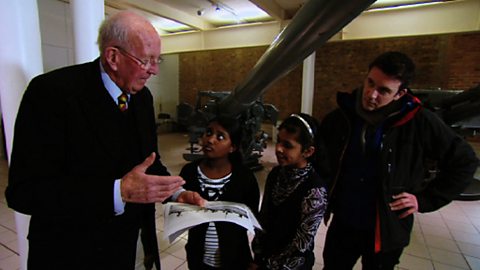
How to interview people
BBC Bitesize for Teachers
Horrible Histories: Raid and Trade game! game
Play Horrible Histories: Raid and Trade KS2 History
More on Local history
Find out more by working through a topic
- count9 of 10

- count10 of 10
- count1 of 10


