All about calculators
The first mechanical calculator was introduced around 400 years ago and looked a lot different to the ones we use now. Used by generations, calculators have been a part of education and various careers for many years, with historic designs evolving into the devices and applications we know today.
Of course, early forms of calculations and mathematics go back much further. But what did people use before calculators, when were they invented, and how do they actually work?
Here, BBC Bitesize has created this guide to answer those questions and more!

What is a calculator?

Used in everyday life, a calculator is typically an electronic or mechanical device used for performing calculations. These calculations vary from arithmetic such as addition, subtraction, multiplication and division to more complex mathematics.
Developed over the centuries, there are many different types that have different functions, such as scientific calculators and graphing calculators. But the more basic calculators are usually small devices with a visual display and keyboard, which contains number and various symbol buttons.
Today, most computers and smartphones have built-in calculator applications. The calculators we know and use today are vastly different from early designs and products.
Who invented the calculator and when?

French mathematician and physicist Blaise Pascal is widely recognised as the inventor of one of the first mechanical calculators. Born in 1623, Pascal invented a pioneering early calculating device when he was in his late teens.
Known as the Pascaline, he is said to have created it in the 1640s to assist his father, who was a tax collector, with calculations. The early calculator wasn’t small like the many we know today.
It was a mechanical, brass-boxed machine that could add and subtract directly using a gear and wheel mechanism. By turning the numbered dials, which were located on the outside of the box, you could add and subtract.
It could also perform multiplication and division, although this relied on repeated additions and subtractions. But while Pascal created the first widely known mechanical calculator, centuries later it was revealed that his invention was preceded by a 1623 design by Wilhelm Schickard.
The German professor is said to have designed a ‘calculating clock’ known as the 'Rechenuhr' to assist astronomer Johannes Kepler with addition, subtraction, multiplication, and division.
But an early prototype is said to have been destroyed by fire, with a later model also lost during the Thirty Years’ War in Germany.
After Schickard’s death, his invention was largely forgotten until sketches were rediscovered in the 20th century by German historian Franz Hammer. In the 1960s, the first functional replica of the design was created.
Other pioneers of early calculators include John Napier, creator of rods called ‘Napier’s bones’ that simplified multiplication and division and Gottfried Wilhelm Leibniz who designed the ‘Stepped Reckoner,’ capable of all four arithmetic operations – addition, subtraction, multiplication and division.
What did people use before calculators?
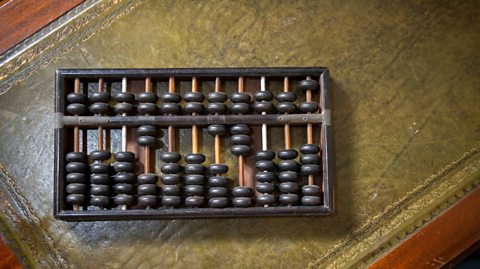
It’s hard to imagine life without the modern calculator - but centuries ago, there were other objects and tools to help with calculations. If we stretch really far back in time, people would source natural items like stones, twigs and shells to help keep count and do basic mathematics.
But one ancient calculating tool that has been used for centuries is the abacus, which in Greek means a ‘board, slab or calculating table.’ The manual rectangular frame has moving beads that can perform addition and subtraction.
The sliding beads represent numbers and the vertical rods they are on represent different place values such as ones, tens and hundreds. Slide rules were invented in the 1620s, used widely for centuries.
The hand-operated analogue device was used for everything from rapid multiplication to logarithms. A slide rule is essentially a ruler and a sliding piece, both marked with logarithmic scales that allowed for quick maths calculations.
Of course, certain calculations were noted down on mathematical tables for people to refer to and manual methods like pencil-and-paper were used regularly for mental arithmetic.
How do calculators work?

There are several factors that work together in a calculator to perform various mathematical functions. How it all comes together is quite complex and there is a lot of in depth detail, but here's a more basic, stripped back step by step of how it all works for most standard calculators.
On a calculator, there are several physical buttons labelled with digits and operational symbols. When pressed down, a button completes a circuit beneath the key which sends an electrical signal through a circuit board.
The microprocessor, known as a central processing unit (CPU), identifies the signal and the button that has been pressed. The CPU is a tiny computer chip that is like “the brain” of the calculator.
It consists of thousands of electronic switches, known as transistors, and directs all operations and calculations. When a button is pressed, the transistors can turn electricity ON and OFF.
ON is when electricity flows and represents 1, while OFF is when electricity doesn't flow and represents 0. Due to this, when the CPU identifies which button is being pressed, it converts the digit into binary.
This is where it gets tricky – but stick with us! The decimal number system we use every day is called denary, and this system is based around the number 10, using the digits from 0 to 9.
But a calculator does not understand this - a calculator understands the binary system, which is instead based around the number 2, using only the digits 1 and 0. The binary code in a calculator therefore must reduce the input into a base-2 system of 1s and 0s.
For example, if you press the number 9, the calculator will need to convert the decimal to its binary (strings of 0s and 1s) which is 1001. In many calculators, this is usually done by using a built-in look-up table which consists of pre-stored data that matches input values to specific output values.
This means that every calculation inputted is built from thousands of on and off switches. The CPU then processes the information by using circuits made from transistors.
In a calculator, there are many transistors paired in different ways that form what is known as logic gates which perform these operations. The logic gates provide specific outputs according to the placement of transistors, the most basic being AND, OR and NOT gates. You can find more out about logic gates and how this specifically works here.
By combining these gates, a calculator can perform operations. Most sources say these gates are combined to create the ALU (Arithmetic Logic Unit), that uses logic gates to perform operations like addition, subtraction, multiplication and division. Inside the ALU, all calculations happen in binary and the transistors use different ON and OFF switch patterns to produce the correct results.
When you press the equal (=) sign for your calculation, the CPU converts the binary answer back to decimal which is suitable for screen display and for us to understand. Although, many calculators store numbers in binary registers, in a Binary-Coded Decimal (BCD) format. This means each decimal digit (0-9) is already stored as a 4-bit binary code (e.g. 9 is 1001) which can make it easier to display the final answer on screen.
How do you use a calculator?

Calculators are used for many purposes, from education to engineering, finance and more. Using a calculator usually involves inputting numbers and symbols in a sequence to get the result you are seeking.
If you’re working on an addition equation, you can input the first number, then the + sign, followed by the second number and then press the equals (= ) sign to get the answer. To calculate a percentage, multiply the total amount by the decimal form of the percentage.
For example, 30% in decimal form is 0.30. There are so many different examples we could mention, but you will learn more by giving it a go yourself! Head to our learn more section below to find out more from Bitesize!
This article was written in March 2026
