Micro:bit Showcase at MozFest
This is a guest post from Spencer Marsden, when he’s not busy being a resident superhero AV Technician for BBC North, he spends a great deal of time creating seriously impressive applications with the BBC micro:bit.
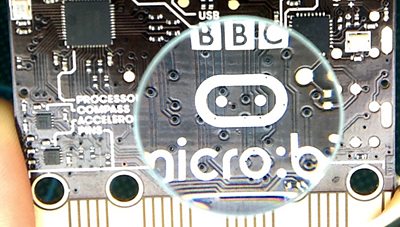
I'll begin by saying I had a great time at MozFest. It was really vitalising to be bringing something to the festival, and to also be in a position of (re)presenting the BBC's micro:bit.
I have been to MozFest before, as a spare pair of hands in the Ethical Café - where, between honing my nascent smoothie-making skills, I enjoyed dialogues with some fascinating people. I was inspired by some RFID projects, and following a conversation with a maker I was able to iterate a few ideas and develop a tool during a placement with R&D.
Recently I have been creating some hardware objects for BBC Learning; these are conversation pieces to showcase their micro:bit project. My first build was a ping-pong game, with bats that light-up and trigger videos on ball impacts. This was shown at the launch event for the micro:bit in March.
The next sporting hardware challenge was a foosball table, with goal-line technology, sound, lights, videos, and a scoreboard. The micro:foosball has two goals (ouch!): to show that the micro:bit can be part of a big fun object, and to present great photo opportunities for easy sharing on social media.
Ian Forrester asked if I'd like to come to MozFest again, and I jumped at the chance, putting the foosball table forward as a project to showcase. BBC Learning agreed that an appearance at the festival aligned with their project aims, and primed me with the latest information to share with festival-goers. It was then a question of logistically how to get a rather large and slightly delicate object to London...
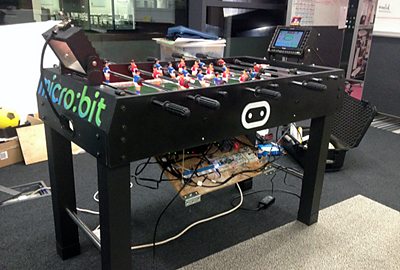
The table uses a pair of micro:bits to keep score, and trigger events and actions on Raspberry Pis & Arduinos, these bits of hardware are all hidden underneath the pitch. After arriving at MozFest I set about re-assembling the table as well as fixing various injuries it had sustained, including a snapped 3D printed arm for the laser sensor, and a faulty HDMI distribution amp.
Being at the festival afforded me the opportunity to talk with David Whale, a developer who has been working with on the micro:bit project for a while. He suggested I share a signal flow diagram with attendees and on social media, I opted for an informal tone...
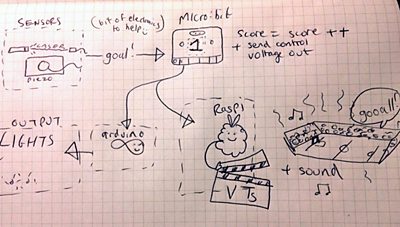
It was great to talk directly with David, gaining insights into the project as well as talking through additional hacks and opportunites.
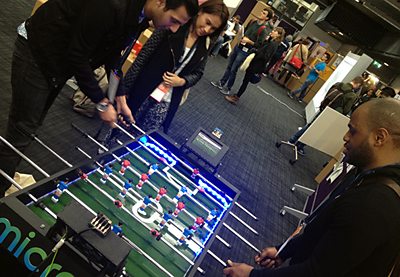
On the Saturday the table was in constant use - my intention was to work on additional features such as tweeting goals live and capturing images, but as it panned out I spoke with visitors all day.
On the Sunday I gave a workshop about using the micro:bit. Interestingly, before I started I had a conversation with a teacher who had some misgivings about the project. He was worried about the timing, teacher inclusion in the planning, and the overall placement of the micro:bit in the current technology environment. I couldn't speak with great knowledge or authority about the first two issues, but we did talk at length about how the micro:bit serves a space alongside other hardware prototyping platforms. I reflected that the micro:bit seems, to me at least, like an ideal 'first contact' to code - a first digital object to create for and with, rather than to consume. He liked the perspective of it as a standard sensor-laden package, with an environment and teaching materials ready to go.
In my workshop I spoke about my own background as a hacker, my own perspective on the micro:bit and what it was designed to achieve. I showed the browser based IDEs - 'Touch Develop' and 'Blocks' as well as a peek at the ARM Mbed C programming IDE. I also showed the ping pong kit and finished with the foosball table - it was a lively session and was a lot of fun.
After the session, it was a case of more foosball games and conversations, I also started to harvest ideas for what else the table could do, with players having to write down an idea after every goal:
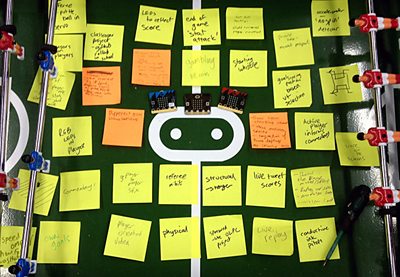
It was then time to de-rig and pack the table away. It had all worked better than I had hoped, and had garnered interest from and been enjoyed by many people.
To conclude I would perhaps state the obvious in saying you get out from MozFest what you put in, and the work and preparation of the table resulted in some fascinating interactions. I fed back to Learning some of the points raised in conversation, and have continued to work on new micro:bit based gizmos. I am to spend a fortnight with BBC Learning in the new year, and I'm looking forward to bringing my Mozfest experience to bear.
