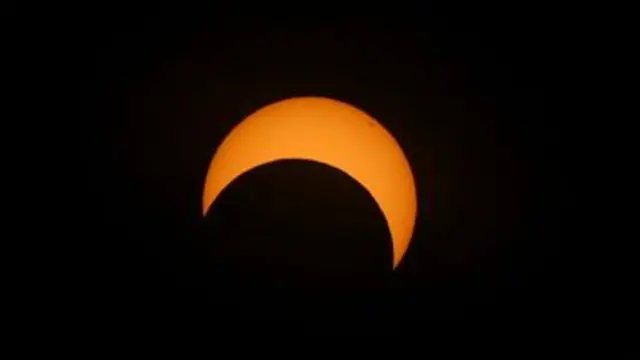
Summary

  • Watch back our live stream of the solar eclipse by pressing the button above

  • BBC reporter Sarah Farmer was streaming live from a viewing event at Hengistbury Head

  • We were also at events in Berkshire, Dorset, Hampshire and Oxfordshire

  • It was the most coverage seen from the UK and Ireland since the 1999 eclipse

  • More than 90% of the Sun was covered by the Moon for most of the UK, while parts of Iceland and Spain witnessed a rare total eclipse

  • Looking directly at the Sun can severely damage your eyes - even during an eclipse. Find out how to watch it safely

  1. Thanks for watchingpublished at 19:43 BST 12 August

    Thank you for joining BBC South's live coverage of the once-in-a-generation solar eclipse.

    Our reporters have been broadcasting live from Rutherford Appleton Laboratory in Oxfordshire, the University of Reading in Berkshire, Winchester Science Centre in Hampshire, and Hengistbury Head in Dorset.

    There will be more pictures, video and reaction online tomorrow morning.
  2. How can I watch the solar eclipse safely?published at 18:11 BST 12 August

    Looking directly at the Sun can severely damage your eyes - even during an eclipse.

    You can use special eclipse glasses to look at the eclipse. It is not safe to just view it through sunglasses, or binoculars or a telescope.

    If you do not have a pair of eclipse glasses you will need to follow the eclipse indirectly using a pinhole projector.

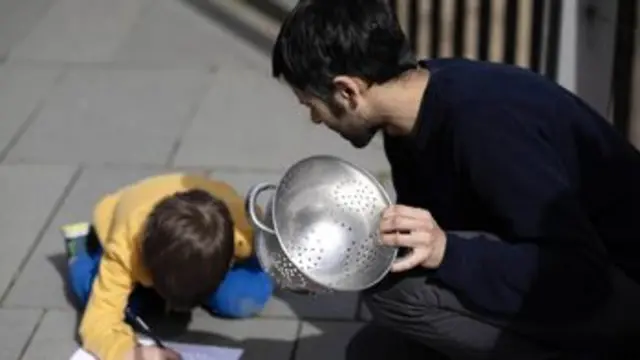
    You can make a simple one with a single sheet of card or something more ambitious using a cardboard box - or you can use a colander to project multiple images all at once.

    A man and young boy look at a piece of paper as a colander projects the eclipse onto itImage source, EPA-EFE/REX/Shutterstock
    Image caption,

    You can use a colander to project multiple images onto a piece of paper

  3. Are you watching the eclipse? Get in touchpublished at 18:10 BST 12 August

    We want to hear from you!

    Are you watching the eclipse? How are you watching?

    You can share comments, pictures and videos in the following ways:

    Please read our terms & conditions and privacy policy.

    In some cases a selection of your comments and questions will be published, displaying your name and location as you provide it unless you state otherwise. Your contact details will never be published.

    A purple banner with Your Voice written in white
    Image caption,

    Tell us where you are

  4. When is the peak?published at 18:08 BST 12 August

    Depending on where you are in the UK, the eclipse will be at its maximum between 19:02 BST and 19:16 BST.

    In Reading, the partial solar eclipse will reach a maximum of 92.9% at 19:13 BST.

    The further north, the earlier you will see the maximum eclipse.

    And, in general, the further west you are, more of the Sun will be covered.

    The best places to view the eclipse are from higher ground, or areas with a clear view towards the western horizon.

    The sun is partially covered by the moon.Image source, Agustín Marcarian/ Reuters
    Image caption,

    Annular solar eclipse as seen in Las Horquetas

  5. Welcome to our live stream of the solar eclipse in the Southpublished at 18:05 BST 12 August

    A partial solar eclipse will be visible across much of the UK and Ireland this evening.

    BBC reporter Sarah Farmer will be live streaming from a viewing event at Hengistbury Head, which can be watched using the button at the top of this page from 18:30 BST.

    For the first time in about three decades, more than 90% of the Sun is expected to be covered by the Moon at the eclipse's peak shortly after 19:10 BST.

    BBC South is reporting live from viewing events in Berkshire, Dorset, Hampshire and Oxfordshire.