Summary

  • The Bank of England holds interest rates at 3.75% as uncertainty over the Iran war continues

  • This is a clear message that higher inflation is on the way – and higher rates are likely this year, writes our economics editor

  • The Bank's committee voted 8-1 to hold the rate - with its chief economist voting for a rise

  • The Bank's decision comes less than 24 hours after oil prices hit their highest level since 2022 at $126 a barrel

  • What are interest rates? Interest is the extra amount you get charged to borrow money. The rate set by the Bank of England - now at 3.75% - influences rates set by other lenders, which in turns affects consumer loans, mortgages and return on savings

  1. 'Where we go depends on size and duration of energy shock,' says BoE governorpublished at 12:40 BST

    Dearbail Jordan
    Business reporter, reporting from the Bank of England
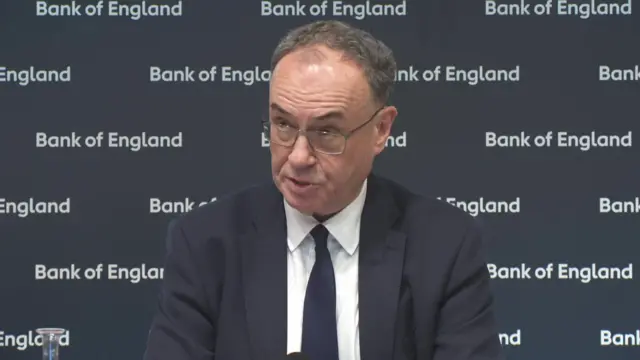
    Bank of England governor Andrew Bailey in suit and tie sitting down during a press conference

    Bank governor Andrew Bailey has started speaking.

    He says that where we go from here – which means what will happen to interest rates - will "depend on the size and duration of the energy price shock".

    You can watch live above.

  2. New fixed mortgage could cost £80 a month more during next three years - Bankpublished at 12:39 BST

    Kevin Peachey
    Cost of living correspondent

    People coming to the end of their fixed mortgage deals will be looking with some trepidation at the news coming from the Bank today.

    In its report, the Bank's rate-setting committee says that, over the next three years, average monthly payments for those moving on to a new deal (or getting a first one) are expected to rise by approximately £80.

    But it stresses that is an average and there could be considerable variation, and that estimate will depend partly on the outlook for energy prices and all that affects.

    About 53% of UK mortgage holders are expected to see their payments rise, the Bank says, but around 25% of those who fixed at higher rates should see their payments fall, despite recent increases in rates.

  3. UK in 'stronger position' due to government choices, Reeves sayspublished at 12:25 BST

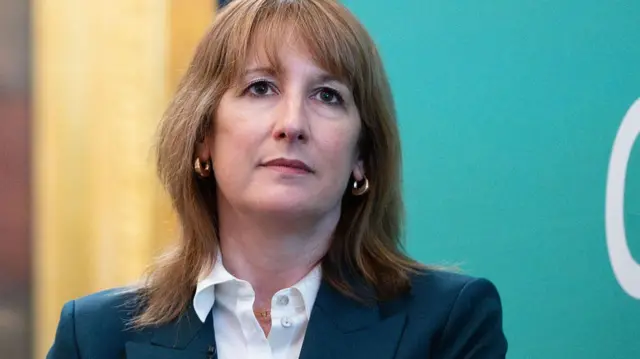
    A file photo of Reeves, sitting on stage at an eventImage source, Getty Images

    In a statement released after the Bank of England's decision to hold interest rates at 3.75%, Chancellor Rachel Reeves says the war in the Middle East is "not our war, but it is one we have to respond to".

    "Every choice I make will be about keeping costs down for families and businesses, without repeating the mistakes we’ve seen in the past that resulted in higher inflation and higher interest rates," she says.

    "We entered this conflict in a stronger position because of the choices this government took to build economic stability, and we are going further to take back our energy security."

    She adds that the government is also "backing British industry" to "build a Britain that is stronger, more resilient, and prepared for the future".

  4. Reeves has 'weakened' economy and left UK 'vulnerable' to energy crisis - Conservativespublished at 12:22 BST

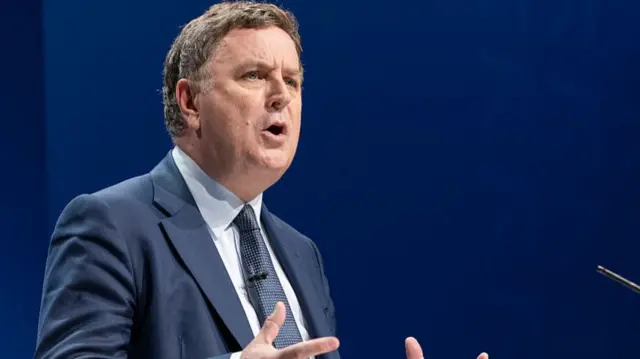
    Mel Stride Shadow Chancellor of the Exchequer delivers a speech to the Conservative Conference on October 6, 2025 in Manchester, EnglandImage source, Getty Images

    Shadow chancellor Mel Stride says Rachel Reeves has "weakened" the UK economy, following the Bank of England's decision to hold interest rates at 3.75%.

    He adds that the Labour chancellor has "left us vulnerable in the run up to the latest energy crisis".

    "The conflict in the Middle East is pushing up prices - but the UK already had the highest inflation in the G7 thanks to Labour’s choices," he writes on X.

    "Tax hikes, reckless spending and disastrous energy policies have paved the way for high inflation and interest rates staying higher for longer."

  5. Committee almost united over decision to holdpublished at 12:15 BST

    Kevin Peachey
    Cost of living correspondent

    At its last meeting in March, the committee was unanimous in its decision to hold interest rates.

    This time, the vote was 8-1.

    The Bank’s chief economist, Huw Pill, voted for a rise to 4%. Other members said the Bank should wait to see the extent of the inflationary pressure, despite some considering to vote for a rise.

  6. Bank outlines three energy price scenarios, reflecting Iran war uncertaintypublished at 12:13 BST

    Faisal Islam
    Economics editor, reporting from the Bank

    The Bank reflected the uncertainty over the war in the Middle East by outlining three scenarios for energy prices.

    Its experts seem to endorse a modest rate rise or two even in a more benign scenario, with energy prices moderating from here.

    The Bank’s chief economist Huw Pill voted for a rise this month, alone. Other members said the Bank should wait to see the extent of the inflationary shock.

    In an adverse scenario with oil above $120 a barrel for the rest of the year and much higher natural gas prices, as many as six rate rises to 5.5% are hinted at, by the end of the year, to try to manage inflation down from a forecast 6%. The economy would be much weaker in such a scenario and unemployment higher.

    The oil price was already around this range this morning, after President Trump indicated the US blockade of Iranian ships could last months longer.

    It is the relatively modest reaction of gas prices, for example compared with the Ukraine crisis two years ago, that has helped the Bank hold off rate rises.

    It also said that the pass through of inflation to wages - which can become a reinforcing upward spiral - might be limited by the fact that most pay deals for the year were concluded before the start of this energy shock

  7. Bank points to likelihood of higher inflation and interest rate rises later this yearpublished at 12:09 BST

    Faisal Islam
    Economics editor, reporting from the Bank

    While the Bank of England held interest rates at 3.75% just now, it pointed to the likelihood of higher interest rates, and the possibility of what it called "forceful" rises.

    Up to six rises could be possible in a worst case if oil prices remain at today’s levels approaching $130 a barrel for the rest of the year, and gas prices rise further, with inflation almost doubling to above 6%, it says.

    The Bank’s nine member committee has sent the message with its deliberations and forecast that higher inflation is on the way and higher rates are likely this year.

    Exactly how much higher both will go, remains as uncertain as the underlying prospects for reopening the Strait of Hormuz.

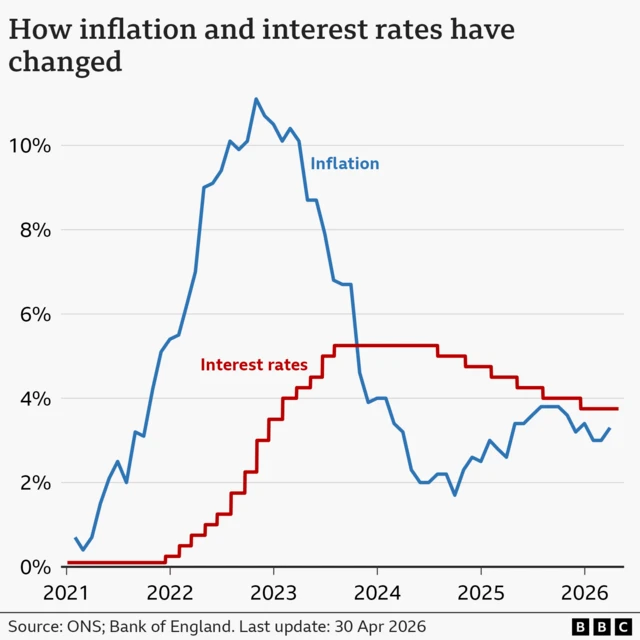
    A line chart showing interest rates and CPI inflation in the UK, from January 2021 to April 2026. Interest rates were at 0.1% in January 2021. They were increased from late-2021, reaching a peak of 5.25% in August 2023. They were then lowered slightly to 5% in August 2024, to 4.75% in November, to 4.5% on 6 February 2025, to 4.25% on 8 May 2025, to 4% on 7 August, and to 3.75% on 18 December. At the Bank of England's latest meeting on 30 April 2026, rates were held at 3.75%. The inflation rate was 0.7% in the year to January 2021. It then rose to a peak of 11.1% in October 2022, before falling again to a low of 1.7% in September 2024 and then starting to rise again. In the year to March 2026, it was 3.3%, up from 3.0% the previous month.
  8. No surprise the interest rate was held, but what next?published at 12:03 BST

    Kevin Peachey
    Cost of living correspondent

    There’s no great surprise in that decision by the Bank of England to hold interest rates at 3.75% – it was widely predicted by analysts.

    But now every page of the committee’s report and every word spoken by the Bank’s governor will be pored over by the markets.

    Any indication of what the members of the rate-setting committee might do at future meetings can shift their expectations.

    In turn, that can have an impact on what lenders charge borrowers, and what banks and building societies offer savers.

  9. Interest rate held by Bank of England at 3.75%published at 12:00 BST
    Breaking

    The Bank of England holds its interest rate at 3.75%.

    Our teams are looking over the announcement now and we'll bring you more shortly.

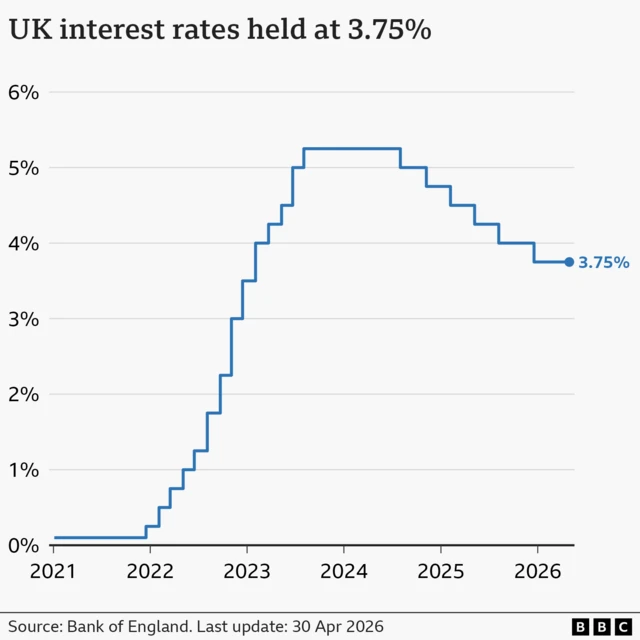
    A line chart showing interest rates in the UK from January 2021 to April 2026. At the start of January 2021, rates were at 0.1%. From late-2021, they gradually climbed to a high of 5.25% in August 2023, before being cut to 5% in August 2024, 4.75% in November, 4.5% in February 2025, 4.25% in May, 4% in August, and 3.75% in December. At the Bank of England's latest meeting on 30 April 2026, rates were held at 3.75%.
  10. Bank of England's interest rate decision expected shortlypublished at 11:58 BST

    At 12:00 BST we will hear the Bank of England's decision on interest rates, which many experts expect to be held at 3.75%.

    We'll bring you the news as soon as we have it, followed by analysis from our team of expert on what it means for you.

  11. Analysis

    Beyond the rate decision, people will be looking closely at the Bank's language todaypublished at 11:56 BST

    Dearbail Jordan
    Business reporter

    It is unlikely - not impossible - but highly unlikely that the Bank of England will change interest rates today.

    What we'll be looking at is the language the Bank uses and what it could mean for rates in the coming months.

    What impact will the Iran war have on Britain's finances? What will it mean for energy bills, inflation and, by extension, the cost of living?

    The Bank may talk about the prospect of stagflation - stagnant economic growth and rising inflation at the same time.

    Or it could repeat what it said in February, that it stands ready to act. Because, at the moment, we just don't know when the conflict will end.

  12. The last 24 hours shows how unpredictable things arepublished at 11:51 BST

    Kevin Peachey
    Cost of living correspondent

    Members of the rate-setting committee will be earning their crust today as they weigh up all the complicated factors affecting economies here and around the world.

    Last night added another important issue to consider as oil prices jumped to their highest level since 2022 before dipping in the last hour or two.

    A wait-and-see approach, and a hold in interest rates, may seem like the easy option when faced with a whole load of economic unpredictability. It is, however, a very active decision.

    As one analyst says, the committee is likely to "resolutely do nothing".

    As our economic editor notes, the latest reports of US plans to strike Iran will not be factored into today's decision - read Faisal Islam's analysis.

  13. Ups and downs of mortgage rates are tricky to predictpublished at 11:43 BST

    Kevin Peachey
    Cost of living correspondent

    One thing is clear: the economic upheaval created by the war in Iran has pushed up the cost of mortgages for homeowners getting a new fixed deal.

    Remember, for borrowers, the interest rate on a fixed mortgage does not change until the deal expires, usually after two or five years, and a new one is chosen to replace it.

    The average rate on a two-year fixed deal was 4.83% at the start of the conflict, but rose to a peak of 5.90%, according to financial information service Moneyfacts. That has now dropped to 5.79%.

    A host of lenders have announced cuts in the last 24 hours, but brokers say that fixed rate rises in the coming weeks cannot be ruled out.

    "The standard advice in uncertain economic times stands: secure a mortgage rate you think suits your circumstances or looks reasonable value for money as soon as you can, then try to switch to a cheaper deal with the lender before your mortgage is due to complete," said Aaron Strutt, from mortgage broker Trinity Financial.

  14. Savers urged to shop aroundpublished at 11:41 BST

    Kevin Peachey
    Cost of living correspondent

    Savers are keen for interest rates to go up. Borrowers are keen for rates to go down. Most people actually fall into both camps.

    When interest rates are held, the temptation for savers, in particular, is to stick with what they've got.

    But experts say that "apathy" can mean they are missing out on the possibility of a better return on their nest eggs.

    Half of UK savings accounts can beat 3.75% - the current Bank of England benchmark rate - but it is usually those who haven't switched provider for a long time who get the worst deal, according to financial information service Moneyfacts.

    The danger is that if prices rise sharply, then the buying power of those savings is diminished, especially if the interest received on those savings is poor.

  15. Reports of US strike plans on Iran won't be factored into today's decisionpublished at 11:39 BST

    Faisal Islam
    Economics editor

    I’m on my way into the Bank of England to find out its latest interest rate decision and hear from the Governor Andrew Bailey.

    While the number crunchers here have also attempted its latest forecast for inflation and the health of economy, the news overnight dominating all of this is that the oil price has surged to the highest levels seen during the Iran War, indeed since the full-scale invasion of Ukraine four years ago.

    The hopes just a fortnight ago of a ceasefire in the Middle East leading to a steady slow path to some sort of normal situation in the Gulf appear to be in tatters this morning. Back then there was a sharp fall in the Brent crude oil price below $90 a barrel leading to stabilisation of petrol and diesel prices.

    President Trump’s overnight comments appearing to confirm reports in DC that the US is preparing for an ongoing blockade of Iran’s sea traffic have shifted markets to the expectation that the Strait will be blocked for months.

    Also a fortnight ago I spoke exclusively to Andrew Bailey, who was very much in "wait and see" mode and said that market expectations of multiple rate rises had gotten "way ahead" of things.

    While the developments of the past 48 hours will not have been factored into today’s decision and new numbers, it will condition how they are viewed. Could there be a vote or two for a rate rise on the nine member committee? We will find out at noon.

  16. Oil prices jump to highest level since 2022published at 11:37 BST

    This Flourish post cannot be displayed in your browser. Please enable Javascript or try a different browser.

    Oil prices jumped to their highest since 2022 after a report that the US military is set to brief President Donald Trump on new plans for potential action in the Iran war.

    US Central Command has prepared a plan for a wave of "short and powerful" strikes on Iran to try to break the deadlock in negotiations with Tehran, news site Axios reported. The BBC has contacted US Central Command and the White House for comment.

    Brent crude rose by almost 7% to more than $126 (£94) a barrel at one point, the highest since Russia's full-scale invasion of Ukraine.

    Energy prices have risen this week as peace talks appear to have stalled, with the key Strait of Hormuz waterway still effectively closed.

    After reaching $126.31 a barrel at one point in Asian trade, the price of Brent crude fell back to around $116 in European trade.

    Crude oil is a key ingredient in petrol and diesel, and the jump in costs since the start of the Iran war has pushed up pump prices for motorists.

  17. What's been happening with interest rates?published at 11:28 BST

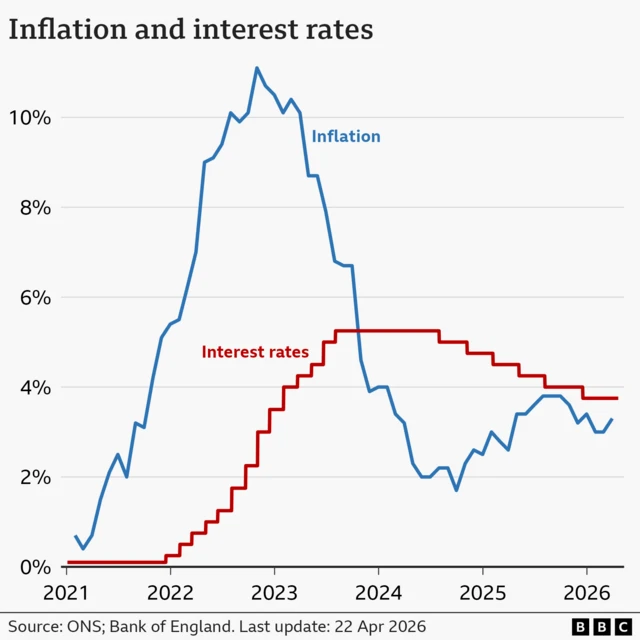
    Here's a look at what UK inflation and interest rates have been doing over the last five years.

    The inflation rate has come down significantly since the high of 11.1% recorded in October 2022 as a result of the war in Ukraine.

    The latest figures show it was 3.3% in the year to March 2026, up from 3% in the year to February.

    A line chart showing interest rates and CPI inflation in the UK, from January 2021 to March 2026. Interest rates were at 0.1% in January 2021. They were increased from late-2021, reaching a peak of 5.25% in August 2023. They were then lowered slightly to 5% in August 2024, to 4.75% in November, to 4.5% on 6 February 2025, to 4.25% on 8 May 2025, to 4% on 7 August, and to 3.75% on 18 December. At the Bank of England's latest meeting on 19 March 2026, rates were held at 3.75%. The inflation rate was 0.7% in the year to January 2021. It then rose to a peak of 11.1% in October 2022, before falling again to a low of 1.7% in September 2024 and then starting to rise again. In the year to March 2026, it was 3.3%, up from 3.0% the previous month.

    The Bank of England's base rate reached a recent high of 5.25% in 2023. It remained at that level until August 2024, when the Bank started cutting.

    Five cuts brought interest rates down to 4%, before the Bank held rates at its meetings in September and November 2025, before a cut in December and further holds in January and March 2026.

  18. Analysis

    A big surprise if the Bank does anything except hold the ratepublished at 11:25 BST

    Ben King
    Business reporter

    It would be a big surprise if the Bank of England does anything except keep rates on hold at 3.75% at noon today.

    But it will still be an interesting day for anyone with borrowings or savings.

    The Iran war will be the biggest factor in rate-setters' thinking. It's pushed up oil prices, and with it prices of petrol, diesel, heating oil and much else of what we buy in the UK.

    Today's announcement will provide many important clues to how the Bank's Monetary Policy Committee members view that oil shock, and the best way to respond.

    In particular, how likely are they to announce a 0.25% rate hike in the summer to try to keep a lid prices if they are rising.

    Watch out for any dissenting voices voting for a hike now.

  19. What happens at the Bank todaypublished at 11:12 BST

    Dearbail Jordan
    Business reporter, reporting from the Bank of England

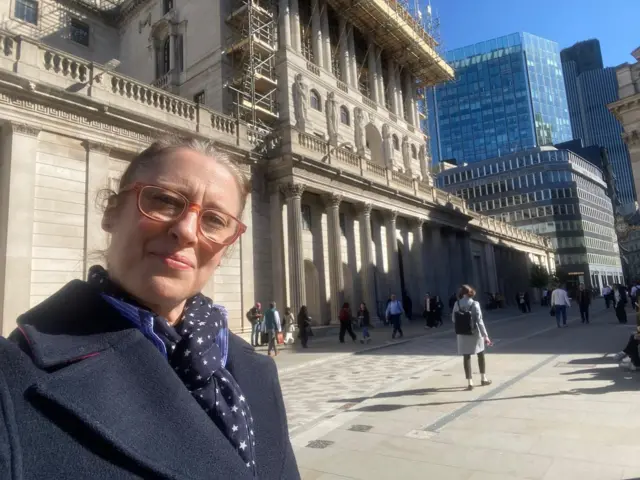
    BBC business reporter Dearbail Jordan standing outside the Bank of England

    At midday today, two things will happen: the Bank of England will announce its interest rate decision and the BBC will publish a news story all about it.

    How can we do this at the same time? The secret is that we journalists get to see the announcement an hour or two before its wider release.

    Because it is market-sensitive information - an unscrupulous trader could, theoretically, make a lucrative bet on the decision if they had prior knowledge - the Bank of England locks us all in its basement to stop any leaks. Not a joke. We must also hand over our phones and the wi-fi is turned off.

    But it means that we get time to go through both the rate announcement and, four times a year including today, a big old brick of a report setting out the Bank's forecasts for the UK economy and inflation.

    So, we read, we write, we scoff biscuits and by the time 12:00 rolls around, the wi-fi is switched on and the story wings its way from the laptop to you.

    See you on the other side.

  20. Bank of England expected to hold interest rates at middaypublished at 11:08 BST

    Thanks for joining us ahead of the Bank of England's latest interest rate decision.

    There are eight rate-setting meetings a year and the outcome affects how much people pay for borrowing on things like mortgages and credit cards and also how much interest people get for their savings.

    Today, the Bank is expected to hold rates at 3.75% - where it's been since December - as a result of the Iran war causing oil prices to rise.

    The Bank uses the interest rate to try and keep inflation at its 2% target - inflation rose to 3.3% in March.

    Before the Iran war, analysts had been expecting interest rates to be cut once or twice this year. Now they think they'll be held or even rise.

    Stay with us for today's decision and our experts' guide on what it all means for you and your money.