Summary

  • Donald Trump has warned that the Iran deal - set to be formally signed on Friday in Switzerland - is "not final"

  • He says the US could resume attacks if the agreement doesn't work out - "If they don't behave, we'll go right back to dropping bombs right smack in the middle of their head, OK?"

  • The president is giving another news conference at the G7 summit now - watch live on this page

  • The deal between the US and Iran has not been revealed - and the White House says one reported version "does not reflect the language" of the actual agreement

  • Earlier, G7 leaders called for a "robust" agreement to follow the Iran deal

  1. Analysis

    Donald Trump's complex relationship with the G7 takes another turnpublished at 17:20 BST

    Bernd Debusmann Jr
    White House reporter

    Donald Trump has just said it has been "one of the most successful" G7 summits.

    The US president has had a long and often complicated relationship with the G7 - stretching back to the start of his first term in office.

    The summits he attended in his first term were filled with tension, driven by his initial push for tariffs and an “America First” foreign policy that upset once-close allies. Some even described the group as “G6+1” - with the US as the pseudo-outcast.

    Those tensions have continued into his second term, fuelled by US frustration over a perceived lack of help during the war in Iran and a belief among allies that US support for Ukraine was wavering.

    Within this context, the pledge of the G7 this year - including the US - to help Ukraine with stronger air defences, energy and fresh sanctions as the war with Russia continues will be seen as a victory for a group that has not always seen eye to eye.
  2. 'I think that's regime change' - Trump says on Iranpublished at 17:17 BST

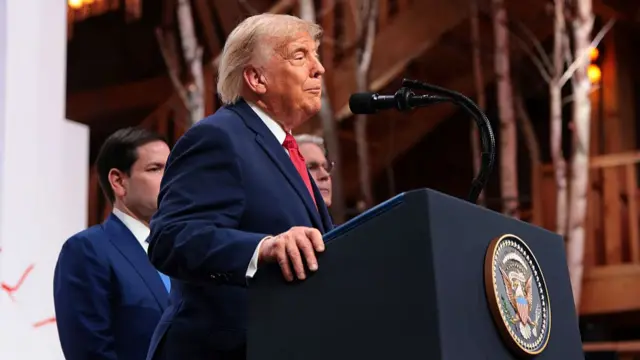
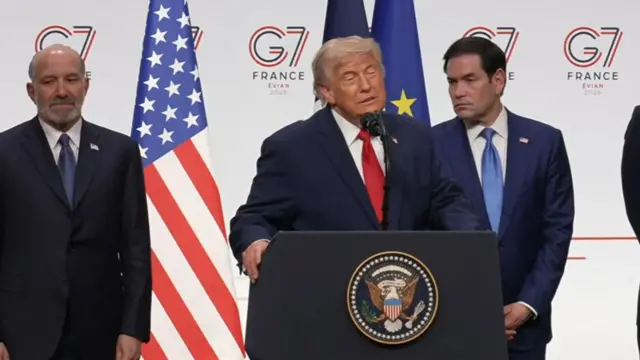
    Donald Trump speaking at a podium at the G7 Summit in FranceImage source, Getty Images

    Trump starts the news conference by thanking President Macron for welcoming him to France, saying it has been "one of the most successful" G7 summits.

    He says the summit comes after the signing of a peace deal that ends the current war in the Middle East, opens the Strait of Hormuz and prevents Iran from obtaining nuclear weapons.

    Trump adds that Iran now has a new group of leaders who are "smarter" and "far less radicalised", saying he has achieved regime change.

    "You talk about regime change, nobody will say that, but I guess it is," he says. "One set of leaders is all gone, the second set of leaders is all gone. Their third set of leaders is a little bit gone... I think that's regime change."

    He then talks about the movement of the stock market in relation to the peace agreement.

  3. Trump news conference beginspublished at 17:01 BST
    Breaking

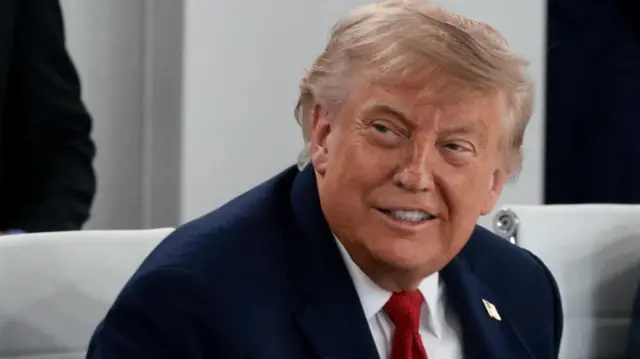
    Donald TrumpImage source, Reuters

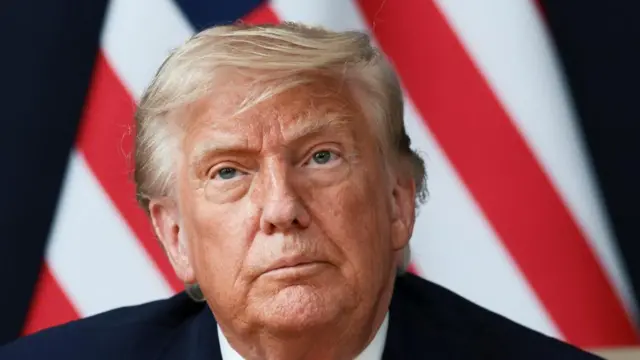
    Donald Trump has started speaking at the G7 summit in France.

    You can watch live at the top of the page.

  4. Trump news conference appears to be delayedpublished at 16:57 BST

    We're still waiting to hear from US President Donald Trump, who said he'd be speaking at a news conference this afternoon.

    Earlier, he posted on his social media platform Truth Social that he would be speaking "in 45 minutes", which would have been 15:45 BST (14:45 GMT) - more than an hour ago.

    There's been no update yet on when the news conference might happen.

    The US president has, however, spoken extensively to journalists at his earlier bilateral meetings with other leaders.

  5. Trump says US considering reimposing sanctions on Russiapublished at 16:52 BST

    Donald TrumpImage source, Reuters

    As we've reported, Emmanuel Macron has said Trump has "taken note that there is no serious will on Russia's side for peace".

    Just before Macron spoke, Trump was asked by journalists whether he thought Russian President Vladimir Putin was more responsible for the Ukraine war. He replied that he didn't want to get into that, as it could risk jeopardising a potential peace deal.

    But Trump has also told journalists that the US is considering whether to reimpose sanctions on Russia.

    "We're looking at that," he said.

    The US has suspended sanctions on Russian oil in an effort to bring down global energy prices, which soared as a result of its war with Iran. Oil prices fell recently after the two sides agreed a deal.

  6. Italian and German leaders hail G7 success after reaching agreement with Trumppublished at 16:28 BST

    Italy's Prime Minister Giorgia MeloniImage source, EPA

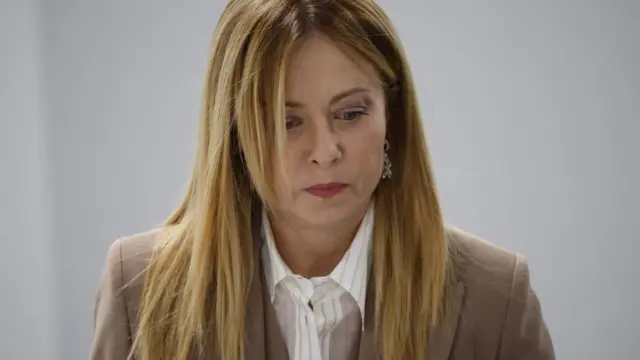
    Speaking on the sidelines of the G7 summit, Italian Prime Minister Giorgia Meloni says reaching an agreement with Trump over Ukraine at the summit is a win for Europe, as his support in this area cannot always be taken for granted.

    Meloni also says she will propose that the EU puts forward a single negotiator for Ukraine. US envoys have previously communicated with Russia directly without EU representation.

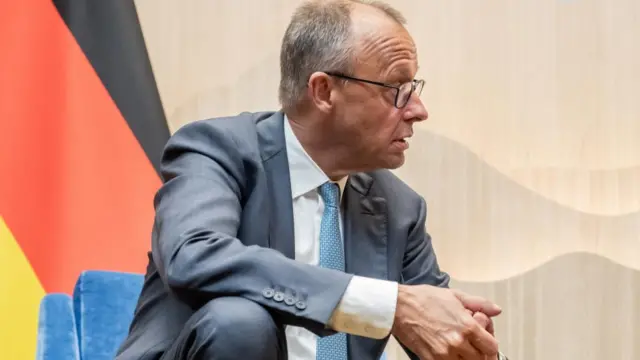
    German Chancellor Friedrich Merz has also described the joint declaration made by G7 leaders at the summit in Evian-les-Bains as a "real success".

    The chancellor notes that it is "the first time since US President Trump took office that we have issued a joint declaration at a G7 summit and found common language on the major foreign and security policy issues of our time".

    "I consider that a real success," he says.

    German Chancellor Friedrich MerzImage source, Reuters
  7. Trump sees no Russian will for peace, Macron sayspublished at 16:12 BST

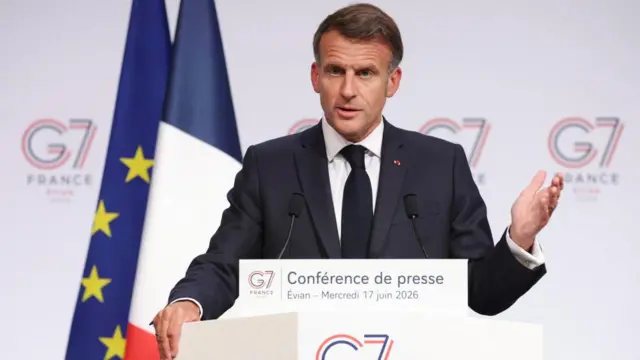
    French President Emmanuel MacronImage source, EPA

    More from Macron's news conference.

    Macron is asked whether the G7 summit showed a change in attitude from Trump on Ukraine, and if he can actually trust the US president to follow through on commitments to support Kyiv.

    The French president says he welcomes US efforts to negotiate with Russia to end the war, but that so far "nothing has come back" from the Kremlin.

    "President Trump, like the rest of us, has taken note that there is no serious will on Russia's side for peace," Macron says.

    • That brings Emmanuel Macron's news conference to a close. We're expecting Donald Trump to speak soon - stay with us
  8. White House official says US media reported deal 'does not reflect language of actual MoU'published at 15:57 BST

    Paul Adams
    Diplomatic correspondent

    The White House director of communications, Steven Cheung, says a document, published by CNN, purporting to represent the text of the Memorandum of Understanding between Iran and the US "does not reflect the language of the actual MoU".

    But the CNN version is identical to one published earlier by Bloomberg. It may not reflect the exact wording of the text due to be signed at a ceremony in Switzerland on Friday, but it offers some insights into a document designed to end the war and kick off two months of detailed negotiations.

    The US will lift its naval blockade of Iranian ports, while Iran will "take steps" to ensure the movement of merchant ships through the Strait of Hormuz, according to the reported text.

    The language on the all-important nuclear issue is vague. Tehran will "reiterate" its promise never to develop a nuclear weapon, a pledge Iran has made many times in the past. All other nuclear issues "will be adequately addressed in a final agreement".

    While international sanctions on Iran will stay in place, the US will issue waivers for the export of Iranian oil as soon as the MoU is signed and billions of dollars of frozen Iranian assets will be made available as talks progress.

  9. Macron calls UK and France defence commitment for shipping an 'offer on the table'published at 15:52 BST

    Macron then turns to the conflict in Iran.

    He welcomes the agreement between the US and Iran, saying it will bring an end to economic instability.

    "We've agreed that toll-free passage through the Strait of Hormuz is the keystone of this agreement, and that starts as of now," he says.

    Macron adds that the defence commitment put together by the UK and France to help shipping return to normal is an "offer on the table", and says about 20 countries "have already fully committed to commit to this kind of operation".

    Media caption,

    Macron addresses US-Iran deal at G7

  10. Ukraine forces advancing and Russia moving backwards, Macron sayspublished at 15:48 BST

    Emmanuel MacronImage source, Reuters

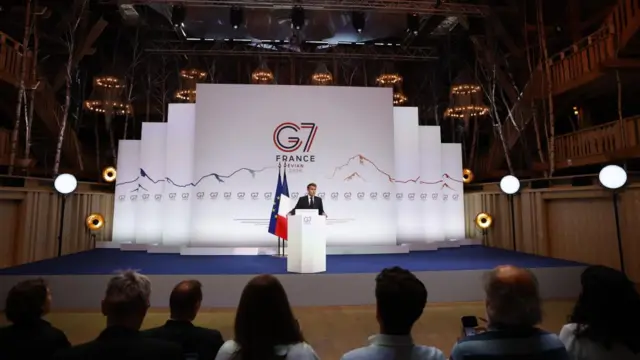
    Macron says the G7 summit in Evian has seen significant discussions on Ukraine and Iran, with nine declarations adopted unanimously by G7 leaders.

    The French president begins with Ukraine, saying there was general agreement among G7 leaders to provide more support for Ukraine and boost its air defence capabilities.

    He says G7 members agreed that the "balance of power" between Russia and Ukraine has changed, with Ukrainian forces now "moving forwards... and Russia backwards".

    Macron says Donald Trump acknowledged it was important to mobilise the US defence industry to provide more weapons for Ukraine.

    There was also agreement to "step up the sanctions" being placed on Russia, he says.

  11. Macron speaking now - watch livepublished at 15:32 BST

    French President Emmanuel Macron's news conference has started.

    You can watch live at the top of this page.

  12. Indian PM raises deaths of sailors in US Gulf strikepublished at 15:28 BST

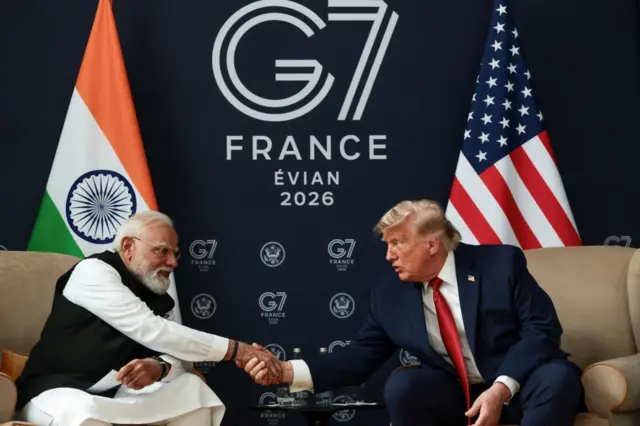
    U.S. President Donald Trump attends a bilateral meeting with Indian Prime Minister Narendra Modi during the G7 Summit in Evian-les-Bains, FranceImage source, Reuters

    Outrage erupted in India last week after three sailors were killed in a US strike on a tanker the US said was violating its blockade of Iranian ports.

    The US also struck two other ships in the Gulf last week, all with Indian crew on board.

    After a bilateral meeting with US President Donald Trump, Indian Prime Minister Narendra Modi says he has emphasised "the importance of freedom of navigation".

    "Their safety is of utmost importance to us," he says, referring to Indian seafarers who keep global shipping routes running.

    Asked if he has condolences for the families affected, Trump says: "I heard about that. It’s a rough profession... we love all of those people, they’re great people."

  13. Trump and Modi speaking - watch livepublished at 15:14 BST

    US President Donald Trump and India's Narendra Modi are meeting on the sidelines of the G7 summit.

    You can watch them take questions from the press in the live stream above by clicking watch live.

    We're still waiting for the news conference from French President Emmanuel Macron, which has been delayed. After that, we're expecting a news conference from Donald Trump.

  14. Trump calls G7 trip 'great success'published at 15:12 BST

    US President Donald TrumpImage source, Reuters

    US President Donald Trump has just posted on Truth Social, calling his G7 trip a "great success".

    "The trip was a Great Success but, mostly what people wanted to talk about, is the fact that Iran will not have a Nuclear Weapon, and that the Strait of Hormuz will immediately be opened!" he writes.

    Trump also mentions the US economy, saying the stock market has surged and oil prices have gone down "because of the settlement".

    He adds that he will hold a news conference in 45 minutes, then head to Versailles for dinner with French and other European leaders, before returning to the US.

    • As a reminder - the full text of the US-Iran deal still hasn't been made public
  15. Text of deal will be published on Friday 'at the latest', Vance sayspublished at 15:01 BST

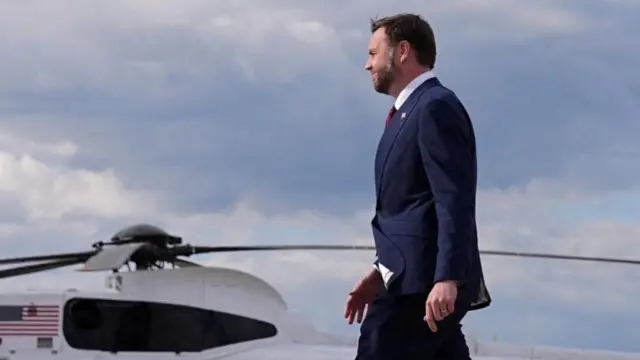
    U.S. Vice President JD Vance walks as he arrives at Joint Base Andrews, Maryland, U.S.Image source, Reuters

    US Vice-President JD Vance has told CBS News, the BBC's US partner, that the text of the US-Iran deal will be released on Friday "at the latest".

    He says Qatari and Pakistani negotiators have asked the US to hold off publishing the full text "for a little while".

    "We're actually trying to push them to get it out today, because we want to tell the American people what's in this deal," Vance says.

    Asked about reports that the deal includes a $300bn (£223.7bn) reconstruction fund for Iran, the vice-president says "none of those things flow to Iran unless Iran fundamentally changes how it behaves with the world".

  16. Unclear if Lebanon included in deal as Israel launches more strikespublished at 14:38 BST

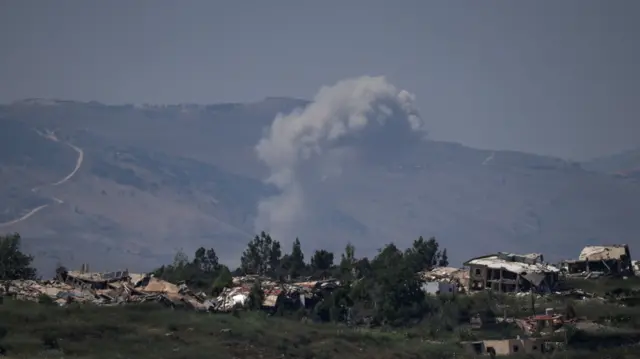
    Smoke rises in southern Lebanon, as seen from the Israeli side of the Israel-Lebanon border, in northern IsraelImage source, Reuters
    Image caption,

    Smoke rises in southern Lebanon after strikes earlier today

    One of the main sticking points in the US-Iran deal is the conflict between Israel and Lebanon.

    It's still not clear whether Lebanon is included in the deal, but Israeli forces launched new strikes in southern Lebanon earlier today, according to Lebanese state media.

    The Israeli military has not yet commented, but has previously said it was targeting the Iran-backed armed group Hezbollah.

    Lebanese President Joseph Aoun says his country's talks with Israel are "independent" of the US-Iran deal, but welcomes "any country that helps us, including Iran".

    Donald Trump has called on Israel to "be more responsible" in Lebanon, but also described it as a "minor war" that would not affect the US's agreement with Iran.

    Meanwhile, a joint statement by G7 leaders - including Trump - published today says it supports "an immediate robust ceasefire" in Lebanon and Beirut's efforts to "achieve the disarmament of Hezbollah".

    • We're still waiting for Macron's news conference - when it starts, you can watch live at the top of the page
  17. US-Iran deal to be formally signed in Switzerland on Fridaypublished at 14:15 BST

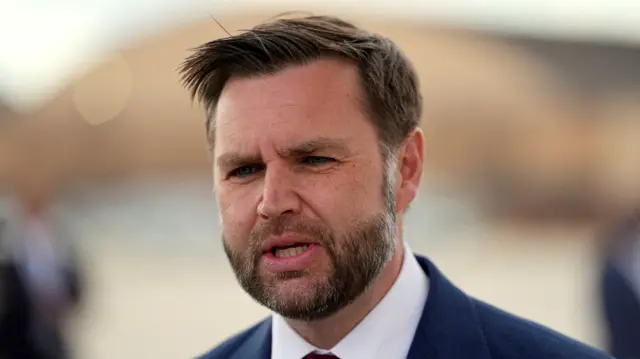
    US Vice President JD VanceImage source, REU
    Image caption,

    US Vice-President JD Vance is expected to attend the signing of the deal

    While we wait for Macron to speak, here’s a reminder that the memorandum of understanding between the US and Iran is set to be formally signed in the Swiss resort of Bürgenstock on Friday.

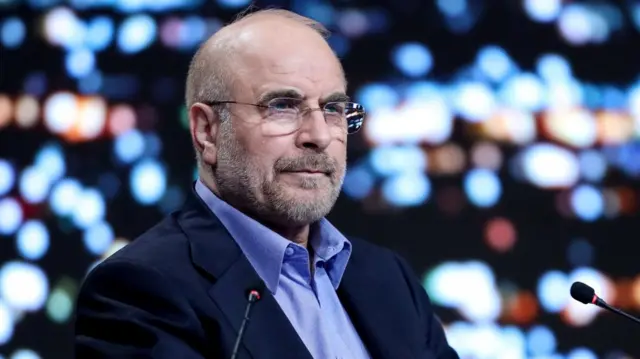
    Iran's Speaker of the Parliament Mohammad Bagher Ghalibaf and US Vice-President JD Vance are both expected to attend the signing.

    The text of the deal has not yet been published.

    A new round of negotiations on reaching a final peace deal - covering issues such as Iran's nuclear material - is expected to begin the same day as the signing.

    Mohammad Bagher GhalibafImage source, Reuters
    Image caption,

    Mohammad Bagher Ghalibaf has been the top negotiator in the Iran-US talks

  18. Macron to speak at G7 summitpublished at 13:59 BST

    French President Emmanuel Macron will be holding a news conference shortly at the G7 summit.

    We’ll bring you the key points, and you can watch live by pressing play at the top of the page.

  19. Tehran selling deal with US as victory – but for Iranians it was necessitypublished at 13:47 BST

    Amir Azimi
    Senior News Editor – Persian Service

    Meanwhile, how does Iran view the deal with the US?

    Iran's leadership is trying to present its emerging memorandum of understanding (MoU) with the US not as a retreat, but as the result of resistance and victory. That is not an easy argument to make.

    The country has just gone through a damaging war, the economy is under severe pressure, and parts of the Islamic Republic's own support base have spent months denouncing any compromise with Washington.

    There are also Iranians, both inside the country and abroad, who see the crisis not as a moment for diplomacy, but as an opportunity for regime change.

    This is the divided political landscape in which Tehran is now trying to sell the deal.

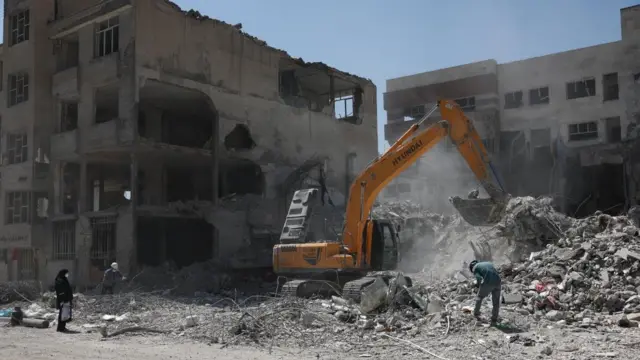
    A machine operates near a residential building, which was damaged in a U.S. and Israeli strike in March, in Tehran, Iran June 7, 2026Image source, Reuters
    Image caption,

    A machine works near a residential building damaged in a US and Israeli strike in Tehran

  20. Strait of Hormuz - why is it significant?published at 13:37 BST

    Vessels at the Strait of HormuzImage source, Reuters

    Earlier we brought you a post on what the apparent text of the US-Iran deal says about the Strait of Hormuz.

    The waterway has been a key focus in the conflict. Bounded to the north by Iran and to the south by Oman and the United Arab Emirates (UAE), the strait - only about 50km (31 miles) wide at its entrance and exit, and about 33km wide at its narrowest point - connects the Gulf with the Arabian Sea.

    About 20% of the world's oil and liquefied natural gas (LNG) usually passes through the strait, with oil coming not only from Iran but also from other Gulf states such as Iraq, Kuwait, Qatar, Saudi Arabia and the UAE.

    About 3,000 ships usually sail through the strait each month, but this has dramatically decreased after Iran threatened to attack tankers and other ships.

    This Flourish post cannot be displayed in your browser. Please enable Javascript or try a different browser.