
It’s an image you’ve probably seen countless times on your socials. Someone relaxing with cucumber slices over their eyes. And it’s become synonymous with self-care and relaxation.
Spa vibes aside, there are various claims online about the fruit (yes, it’s a fruit and NOT a vegetable as they contain seeds and grow from a flower) – everything from being good for eyes and skin, to having negative calories. BBC Other Side of the Story has taken three popular claims about cucumbers and turned them into a fact-check salad.
CLAIM: Cucumbers can help puffy eyes - TRUE
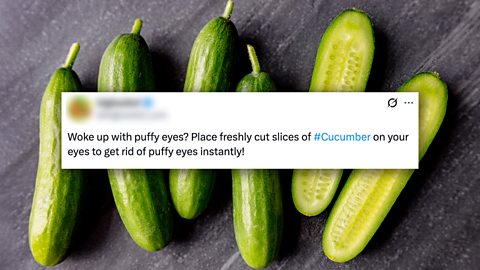
For years, people have claimed that cucumbers can soothe the skin around your eyes, especially if it's feeling dry or puffy. And, perhaps surprisingly, there is some science behind those claims.
According to the US health website Healthline, cucumbers are made up of about 96% water and contain beneficial nutrients like vitamin C, vitamin K, potassium, and fibre.
There's also evidence that the cooling sensation of chilled cucumbers can provide temporary relief for tired, puffy eyes. Skincare Specialist Hayley Williams says "Cucumber slices are a classic beauty remedy for a reason. The cooling sensation can help temporarily reduce the appearance of under-eye puffiness and leave the eye area looking fresher and more awake." The effect is similar to using a cold compress, making cucumbers a simple and inexpensive way to soothe irritated skin.
Hayley stresses that the benefits are only temporary. "While it's not a miracle cure, it's a simple and soothing way to refresh tired eyes". So, cool cucumber slices may briefly reduce puffiness, but there is no scientific evidence that they can permanently get rid of wrinkles, dark circles or other signs of ageing.
CLAIM: Cucumbers have negative calories - FALSE
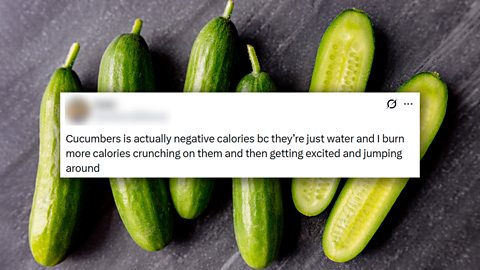
Cucumbers, like celery, are sometimes described as having negative calories. That means people burn off all the calories in them just by eating them, digesting them, then sending them through our bodies.
However, negative calorie foods do not exist. A study in Maastricht University in the Netherlands found that the number of calories in food is more than those used to chew and process it, even if they are low in calories.
It's not all bad news for cucumber fans, though. Cucumbers are still a healthy snack choice. According to BBC Good Food, a fifty gram serving contains just 15 calories, but they're also packed with antioxidants and may help keep blood sugar levels in check. Plus, because they're around 96% water (remember?), they're great for staying hydrated too.
They’re good for your eyes, great for your insides - and it looks like they don’t even scare cats either. No wonder cucumbers are so special they get their own day.
CLAIM: Cats are scared of cucumbers - MAYBE
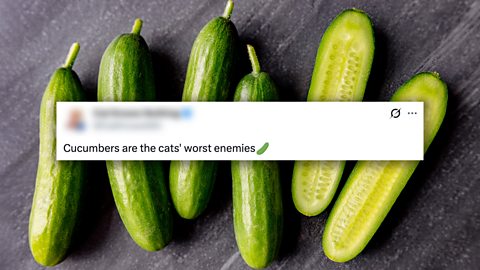
A strange social media trend involves secretly placing a cucumber behind a cat. When the cat turns around and spots it, it often jumps in surprise. But that doesn't necessarily mean cats are scared of cucumbers.
According to Dr Pamela Perry, a cat behaviour expert at Cornell University in the US, the cats in these videos are probably just surprised by an object appearing behind them. She also says there's no evidence that cats mistake cucumbers for snakes.
“Cats don’t have a natural fear of snakes,” she explained. “In fact, a lot of them hunt snakes.”
Dr Perry’s theory is that cats who are more likely to be fearful will react in an extreme way when they spot a cucumber that wasn’t there before - or any object. It’s down to their individual personality more than anything else. She doesn't recommend trying the cucumber trick at home, as being startled in this way can cause unnecessary stress and isn't enjoyable for cats.
It’s always important to check multiple sources when it comes to theories such as animal behaviour. A video featured on the Scientific American website showed an animal behaviour expert place different fruit and veg, including a cucumber, celery and a potato, in front of a cat - which seemed to ignore every single item!
So, while some cats may react dramatically to cucumbers, there's not enough evidence to say that cats as a whole are scared of them. More research is needed before that claim can be treated as fact.
What can cucumbers teach us about fact-checking?
From beauty hacks to funny cat videos, social media is full of surprising claims. Some turn out to be true, some are exaggerated and others are completely false.
That's why it's important to ask questions before believing or sharing something online:
• Who is making the claim?
• What evidence do they provide?
• Do experts agree?
• Have other trusted sources reached the same conclusion?
Just because something goes viral doesn't mean it's true. Popularity isn't proof, and the best way to separate fact from fiction is to look at the evidence.
This article was published in June 2026

Not sure if the news you’re seeing on social media is true or false? Can you always tell if the things you see online are real or fake? Learn how to get the other side of the story with our quizzes, videos and explainers.
Has Doctor Who been cancelled for good? The truth behind the claims
Rumours spread on socials after the 2026 Christmas special was called off